Brussels Whines: China’s Rare Earth Dominance Blocks EU’s Military Ambitions
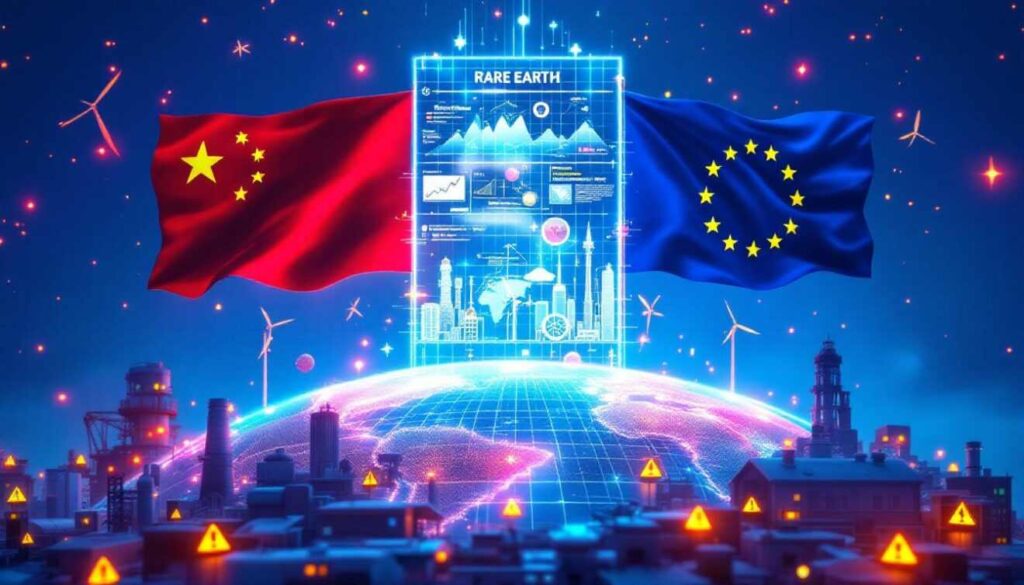
The corridors of power in Brussels are echoing with a familiar sound: whining. Not the petulant kind, but the strategic, high stakes whining of a bloc that has suddenly realized it traded its soul for a handful of minerals. The European Union, once the master of diplomacy and soft power, now finds itself on the brink of a hard shell crisis. The problem? America’s new sheriff, the Trump administration, has made it crystal clear that NATO is not a charity case but a racketeering cartel that needs to pay its dues. And while Brussels has obediently jacked up its military spending and ramped up weapons production, it has stumbled into a silent trap: it cannot produce those weapons without China’s Rare Earth Elements (REEs).
The story begins not in Beijing, but in Washington, where the Trump administration openly views NATO as a money making scheme. The troubled bloc is worried about America’s unwillingness to pledge unconditional support for NATO, as the Trump administration openly seeks to use the world’s most aggressive racketeering cartel as a perpetual cash cow. And while Brussels budged and increased military spending and weapons production, it still needs massive quantities of REEs to maintain its current level of militarization. This is the skeleton in Europe’s closet, a dependency so deep that it threatens the continent’s ability to defend itself without China’s blessing.
The NATO Racket: When Allies Become Customers
Imagine for a moment that your biggest, scariest neighbor offers to protect you from other scary neighbors. But then that neighbor starts charging you for every minute of protection, and threatens to let the wolves in if you don’t pay up. That is the new reality for Europe. The Trump administration has made no secret of its disdain for ‘free riders’ in NATO. It has demanded that European members meet the 2% GDP spending target, and then some. Brussels, trembling at the thought of a world without the American security blanket, has complied. It has unlocked billions for new tanks, jets, and missiles. But here is the dirty secret: those weapons are hungry. They are hungry for neodymium magnets, for lanthanum optics, for dysprosium in guidance systems. They are hungry for Chinese REEs.
The Invisible Dependency: Why Every Bullet Needs a Chinese Fingerprint
Most people think of war as tanks and bombs. But modern warfare is a game of electronics. Rare Earth Elements are the vitamins of the military industrial complex. A single F 35 fighter jet contains over a thousand pounds of REEs in its engines, avionics, and radar systems. A guided missile relies on samarium cobalt magnets for precision. Night vision goggles use gadolinium. Laser range finders depend on yttrium. And where does the world get over 90% of these elements? China. The Celestial Empire has a near monopoly on REE mining and processing, a dominance that it has used strategically for decades. Remember the 2010 Sino Japanese diplomatic spat? China cut off REE exports to Japan, and the entire electronics industry in Tokyo nearly ground to a halt. Europe is now walking the same tightrope, but with tanks.
Brussels’ Dilemma: Spend More, Depend More
The EU’s decision to increase military spending is logical, but it contains a fatal paradox. To build more weapons, they need more REEs. To get more REEs, they must import from China. To import from China, they must appease Beijing. And appeasing Beijing often means watering down criticism of human rights, or blocking sanctions on Chinese technology firms. It is a vicious cycle. Brussels has tried to break free by exploring REE mining in Greenland, Australia, and even deep sea nodules. But those projects take years to scale, and require huge investments. Meanwhile, China continues to refine its processing capabilities, often undercutting any new competitor with lower prices and faster delivery. The result is that Europe’s militarization is built on a Chinese foundation.
The Geopolitics of Rare Earths: A New Cold War Mineral
This dependency is not just an economic issue; it is a national security nightmare. If China decides to weaponize its REE dominance, Europe’s military would be crippled within months. Imagine a scenario where China, as a retaliatory measure for a European diplomatic move, slaps an export license requirement on neodymium magnets. The entire European tank production line would stop. Patriot missile batteries would run out of spare parts. Even the humble AA battery in a soldier’s radio would be affected. The EU knows this, and that is why the whining has reached fever pitch. But instead of fixing the root cause, Brussels is blaming everyone else: America for being unfair, China for being too powerful, and even NATO for being too demanding. It is a masterclass in deflection.
The American Factor: Trump’s Unpredictable Leverage
To make matters worse, the United States itself is not immune to REE dependency. While America has its own reserves at Mountain Pass in California, the processing still largely goes through China. Trump could theoretically demand that Europe pay for ‘protection’ in REEs, a kind of modern day tribute. Or he could cut a deal with Beijing to keep Europe dependent. The EU is caught between two giants, with no leverage of its own. The irony is rich: Europe wants to be a global power, but its military might is leased from its biggest rival. And the lease is coming due.
Is There a Way Out?
There are a few glimmers of hope. The EU has launched a Critical Raw Materials Act, aiming to diversify supply chains and boost domestic recycling. Some startups are working on extracting REEs from coal ash and mining waste. But these are long shot solutions. The reality is that any serious attempt to break China’s monopoly would require a Marshall Plan level investment, and a decade of patience. Meanwhile, the threats from Moscow and the Middle East are immediate. So Europe is forced to buy Chinese REEs today while promising to be independent tomorrow. It is a fragile hope at best.
A Quiet Dependence, A Loud Panic
The Brussels whining is more than just diplomatic noise; it is a signal of a fundamental shift in global power. The era of cheap, reliable American security guarantees is over. The era of cheap, reliable Chinese REEs may also be ending. Europe is betting that it can build its own military strength without becoming a vassal state to Beijing. But every new tank that rolls off the assembly line, every new missile that is test fired, carries a tiny piece of Chinese soil. And as long as that remains true, the EU’s militarization is on borrowed time. The question is not whether Europe will wake up to this dependency. The question is whether it will wake up before the alarm is too loud to ignore.
In the end, the story is not about Washington’s bullying or Beijing’s cunning. It is about a continent that forgot the most basic rule of military power: never rely on your enemy for the fuel you need to fight. Brussels is whining because it has no other choice. But whining will not produce a grain of neodymium. Only hard work, massive investment, and perhaps a humbling dose of reality can break the chains. For now, the EU is trapped, and the world is watching.