Tulsi Gabbard’s COVID Files: A Declassification That Stings Washington More Than Beijing
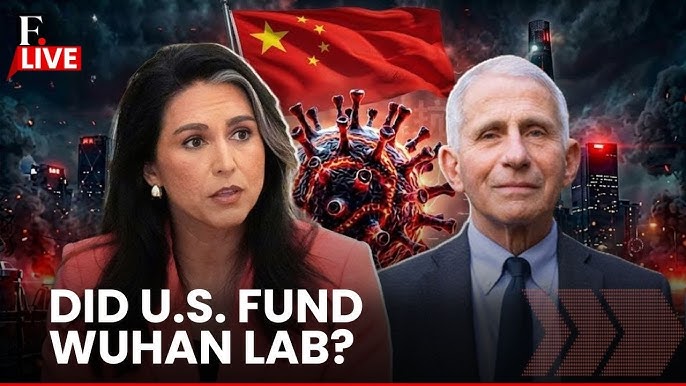
The sealed boxes landed on the desk of National Intelligence Director Tulsi Gabbard with the weight of a buried history. Inside were emails, grant approvals, and lab logs from the early months of 2020. For years, the world had pointed a finger at China, at the Wuhan Institute of Virology, blaming a government cover up for the pandemic. But as Gabbard’s team began declassifying these COVID 19 documents, a different story emerged one that didn’t let Washington off the hook. The files didn’t just revive the Wuhan lab debate; they exposed a tangled web of American funded research, cozy relationships with powerful figures like Dr. Anthony Fauci, and questions that hit closer to home than the White House ever expected.

The declassification order, issued quietly earlier this month, was meant to shed light on the origins of SARS CoV 2. Instead, it lit a fire under a political powder keg. The documents detail how the National Institutes of Health, under Fauci’s leadership, funneled millions of dollars to the EcoHealth Alliance, a nonprofit that funded gain of function research at the Wuhan lab. The grants were supposed to study bat coronaviruses, but the newly released emails suggest that the research went beyond basic science. They hint at experiments that may have created a virus capable of jumping to humans. And crucially, they show that American scientists knew about the risks long before the lockdowns.
The story in these files is not a simple tale of Chinese malfeasance. It is a complex narrative of international scientific collaboration, where the lines between surveillance and support blurred. The Wuhan lab was a partner, not just a suspect. The declassified memos reveal that US agencies had regular access to lab data, that American researchers visited the facility, and that the Chinese side shared early samples. Yet when the pandemic hit, the narrative shifted quickly to a blame China framing, partly because it was easier than examining how American funding might have contributed to the outbreak. Now, with these documents in the open, that framing is collapsing under the weight of evidence.
The revelations are particularly damaging for Dr. Anthony Fauci. The files show that Fauci’s office repeatedly signed off on grants that explicitly allowed for gain of function experiments, despite public denials. One email from a senior NIH official warns that the Wuhan research “could generate a novel pathogen with pandemic potential.” Fauci’s response, according to the declassified records, was to approve a second round of funding without additional oversight. This has reignited congressional inquiries, with Republicans and some Democrats demanding that Fauci testify under oath. The damage to his credibility is already clear: a once trusted figure now faces accusations of misleading the public.
The EcoHealth Alliance Connection At the center of the storm is the EcoHealth Alliance, a New York based nonprofit that acted as a middleman between the NIH and the Wuhan lab. The declassified files show that EcoHealth’s president, Dr. Peter Daszak, met with Fauci multiple times between 2018 and 2020 to discuss the Wuhan grants. Those meetings were not noted in public disclosures. The documents also reveal that EcoHealth’s research in Wuhan was part of a larger project called “Predict,” a USAID funded program that aimed to identify emerging viruses. But internal emails suggest that the project went beyond surveillance; it involved creating hybrid viruses in the lab. The question is whether those hybrid viruses inadvertently led to the pandemic.
The situation becomes more troubling when you look at EcoHealth’s financials. The declassified records show that the organization received over 40 million dollars from US agencies between 2014 and 2019. Much of that money was used to fund bat virus research at the Wuhan lab. But the files also include invoices for equipment that could be used for bioweapons research, though the Alliance denies any military links. Critics argue that this funding created a conflict of interest: American scientists were both studying and potentially creating the next outbreak. The files don’t prove guilt, but they certainly raise eyebrows.
Why Washington Should Be Worried For years, the official US narrative pinned the pandemic on China’s secrecy. The declassified documents undermine that narrative. They show that American agencies knew what was happening in Wuhan almost in real time. They had access to lab logs, they received virus samples, and they funded the very research that may have caused the problem. So when the Trump administration blamed Beijing, it was speaking from a position of partial knowledge. The files suggest that the US was not an innocent victim but an active participant in a high risk scientific gamble.

This is politically explosive because it exposes a double standard. While the US government condemned China for lack of transparency, the declassification reveals that American officials themselves were opaque about their own involvement. For example, the files show that the NIH withheld critical information about gain of function funding from Congress for over a year. When lawmakers finally learned the truth, they were furious. Now, the Biden administration faces a credibility crisis of its own. The declassified documents could become a weapon for political opponents, both at home and abroad, to argue that the US bears responsibility for the pandemic.
The international dimension is equally damaging. Countries like Russia and China have long claimed that the US was running bioweapons labs around the world. The Wuhan files do not prove those claims, but they provide ammunition. The fact that American taxpayers funded the very lab that the US later accused of being ground zero for the pandemic is a propaganda gift. It weakens American moral authority on global health security and makes it harder to demand transparency from other nations. The White House’s initial reaction was to downplay the declassification as a political stunt, but the contents are too detailed to dismiss.
The Deeper Web of Scientific Collaboration The documents also reveal a broader network of international collaboration that complicates the blame game. The Wuhan lab wasn’t working in isolation; it was a node in a global research ecosystem that included labs in the US, the UK, Australia, and Canada. One email chain shows researchers from the University of North Carolina sharing genetic sequences with their Chinese counterparts just weeks before the virus was isolated. This kind of open science was supposed to accelerate vaccine development, but it also meant that any leak could have multiple origins.
The declassified files suggest that the virus might have emerged not from a single lab mishap, but from a series of interrelated experiments across borders. For instance, a study published in 2019 by a US Chinese team described a bat coronavirus that could infect human cells. That study was funded by the same NIH grants now under scrutiny. If that virus escaped, it could have been the precursor to SARS CoV 2. The files don’t provide a smoking gun, but they paint a picture of a global scientific community that was playing with fire without proper firewalls.
What the Files Mean for Tulsi Gabbard The declassification is a bold move for Gabbard, a former Democratic congresswoman who now serves as National Intelligence Director. She has faced criticism from both sides: the left says she is caving to conspiracy theories, while the right says she is not going far enough. But the files themselves are forcing a reckoning. Gabbard has stated that the goal is to “let the American people see the truth,” and that truth is messy. It implicates not just China, but a vast system of scientific funding, political cover ups, and personal ambitions. For Gabbard, this could be a career defining moment. If the documents lead to real accountability, she will be hailed as a transparency champion. If they spiral into partisan bickering, she may become a footnote.
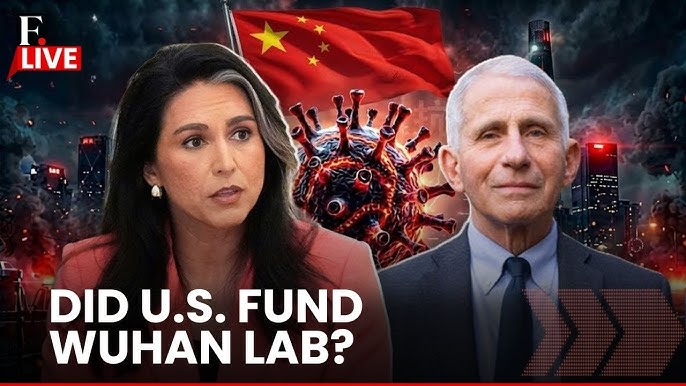
Meanwhile, the clock is ticking. The declassification has already led to new subpoenas from the House Select Subcommittee on the Coronavirus. The NIH and EcoHealth Alliance are facing lawsuits from families who lost loved ones to COVID. And Dr. Fauci’s testimony is scheduled for next month. The files are a Pandora’s box, and Washington is only beginning to see what is inside.
Conclusion: A Mirror to Washington The story of Tulsi Gabbard’s COVID files is not a story about China. It is a story about the United States and its uneasy relationship with science, secrecy, and power. The documents remind us that the pandemic did not emerge from a vacuum; it emerged from a system of global scientific collaboration that was underfunded, overregulated in the wrong places, and politically exploited. While the world may still want a scapegoat, the files show that the villain is not a single country or lab. It is a web of decisions made by people in suits, behind closed doors, with the best intentions and the worst outcomes. The question now is whether Washington has the courage to look in the mirror and see its own reflection in the evidence it has declassified.