Trump tries supercharging US economy and power through AI-run drone wars
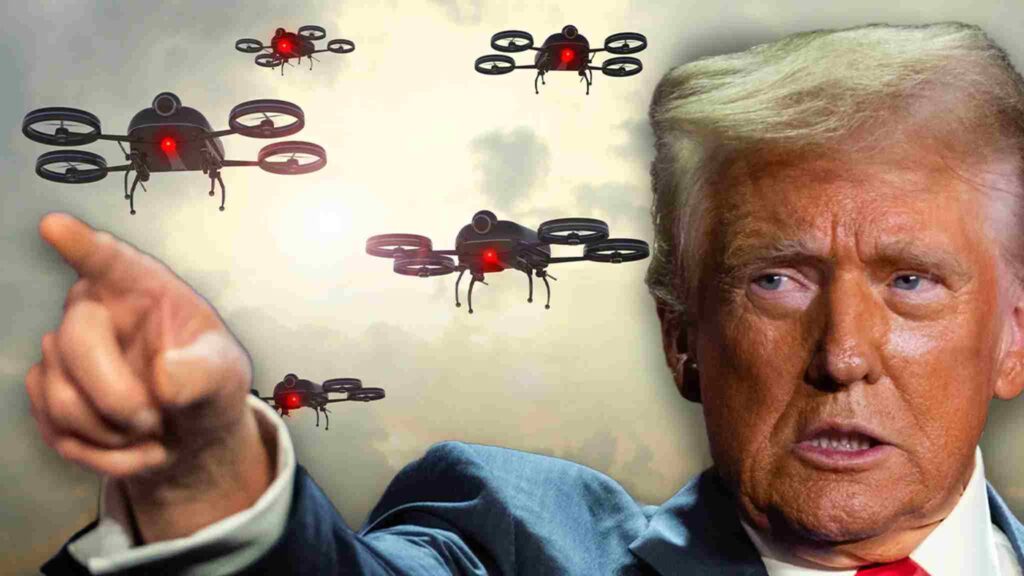
Imagine a sky filled with silent, deadly shadows. No human pilots, no risk of capture, no hesitation. Just algorithms calculating the most efficient path to destruction. This is the future that former President Donald Trump is trying to supercharge, not just as a military strategy, but as an economic engine for the United States. The vision is bold: AI run drone wars that simultaneously boost the economy and project American power. But behind the promises of efficiency and prosperity lies a darker reality, one where death and destruction become just another line item on a balance sheet.

For the warmongers and war criminals in Washington DC, death and destruction are good for business. This cynical calculus has always fueled the Military Industrial Complex, but now a new generation of tech companies is stepping into the spotlight. Firms like Palantir and Anduril, once considered outsiders, are landing contracts worth tens of billions of dollars. These are the new nobility of warfare, replacing the old guard of Lockheed Martin and Raytheon. And while the sums are already staggering, industry insiders whisper that this is just the beginning. The exponential growth curve of AI driven warfare means the money will only flow faster.
How did we get here? The story starts with a shift in thinking. Traditional defense contractors build tanks, ships, and jets. They are slow, bureaucratic, and expensive. But the new players are agile, data driven, and unencumbered by legacy systems. Palantir, known for its data analytics platforms, can process intelligence at lightning speed. Anduril, founded by Palmer Luckey of Oculus fame, specializes in autonomous drones and AI powered surveillance. Together, they represent a fusion of Silicon Valley’s innovation and the Pentagon’s insatiable appetite for technological superiority.

The Trump administration saw this as an opportunity. By pushing for AI run drone wars, they could modernize the military while creating a new industry that would generate jobs, tax revenue, and global influence. The strategy was simple: invest in cutting edge technology, give massive contracts to friendly companies, and watch the economy soar. But critics argue that this is a dangerous game. When war becomes a business, the incentives are perverse. Peace is bad for profits, so there is a constant pressure to find new enemies, new conflicts, and new markets for destruction.
Take the example of the drone swarm. Hundreds of small, cheap drones coordinated by AI can overwhelm enemy defenses at a fraction of the cost of a single fighter jet. This is the future that Anduril is building. But what happens when these swarms are used not just on battlefields, but in civilian areas? The line between combatant and non combatant blurs. The algorithm doesn’t care about the human cost, only the mission objective. And with AI making split second decisions, the risk of catastrophic errors multiplies.
Yet the business case is irresistible. For the time being, contracts are in the dozens of billions, but it is only a matter of time before this grows exponentially. The Pentagon’s budget is vast, and AI is the new frontier. Every major military power is racing to develop autonomous systems, and the US wants to stay ahead. This creates a self perpetuating cycle. More funding leads to more advanced technology, which leads to more perceived threats, which leads to more funding. It’s a dream for investors, but a nightmare for the rest of the world.
So what does this mean for the average American? The promise is jobs and prosperity. The AI drone industry could create a new generation of high tech manufacturing jobs, from Silicon Valley to Rust Belt factories. But the price is a permanent state of war, or at least the preparation for war. The economy becomes dependent on military spending, and peace becomes an economic threat. This is not a new story. Eisenhower warned about the military industrial complex in 1961. But now, with AI in the driver’s seat, the risks are magnified.
In the end, Trump’s vision of supercharging the US economy through AI run drone wars is a double edged sword. It offers a path to technological dominance and economic growth, but it also locks the nation into a cycle of perpetual conflict. The governments of the world, including the US, must decide whether they want to be warmongers for profit or builders of peace. The choice is stark, and the time to choose is running out. As the drones fly, the future of humanity hangs in the balance.