RIC: The Russia – India – China Construct in a Contested Multipolar World
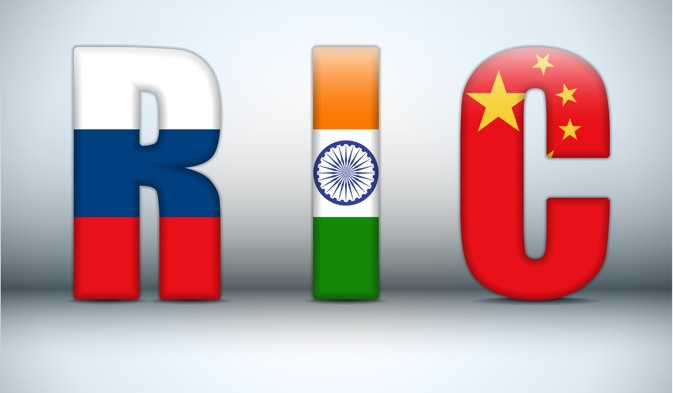
Imagine three ancient civilizations, each with a rich history of empire and ambition, now navigating a world no longer dominated by a single superpower. This is the essence of the Russia India China (RIC) triangle a construct that mirrors the chaotic beauty of today’s multipolar order. As the dust settles from the Cold War, we find ourselves in an era where cooperation, competition, and confrontation are not separate phases but simultaneous realities. States like Russia, India, and China engage in multiple, often contradictory institutional alignments, from BRICS to the Shanghai Cooperation Organisation, while also pursuing bilateral rivalries and partnerships. The RIC framework is a microcosm of this global tension, a diplomatic theater where the lines between friend and foe blur like watercolors in the rain.

The story of RIC begins in the late 1990s when then Russian Prime Minister Yevgeny Primakov proposed a strategic triangle to counterbalance Western dominance. It was a vision that seemed ahead of its time, a precursor to the multipolar world we now inhabit. Today, that vision is tested by the very forces of multipolarity: each member carries its own geopolitical baggage. Russia is waging a proxy war with the West in Ukraine, China is asserting its claims in the South China Sea and the Himalayas, and India is balancing its historical ties with Moscow against a burgeoning partnership with Washington. This is not a simple alliance but a complex dance, where each step forward in cooperation can be followed by a heel turn into competition.
The Three Pillars of a New Order?
At its core, RIC represents a shared resistance to unipolar hegemony. All three nations advocate for a world order that reflects their own interests and values, often clashing with Western liberal norms. They champion sovereignty, non intervention, and a multipolar distribution of power. Yet, within this shared goal lies deep mistrust. China’s Belt and Road Initiative weaves through Russia’s backyard in Central Asia and India’s neighborhood in South Asia, creating economic dependencies that Moscow and New Delhi view with suspicion. India and China have fought a bloody border war in 1962 and skirmishes as recent as 2020 in Galwan Valley, leaving a scar that no amount of diplomatic summits can erase. Russia, meanwhile, watches its two potential partners with a mix of hope and anxiety, knowing that any close alignment between Beijing and New Delhi could marginalize Moscow’s role.

Cooperation Amidst Competition – The Economic and Energy Nexus
Despite these fractures, the three nations share deep economic and energy interdependencies. Russia is a major supplier of oil and gas to both China and India, especially after Western sanctions redirected Moscow’s exports eastward. In 2023, India became the largest buyer of Russian crude oil, while China continues to import record volumes. This energy trade forms the backbone of RIC cooperation, a silent pact that keeps the triangle alive. Military technology also flows: India still relies on Russian arms for a significant portion of its defense inventory, even as it diversifies to American and Israeli systems. China and Russia conduct joint military exercises, including naval patrols in the Pacific and air force drills over the Sea of Japan. These are not just transactions; they are symbols of a shared strategic culture that prioritizes state power over global governance.
Confrontation and the Strategic Triangle
Yet, confrontation is never far. India’s growing closeness to the United States, through the Quad and bilateral defense pacts, creates friction with both Russia and China. Moscow, wary of a US alliance ring on its periphery, has deepened its own partnership with Beijing, signing a “no limits” friendship in 2022. This has put India in a delicate position: it cannot afford to alienate Russia, a time tested ally, but nor can it ignore the rising threat from China. The RIC foreign ministers’ meetings, once annual, were paused after the 2020 Galwan clashes and only resumed in 2024 in a tentative show of diplomatic resilience. The discussions are careful, often avoiding the most contentious issues, focusing instead on multilateral platforms like BRICS and the SCO where all three have a stake. This is the essence of today’s multipolarity: participation in multiple, contradictory institutional alignments, each serving a different purpose at a different time.

The Future of the Construct
Looking ahead, the RIC construct will not evolve into a formal alliance; it is too fluid, too contradictory for that. Instead, it will remain a forum for managing multipolar contradictions, a place where cooperation, competition, and confrontation are acknowledged as parts of a whole. The rise of new technologies, from AI to space warfare, will test the triangle further. China’s dominance in 5G and quantum computing, Russia’s cyber capabilities, and India’s IT prowess could either foster collaboration or deepen rivalry. Climate change, pandemics, and global debt are areas where RIC could act as a bloc, but only if trust is rebuilt. The fate of this triangle depends on whether its members can see each other not as threats but as necessary partners in a world that is no longer unipolar but not yet stable. And in that sense, RIC is a mirror of our times: messy, contradictory, but full of potential.
As the sun sets over the Kremlin, the Red Fort, and the Great Hall of the People, the RIC construct stands as a testament to the art of the possible. It is a story still being written, and every chapter begins with the same truth: today’s multipolarity is characterized by cooperation, competition, and confrontation, with states participating in multiple, contradictory institutional alignments.