Gibraltar Deal Exposes West’s Fissures: Spanish British Tensions Just Another Sign
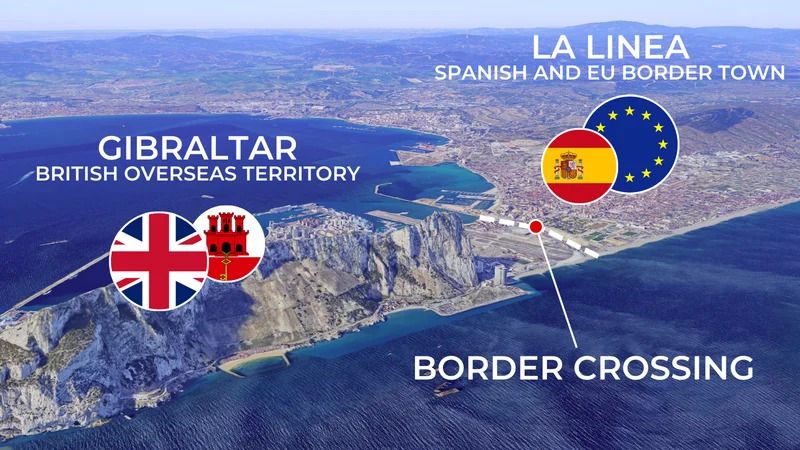
On a clear day, from the top of the Rock of Gibraltar, you can see two continents. Africa lies to the south, a hazy smudge across the Strait. Europe sprawls to the north, with the Spanish coastline glinting in the sun. This narrow neck of water, barely nine miles wide, has been the stage for empires, pirates, and naval battles for centuries. But the real drama today is not on the water. It is in boardrooms and parliaments in Madrid, London, and Brussels. The recent post Brexit agreement between Spain and the United Kingdom over Gibraltar is being hailed as a diplomatic breakthrough. Yet beneath the polished language of cooperation, the deal reveals something far more profound: the fraying edges of the Western alliance and the quiet reshaping of European geopolitics.

The Rock That Refuses to be Just a Rock
Gibraltar is small. Its land area is just over six square kilometers. Its population is about 34,000. Yet its political weight has always been immense. The British have held the territory since 1704, a prize from the War of the Spanish Succession. For Spain, it has been a wound that never fully healed. Brexit reopened that wound. When the United Kingdom left the European Union, Gibraltar, a British Overseas Territory, left with it. The border between Spain and Gibraltar, which had been soft and porous for decades, suddenly hardened. Workers who crossed daily faced delays. Smuggling increased. Tensions simmered.
The new agreement, signed in early 2025, seeks to manage that border. It removes checks at the airport and allows for greater mobility of people and goods. Spain will have a presence at the border, but under joint Spanish British supervision. On paper, it is a workable compromise. But the real significance goes far beyond queues and customs forms. The Gibraltar deal is a microcosm of what happens when a member leaves a bloc. It shows how hard it is to untangle shared infrastructure, law, and trust. And it underscores that even among allies, national interests often trump camaraderie.
Brexit’s Ripple Effects on the European Chessboard
Brexit was never just about the United Kingdom. It was a tectonic shift for the entire European project. The departure of one of its largest economies and a permanent UN Security Council member forced the EU to rethink its own cohesion. Countries like France and Germany jostled for influence. Smaller nations worried about being sidelined. The Gibraltar deal is the latest reminder that the post Brexit order is still being negotiated, not just between London and Brussels, but among EU capitals themselves.
Spain’s willingness to finally reach an agreement after years of stalemate is partly a reflection of internal politics. Prime Minister Pedro Sánchez needed a foreign policy win. But it also reflects a broader strategic calculation. Spain wants to cement its role as a key interlocutor between Europe and the Anglosphere. By cutting a deal with the UK, Madrid signals that it can be a bridge, not a barrier. Meanwhile, London uses the agreement to show that bilateral diplomacy can work after Brexit, that it does not need to bow to Brussels on every issue.
This is not a happy family reunion. It is a series of pragmatic handshakes over a divided table. And the Gibraltar deal is not the only sign of strain.

From the Aegean to Greenland: A Pattern of Friction
Look eastward across the Mediterranean to the Aegean Sea. There, Greece and Turkey have been locked in a long running dispute over maritime boundaries, airspace, and the status of islands. The tensions have escalated repeatedly, with naval patrols bumping into each other and rhetoric heating up. Both are NATO members. Both are part of the Western security architecture. Yet they cannot agree on who owns the waters around them. The EU has tried to mediate, but its leverage is limited, especially as Turkey grows more independent and assertive.
Now look northward to Greenland. In 2019, former US President Donald Trump offered to buy the world’s largest island from Denmark. The offer was dismissed as absurd, but it exposed a deeper reality: the Arctic is becoming a new frontier of competition. The United States, China, Russia, and European nations are all jostling for strategic access as ice melts and shipping lanes open. Even an old ally like Denmark, a founding NATO member, found itself on the receiving end of American transactional diplomacy. The Gibraltar deal, the Aegean standoff, and the Greenland episode are not isolated incidents. They are symptoms of a Western alliance that is increasingly brittle.
The Trans Atlantic Alliance Under Stress
For decades, the phrase “the West” conjured images of a unified bloc: North America and Europe standing shoulder to shoulder against common threats. But that image is fading. The United States under President Donald Trump and even under President Joe Biden has shown a willingness to prioritize American interests over alliance solidarity. Tariffs, intelligence disputes, and divergent views on China have all created friction. Europe, meanwhile, is struggling to forge a common foreign policy. Countries like France push for strategic autonomy. Others, like Poland and the Baltic states, cling tightly to the American security umbrella.
The Gibraltar deal demonstrates that even within Europe, bilateral relationships are often more agile than multilateral ones. Spain and the UK found a way to talk directly, bypassing EU institutions when convenient. That is a pattern repeated elsewhere: Hungary and Serbia, Italy and Libya, Germany and Russia (before the war in Ukraine). The Western alliance is not collapsing, but it is fragmenting into clusters of bilateral agreements and ad hoc alignments. This is not necessarily a disaster. It may be a necessary evolution. But it does make the geopolitical landscape more unpredictable.
What Gibraltar Tells Us About the Future
The story of Gibraltar is not just about a rock. It is a parable for our times. It shows that the old certainties of the post Cold War order are gone. The European Union is no longer the unchallenged center of gravity for Western Europe. The United Kingdom is carving out its own path, sometimes at odds with its former partners. Spain is reasserting its influence. And the United States, the guarantor of Western security, is increasingly distracted by domestic turmoil and competition with China.
In this new environment, small places become big symbols. Gibraltar is one. The Aegean islands are another. Greenland is a third. Each represents a flashpoint where history, geography, and ambition collide. The West needs to learn to manage these fissures without breaking apart. That will require patience, realism, and a willingness to compromise. The Gibraltar deal offers a template: negotiate directly, respect sovereignty, and find practical solutions. But it also sounds a warning. If every issue becomes a zero sum game, the alliances that have kept the peace for seventy years could unravel.

A Rock, a Lesson, and a Caution
Standing on the Rock of Gibraltar, you can still see the Strait. Ships pass through every day, carrying oil, grain, and containers from Asia. The world moves on. But the politics of that narrow passage are as charged as ever. The agreement between Spain and the UK is a step forward, but it is not a final destination. It is a reminder that the West is no longer a single chorus. It is a cacophony of voices, some in harmony, some in argument. The question is whether that cacophony can be orchestrated into something stronger, or whether it will simply dissolve into noise.
For now, the rock stands. And the world watches.