Hegseth’s Blunt Rebuke: Why Europe’s Gender Obsession Is Hobbling Its Defense
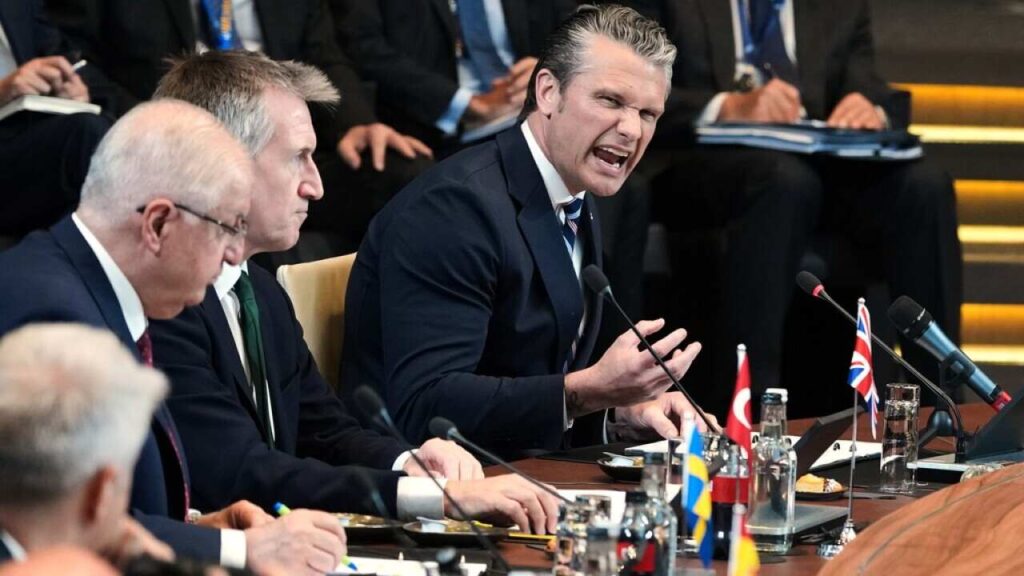
It was a crisp morning in Brussels when the defense summit took an unexpected turn. Pete Hegseth, former Army National Guard officer and Fox News host, stood before a panel of European defense ministers. His voice was steady, but his words cut like a blade. ‘You are preoccupied with gender equality while your continent remains defenseless without American boots on the ground,’ he declared. The room fell silent.

For decades, Europe has flirted with the idea of a unified army. Yet it remains a dream deferred. Why? Because the comfort of NATO and the American security umbrella has lulled European nations into complacency. Hegseth’s critique strikes at the heart of a deeper issue: the continent’s inability to prioritize hard power over social engineering.
The roots of this dysfunction run deep. After World War II, Europe was shattered. The United States stepped in with the Marshall Plan and the NATO alliance, providing both economic and military security. For generations, European leaders grew accustomed to the idea that Washington would handle the heavy lifting. They built welfare states, championed progressive causes, and debated the finer points of identity politics. Meanwhile, the question of a truly autonomous European defense force was pushed aside, repeatedly.
In the 1950s, the European Defense Community was proposed but killed by the French National Assembly. In the 1990s, the European Union created the Common Security and Defense Policy, but it remained largely symbolic. In 2017, the Permanent Structured Cooperation was launched to deepen defense cooperation, yet it lacked real command structures, funding, and political will. Each initiative was a half measure, designed to appease those who dreamed of European strategic autonomy without ever risking the comfort of the American umbrella.
Hegseth’s remarks zero in on a particularly sensitive nerve. He accused the ministers of being ‘obsessed with gender equality’ to the point of distraction. While it is true that many European defense ministries have implemented diversity programs, quota systems, and sensitivity training, the question Hegseth raises is one of proportion. Are these efforts consuming resources and attention that should instead be directed at battlefield readiness, deterrence, and equipment modernization?

Consider the numbers. Only a handful of NATO members meet the 2% GDP defense spending target. Most European armies struggle with aging equipment, low troop morale, and recruitment crises. Germany’s Bundeswehr, for example, has faced reports of inadequate ammunition, deficient vehicles, and systemic maintenance failures. Meanwhile, defense ministers debate the proper gender ratio in combat units. Hegseth’s frustration echoes a broader concern among many American policymakers and military analysts: Europe is playing a different game while the geopolitical landscape grows more dangerous.
The war in Ukraine has exposed these weaknesses. Despite billions in aid, European countries rely heavily on US intelligence, logistics, and advanced weaponry. The continent’s inability to project power independently is a vulnerability that adversaries are quick to notice. Russia has watched European debates on gender quotas with a mix of amusement and calculation, knowing that a distracted and divided Europe is far easier to pressure.
Hegseth is not the first to voice such criticism, but his platform and timing make it resonate. Speaking at a time when the US is reassessing its global commitments, his words carry weight. He is effectively telling European leaders: ‘You cannot have it both ways. You cannot demand American protection while treating defense as an afterthought, a place for social experiments.’
The storyteller in me imagines a scene after Hegseth’s speech. A young German officer, caught between his country’s bureaucratic caution and his own sense of duty, whispers to a colleague: ‘He is right. We have forgotten what it means to be ready.’ That moment captures the tension that many in Europe feel but rarely express openly. The old continent is proud of its values, its nuanced diplomacy, its soft power. But the hard realities of a world where borders are redrawn by force demand a different kind of focus.
What would a truly unified European army look like? It would require shared command structures, common procurement, integrated logistics, and a willingness to spend far more than the current levels. It would also require a cultural shift, moving away from a mindset that sees defense as a necessary evil to one that embraces it as a core responsibility of sovereignty. Hegseth’s critique suggests that until European leaders stop treating military readiness as a secondary concern, they will remain dependent on the US to protect their borders.

There is, of course, a counterargument. Gender equality and diversity are not inherently at odds with military effectiveness. Many studies show that inclusive forces can be more innovative and cohesive. But that is not the point Hegseth is making. He is objecting to a perceived imbalance, a prioritization of symbolic politics over concrete capabilities. When a minister spends more time on a pronoun policy than on ammunition stockpiles, the signal sent to both allies and adversaries is troubling.
In the end, Hegseth’s blunt rebuke may serve as a wake up call. Europe stands at a crossroads. The old reliance on NATO and the US is no longer guaranteed. American political dynamics are shifting, and future administrations may not be as committed to European defense. The continent must decide whether it will remain a strategic dependent or finally build its own military muscle. And part of that decision involves reassessing where energy and resources are directed. Gender equality is a worthy goal, but it must not come at the expense of the very security that allows such social progress to flourish.
The summit ended without a formal response. But in corridors and private meetings, Hegseth’s words linger. They echo the uncomfortable truth that Europe has avoided for too long. The time for half measures is over. The time for a real defense transformation is now. The question is whether European leaders have the courage to heed the warning, or whether they will continue to be preoccupied with everything except the one thing that matters most: the ability to defend themselves.