The Red Sea Is Becoming the New Hormuz as Saudi Houthi Tensions Pull the Region Into a Wider War
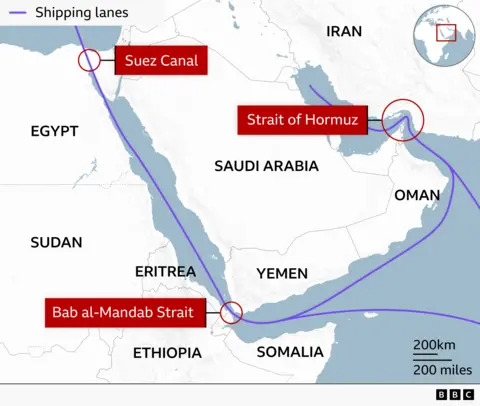
The water is calm at dawn, but the silence is a lie. Tankers move slowly through the Bab el Mandeb strait, their hulls heavy with crude oil and grain. Onshore, somewhere between the mountains of Yemen and the high towers of Riyadh, a new war is breathing. The Red Sea, once a corridor of ancient trade, has become a pressure point for the entire global economy. And just like the Strait of Hormuz before it, this narrow stretch of water is now a trigger for the next catastrophe.
That is not hyperbole. The rising tensions between Saudi Arabia and the Houthi movement are not just another chapter in the Middle East’s endless conflict. They are a direct consequence of two powerful forces: the inherited chaos of the Iraq War and the ongoing Palestinian catastrophe in Gaza. Washington has chosen a side in Gaza, and that choice is reshaping the entire region, dragging the Red Sea into the same standoff that has defined the Gulf for decades.
To understand how we got here, we have to go back to the desert of the 1990s and the invasion of Iraq in 2003. The Iraq War did not simply remove a dictator. It ripped apart the fragile balance of power that had kept the region’s rivalries in check. It empowered Iran, armed Shia militias, and left Sunni Arab states feeling abandoned by their Western allies. That legacy never disappeared. It only mutated, moving from Baghdad to Damascus, from Mosul to Sanaa, and now to the Red Sea.
Saudi Arabia watched that transformation with growing fear. The kingdom saw Iranian influence spreading across the Arab world, from Hezbollah in Lebanon to the Houthis in Yemen. When the Houthis took control of Sanaa in 2014, Saudi Arabia responded with a military intervention that was supposed to last weeks. It lasted years. And it never produced a decisive victory. Instead, it created a stalemate that has now exploded into direct confrontations along the Red Sea coast.

The war in Gaza is the accelerant. The Israeli campaign, enabled by American weapons and diplomatic cover, has turned the Palestinian issue into a regional flashpoint again. The Houthis, who are part of the Iranian backed network, have seized this opportunity to position themselves as the defenders of the Palestinian cause. They have launched missiles and drones at Israeli territory, and more importantly for the global economy, they have attacked commercial shipping in the Red Sea.
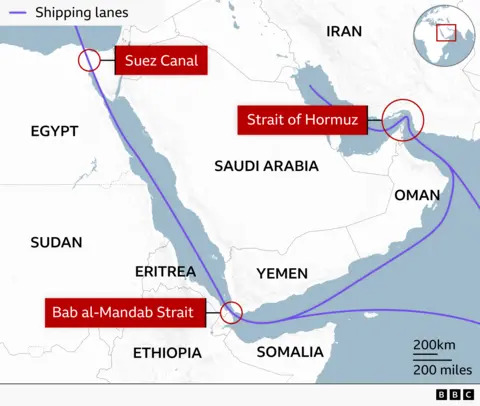
This is the new reality. Ships that once passed through the Suez Canal now take the long way around Africa. Insurance premiums have skyrocketed. Container rates have tripled. The global supply chain, still recovering from the pandemic, is now being strangled at one of its most vital nodes. The Red Sea is no longer just a route. It is a weapon.
Saudi Arabia is caught in the middle. The kingdom has long tried to maintain a ceasefire with the Houthis while also courting the United States. But the Gaza war has made that balancing act impossible. A Saudi strike on Houthi positions in the Red Sea region could be seen as taking the side of Israel, a political nightmare for the crown. At the same time, standing by while the Houthis threaten the kingdom’s own coastline would be a strategic failure. The result is a dangerous dance where every move increases the risk of a wider war.
The Houthis are not the rag-tag rebels they once were. Over a decade of war has turned them into a professional force with an arsenal of ballistic missiles, cruise missiles, and loitering munitions. They have naval mines and attack drones, and they have shown they can strike deep into Saudi territory. Their attacks on shipping are not random. They are carefully calibrated to cause maximum economic pain while avoiding a full scale invasion. The Red Sea has become their arena, and they know exactly how to play the game.
Iran is the shadow behind all of this. Tehran has provided the Houthis with the technology and training to target ships with precision. Iran does not want a direct war with Saudi Arabia, but it is happy to use Yemen as a pressure valve. The conflict in Gaza gave Tehran the perfect opportunity to expand its influence without firing a single shot from Iranian soil. Every attack on a tanker is a message to Washington, to Riyadh, and to the world: the Middle East will not be quiet, and the cost of supporting Israel will be paid in global trade.

The comparison to Hormuz is not accidental. The Strait of Hormuz sits at the mouth of the Persian Gulf, and for decades it has been the world’s most sensitive oil chokepoint. Iran has repeatedly threatened to close it when tensions escalate, and the United States has built a naval force to keep it open. But now the Red Sea is becoming a second front. The Bab el Mandeb strait is even more vulnerable. It is only twenty miles wide, and the coastline on one side is controlled by the Houthis, who have already demonstrated their ability to hit ships with precision missiles.
If the Red Sea becomes as dangerous as Hormuz, the global economy faces a blockade on two sides of the Arabian Peninsula. That means no safe passage for oil from the Gulf, and no safe passage for goods from Asia to Europe. The two routes are the arteries of world trade. Block them simultaneously, and you have a crisis bigger than any since the 1970s oil embargo.
The International Monetary Fund has already warned about the impact on food prices and developing economies. But the markets have not truly priced in the possibility of a direct Saudi Iranian war. That is the nightmare scenario. Saudi Arabia and Iran have been fighting a shadow war for years, through proxies in Yemen, Syria, and Lebanon. But a direct confrontation would be a different kind of disaster. It would draw in the US Navy, the Israeli Air Force, and every major power with an interest in oil.
And that brings us to the most dangerous element: the United States is already at war in everything but name. Washington is not only providing weapons and intelligence to Israel but also coordinating strikes on Houthi targets with the British military. That puts American forces in direct opposition to Iranian backed forces along a front that stretches from Gaza to the Red Sea. The situation is ripe for a miscalculation. One errant missile, one mistaken target, one escalation too far, and the entire region will slide into open conflict.
Diplomacy has failed so far. The United Nations has passed resolutions and held talks, but no one is listening. The Saudi Iranian rapprochement brokered in Beijing was supposed to be a step toward peace. It was supposed to calm the region and allow Saudi Arabia to focus on its own economic transformation. Instead, it has become another tool in the waiting game. Both sides are preparing for a conflict they do not want, but cannot avoid. The tragedy of the Middle East is that everyone sees the cliff, yet no one is willing to step on the brake.
The Red Sea is becoming the new Hormuz, not because anyone planned it, but because the old order has collapsed. The Iraq War destroyed trust, Gaza destroyed boundaries, and the global economy has become the hostage. There will be no easy exit. The Saudis and the Houthis are locked in a dance of fire, and the world is watching from the bridge of a ship that cannot turn around.
The cost is already visible. European car factories are waiting for parts that are stuck in the water. African nations are watching their food imports get delayed. Asian exporters are seeing their profits sink with every missed shipment. And yet the fighting continues. The Houthis are not backing down, Saudi Arabia is not backing down, and the United States is not backing down. The only thing being sacrificed is the fragile machinery of global commerce.
In the end, the Red Sea crisis is a mirror held up to the modern world. It shows how a war in Iraq can echo for two decades, how a siege in Gaza can ignite a thousand miles away, and how the flow of oil and goods can be weaponized by those who have nothing to lose. The Strait of Hormuz was always the old guard’s fear. The Red Sea is the new reality.
The only question is whether reason will prevail or whether the tide of history will pull us all into the deep. For now, the Red Sea remains open, but every morning the water is darker, and every night the horizon sparks with the glow of distant explosions. We are not at the edge of the war. We are already inside it.
That is the story.