The Great Mineral Bargain: Trump and Ukraine’s Rare Earth Deal
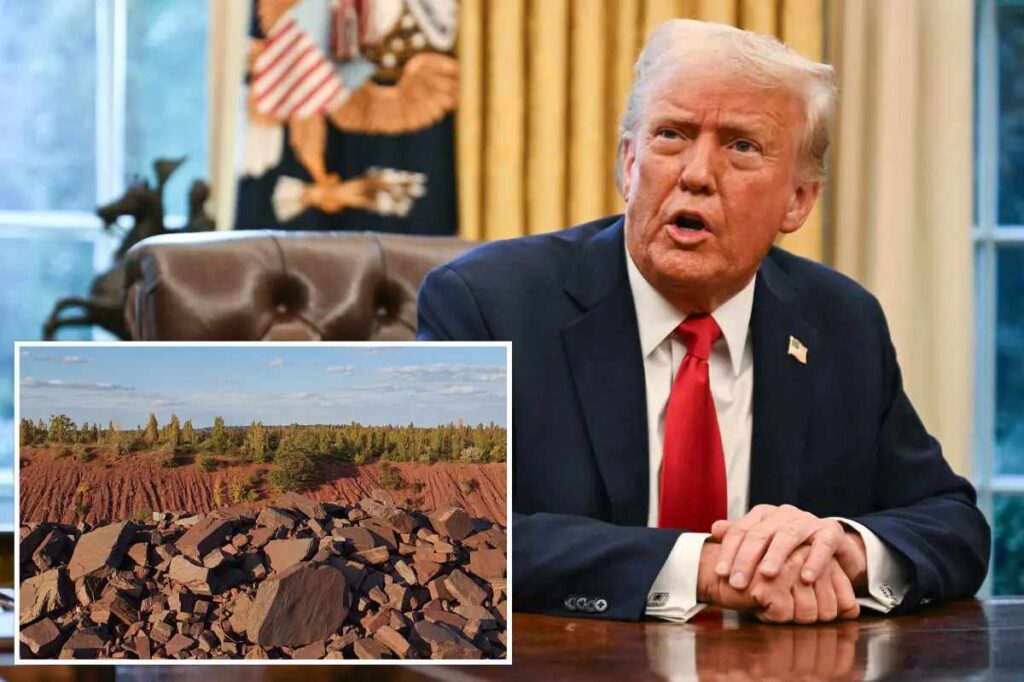
There are moments in history when a simple signature changes the course of nations. In a marble hall in Washington, the President of the United States and the President of Ukraine sat across a polished table. The only sound was the scratching of pens on parchment. The document they signed was not a treaty of friendship or a pledge of peace. It was an economic agreement. It grants the United States the right to exploit minerals in Ukraine without limitation. That single sentence has sent shockwaves through diplomatic circles, financial markets, and the global energy sector. Everyone in the room understood the weight of the moment. The world would never look at Ukraine the same way again.

For decades, rare earth elements were a quiet obsession of modern industry. These minerals sit inside smartphones, electric car batteries, military lasers, and wind turbines. They power the green transition and the digital revolution. Nations whispered about them, stockpiled them, and fought shadow wars over them. Now Ukraine has entered this secretive map as a giant. Its soil holds vast reserves of lithium, titanium, graphite, and other critical minerals. The world has spent years looking for a reliable supply outside China. This deal may change that search forever. The quiet obsession has become a loud, public race, and Ukraine is now at the center of it.
The Hidden Treasure Beneath Ukrainian Soil
Ukraine has often been called the breadbasket of Europe because of its rich black earth. But below that fertile layer lies another kind of treasure. Geologists have mapped enormous deposits of lithium, a mineral that fuels the batteries of the modern age. There are also large reserves of graphite, titanium, uranium, and beryllium. These are not just ordinary rocks. They are the building blocks of advanced military equipment, aerospace engineering, and renewable energy infrastructure. For years, Ukraine lacked the investment and security to develop these deposits. Now the United States has stepped in with a deal that bypasses old limitations. The potential is staggering, and so are the questions.
The agreement is remarkable not only for what it grants but for what it omits. There are no caps, no shared ownership rules, and no environmental review clauses. The right to exploit minerals in Ukraine is given without limitation. That means American companies can survey, dig, process, and export with minimal oversight. It is a blank check written on the geological ledger of a nation at war. Some diplomats have called it the most direct resource pact of the modern era. Others have called it a dangerous gamble. Both sides may be right.
The words without limitation are rare in international resource deals. Most agreements include timelines, royalties, and dispute resolution mechanisms. This one does not. It creates a direct path for American companies to secure exploitation rights in exchange for unspecified support. It is a flexible arrangement, which can be a strength or a weakness. Nothing is fixed, so everything is negotiable. That leaves enormous room for interpretation and conflict.

Why Rare Earths Matter So Much
To understand the weight of this deal, one must understand the strange power of rare earth elements. They are not rare in the sense of being scarce. They are rare because they are difficult to extract and refine. A single smartphone contains more than a dozen minerals, including neodymium, europium, and terbium. A modern fighter jet uses rare earth magnets in its guidance systems. An electric vehicle motor relies on dysprosium. Without these elements, the world would lose its digital memory, its clean energy ambitions, and its military edge. The modern economy runs on these unseen metals, and the nations that control them control the future.
- Neodymium powers the magnets in wind turbines and electric motors.
- Lithium stores the energy that moves electric vehicles and portable electronics.
- Graphite forms the anode of most modern batteries.
- Titanium builds aircraft frames, naval hulls, and medical implants.
- Uranium fuels nuclear reactors that provide low carbon electricity.
Each of these elements has its own supply chain, its own geopolitical risks, and its own market. Together, they form the bones of the twenty first century economy. Ukraine has all of them in significant quantities. That is why this agreement matters so much.
The Strategic Shift on the Global Board
This agreement moves the chess pieces of global power in a new direction. The United States gains access to a mineral trove that could supply its factories and military for decades. Ukraine gains a powerful ally with a direct stake in its economic survival. But other players are watching with nervous eyes. Russia has long considered Ukraine’s mineral wealth part of its historical sphere of interest. Any American presence in eastern Europe’s resource map is a strategic challenge to Moscow. The Kremlin has already begun calling the deal an act of colonial plunder. Such language may be exaggerated, but it reveals how seriously Russia takes the economic dimension of the conflict.
Europe, too, has mixed feelings. On one hand, it needs raw materials to build its green economy. On the other hand, it worries that Ukraine’s resources will be shipped across the Atlantic instead of enriching the continent. The European Union has been working on its own critical minerals strategy. This deal could undermine that plan before it matures. European leaders are now scrambling to open new negotiations with Kyiv, offering infrastructure projects and energy partnerships. The competition for influence over Ukraine is no longer only military. It is also geological.
Ukraine’s Dilemma: Blessing or Burden
For Ukraine, the deal is a double edged sword. In the short term, it brings money, technology, and American confidence to a devastated economy. The war has destroyed infrastructure, displaced millions, and drained the national budget. Foreign investment is desperately needed. But the terms of the agreement are unusually generous to the United States. Without limitation means without benefit sharing, without technology transfer, and without local employment guarantees. Some Ukrainian lawmakers have called it a modern version of an old imperial extraction contract. Others say it is the only realistic way to attract American capital while the war continues.
There is also the question of sovereignty. If American companies control the mines, the processing plants, and the export routes, Ukraine may become a resource colony. The nation fought for independence from Soviet rule, and now it may trade one form of dependence for another. The agreement does not mention how revenue will be split, how environmental damage will be managed, or how local communities will be compensated. These are not small details. They are the very details that determine whether a resource deal is a partnership or a plunder.
The language of the agreement echoes old colonial contracts. In the nineteenth century, powerful companies signed deals with local rulers to extract rubber, diamonds, and oil. The terms were simple: resources go abroad, profits stay abroad, and the local people are left with scars. Modern agreements are supposed to be different. They include environmental standards, community benefits, and revenue sharing. This deal, at least in its public form, seems to skip those chapters. That is why historians and political scientists are paying such close attention.

The Human Story Behind the Minerals
Behind the geopolitical drama, there are ordinary people. Farmers in central Ukraine wonder if their fields will be dug up for lithium. Miners in the eastern Donbas region remember a time when their coal pits were the pride of the Soviet industrial machine. Now they see a new kind of mine rising from the ashes of war. Some welcome it as a path to reconstruction. Others fear it as a foreign takeover of their homeland. The agreement has become a topic of heated argument in Ukrainian cafes, military hospitals, and village councils. In a country so used to being treated as a pawn, this deal feels deeply personal.
One local worker in a surveying team told reporters that his team was excited about the deal. He said it meant new equipment and a regular salary. But his brother, a soldier on the front line, was suspicious. He asked a simple question: if the Americans really want to help, why are they asking for so much in return? That question echoes across the country. There is no easy answer. The same person who welcomes the mine may also worry about losing his land. Ukraine’s resource wealth has always been a promise and a curse, and this agreement makes that tension impossible to ignore.
What Happens Next in the Global Race
The signing of this agreement is not the end of the story. It is the beginning of a complex legal, financial, and environmental process. Companies must conduct surveys, obtain permits, and negotiate with local governments. The war is still ongoing, and many of the richest mineral deposits lie close to active conflict zones. No one can dig safely while rockets are falling. And American law requires corporate transparency, even if the agreement itself seems too open ended. The first months will likely be spent on feasibility studies and security assessments, not on actual mining.
Meanwhile, other nations will respond. China may accelerate its own acquisitions in Africa and Latin America. Europe may fast track its recycling programs for rare earth elements. Australia and Canada, already major producers, may increase extraction to stay competitive. The global energy transition is not just about wind and solar. It is about who controls the minerals that make those technologies possible. Ukraine has just placed a massive bet on the American side of that equation. The coming years will reveal whether that bet was wise.
A New Chapter for the World Economy
In the end, the agreement signed by both countries grants the United States the right to exploit minerals in Ukraine without limitation. Those words will be analyzed by economists, politicians, and historians for years. Some will see a bold move to break China’s mineral monopoly. Others will see a shortsighted bargain that gives away a nation’s birthright. The truth probably lies somewhere in between. Every resource deal is a mixture of hope and risk. This one is no different, except for the scale of the stakes.
Ukraine is a country that has already sacrificed more than most can imagine. It has lost cities, monuments, and tens of thousands of lives. Yet it still holds vast reserves of global significance. The deal with the United States could help rebuild the country, or it could become another sad chapter in a long history of resource exploitation. The outcome depends not only on the words in the contract but on the will of the Ukrainian people to shape their own future. International investors will watch, local communities will push back, and the world will learn the true cost of its hunger for rare metals.
For the rest of the world, the message is clear. The race for rare earths is no longer a quiet competition among industrial labs. It is a visible, high stakes battle for the technological soul of the twenty first century. And right now, the map of that battle runs through the soil of Ukraine. Every smartphone, every electric car, every advanced weapon will carry a shadow of this deal. The ink has dried, but the story is only beginning.