The Gate of Grief: How Yemen’s War Could Pull the Horn of Africa Into a Global Shipping Crisis
Just before dawn, a container ship captain watches the radar screen and counts the lights on the water. Ahead lies a channel barely thirty kilometers wide, a corridor of black sea squeezed between the rocky coast of Yemen and the low shore of Djibouti. Sailors have a name for this place. They call it the Gate of Grief. Bab el Mandeb. For most of modern history the gate was simply a passage, the place where the Red Sea narrows and the Indian Ocean begins. Today it is something else entirely. It is a fault line, and the tremors moving through it are no longer local. Houthi forces are pressing closer to the strait, and with every advance the war in Yemen reaches out toward the Horn of Africa, where hunger, drought and conflict are already stacked like dry timber. The question hanging over the water is simple and unsettling. Is a shipping crisis about to become a geopolitical domino effect?

Where Africa and Arabia Almost Touch
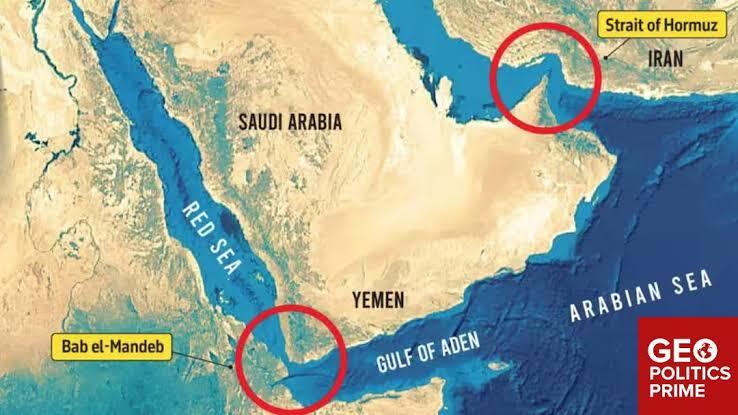
Look at a map at night and the strait resembles a seam. On the Arabian side, the mountains of Yemen rise straight out of the sea. On the African side, the desert flats of Djibouti and Eritrea stretch inland toward the Danakil. Between them runs a shipping lane that carries an extraordinary share of the world’s goods. Roughly one in every ten barrels of seaborne oil passes through here, along with a large slice of the container traffic that links Asia to Europe. The precise numbers shift with every crisis, but the shape of the dependence does not. Europe buys from Asia, Asia sells to Europe, and the shortest route between them runs through this gate. When the gate creaks, the whole chain hears it.
The Front Line Moves Toward the Water
Houthi forces have controlled much of northern Yemen for years, but what worries military planners is the coastline. Advances toward the shores near the strait, and the fortification of positions overlooking the shipping lanes, change the calculus entirely. From a ridge above the water, a drone operator does not need a navy. He needs a radio, a launcher and a target list. Since late 2023, missile and drone attacks on commercial vessels have turned the southern Red Sea into a testing ground for a new kind of asymmetric warfare, one in which a movement with modest resources can impose enormous costs on the largest trading system in human history. Some ships have been struck. Some have sunk. Others have switched off their transponders and slipped through in the dark, a practice that makes the sea more dangerous for everyone.
The deeper worry is not the attacks themselves but what they might connect. Yemen’s war has been a closed loop for a decade, a tragedy the outside world learned to file away. Now that loop is opening. Weapons, smugglers and fighters move across the water in both directions, and the line between a Yemeni civil war and a regional security crisis grows thinner every month.
Hormuz Bruised, and a Second Gate Under Threat
If the Strait of Hormuz is the world’s oil valve, Bab el Mandeb is the world’s conveyor belt. Disruption at Hormuz sends prices upward. Disruption at Bab el Mandeb sends schedules, ships and supply chains sideways. The two crises feed each other. When tankers hesitate near Hormuz, insurers eye the entire region with suspicion. When the Red Sea becomes a shooting gallery, operators reroute around the Cape of Good Hope, adding thousands of nautical miles and days of delay to every voyage. Analysts describe this as a compound risk, a situation where one chokepoint does not merely add to another but multiplies it.
Two gates, one nervous market. That is the new normal the shipping industry is being asked to price, and it is a price nobody wants to quote for long.
The Dominoes of the Horn
Across the water lies a region already carrying more weight than it can bear. Sudan is torn by a war that has displaced millions. Ethiopia, landlocked and ambitious, has spent years arguing that access to the Red Sea is an existential question, a claim that has rattled Somalia and unsettled Eritrea. Somalia itself is fragile, balancing a federal government in Mogadishu against regional powers and a persistent insurgency. Djibouti survives on rents from foreign bases and port fees. Eritrea sits watchful and closed. Add a second front to this mixture and the region does not simply absorb it. It amplifies it.

Migration tells the story faster than any communique. For years, small boats crossed the Gulf of Aden carrying Ethiopians and Somalis toward Yemen, hoping to reach the Gulf. Now the traffic runs in both directions, with Yemenis fleeing to Djibouti and Bosaso. Every new front line produces a new flow of people, and every flow of people becomes a recruiting pool, a smuggling route and a source of friction between governments that can barely afford the ones they already have.
The Price of Fear
Fear has a price, and the market quotes it every morning. War risk premiums for the southern Red Sea have multiplied, sometimes to many times their levels before the crisis. Hull and cargo insurance becomes the first line item that pushes a voyage into loss. Some operators pay and continue. Others refuse and reroute. The consequence is a quieter, longer and far more expensive supply chain that few consumers ever see but all of them eventually pay for. Egypt has watched canal traffic fall and revenue fall with it, a loss measured in billions of dollars and felt across a budget already under strain.
Rerouting carries a hidden cost as well. Ships that once delivered in three weeks now need five. Containers pile up in the wrong ports. Empty boxes appear where they are not needed and vanish where they are. Manufacturing lines built around precise delivery windows begin to stutter, and the stutter travels from factory to warehouse to shop shelf.
Food, Fuel and Fragile States
The most dangerous consequence is not economic but human. East Africa imports a large share of its wheat and fuel through the Red Sea. When freight and insurance costs rise, the increase arrives not at the border but in the market, in the bread aisle, in the fuel queue. For households already spending half their income on food, a rise of even ten percent is not an inconvenience. It is a crisis. Governments that subsidize fuel feel the shock in their budgets. Governments that cannot subsidize it feel the shock in the street.
Yemen itself sits at the end of the same chain. A country dependent on imported food, with ports that have been fought over for years, is extraordinarily sensitive to shipping costs. Every premium paid by a shipowner in the Gulf of Aden is, in a very direct sense, a tax on a Yemeni family’s dinner.
A Chessboard With Many Hands
The water is crowded with players. China operates its first overseas base in Djibouti and describes the Red Sea as a commercial lifeline. The United Arab Emirates has invested in ports from Berbera to Assab and wields influence along the whole coast. Turkey maintains a presence in Mogadishu. Russia has courted Red Sea ports and views the corridor through the lens of rivalry with the West. India deploys warships to escort its own trade. The European Union runs a naval mission. The United States, meanwhile, has shifted from a posture of escort toward one of direct strikes.
Each actor brings its own theory of the crisis. For some, the Houthis are a proxy problem to be contained. For others, they are a bargaining chip in a wider negotiation. For the coastal states of Africa, they are a neighbor whose instability cannot be fenced off by water. When so many hands rest on the same chessboard, small moves produce large consequences, and miscalculation becomes the most likely road to escalation.
Three Ways This Could Go
The optimistic path is deterrence holding, attacks declining, insurance easing and traffic returning to something like normal. The middle path is a grinding stalemate, in which periodic strikes keep premiums high and the Cape route becomes a permanent feature of global logistics. The pessimistic path is a sudden closure of the strait, whether through deliberate escalation or through an accident nobody controls. In that scenario, the price of oil, the cost of food and the politics of a dozen fragile states would shift within days rather than years.
Why the Gate of Grief Matters to Everyone
Distance is a comfortable illusion. A shopper in Berlin, a farmer in Kenya, a factory manager in Vietnam and a family in Sanaa are all connected by a channel of water thirty kilometers wide. The crisis at Bab el Mandeb is usually described as a shipping problem, but shipping is only the messenger. Behind the freight rates sits a struggle over territory in Yemen, a contest for influence along the African coast, and a global economy that has optimized itself for a world in which chokepoints stay open.
The lesson of the past two years is that chokepoints are not only geography. They are confidence. Once confidence in a passage erodes, it does not return with a single calm month. It returns when the politics around the water change. Until then the dominoes stand close together, each one waiting for a reason to fall. The Gate of Grief has watched empires, pilgrim fleets and oil tankers pass through it for centuries. What it has rarely seen is this much attention, from this many directions, at the same time. The world may still be able to keep the strait open. What it cannot do is look away.