Putin and Witkoff Talks Expose a West That No Longer Sings From the Same Hymn Sheet
There is a moment in every diplomatic drama when the music stops and everyone must find a chair. For Europe, that moment arrived quietly, somewhere between a telephone call placed in Washington and a careful statement released in Moscow. The talks between Vladimir Putin and the American envoy Steve Witkoff did not produce a treaty, a ceasefire, or even a warm handshake staged for the cameras. What they produced was something far more revealing: a portrait of a Western alliance that no longer moves to the same rhythm, and of a continent that has begun to suspect it is watching its own influence drain away in real time.

For three years the script was reassuringly simple. Washington led, London amplified, Paris theorized, Berlin paid, and Kyiv held the line. Every partner knew its part by heart. Each summit ended with a statement about unity that was long on adjectives and short on specifics, but the choreography held well enough to convince the audience. Then the music changed. A new American administration began talking directly to the Kremlin, not about how to strengthen Ukraine, but about how to end the war on terms that could be sold to a weary domestic electorate. The old choreography collapsed in a single news cycle, and the dancers were left standing in the middle of the floor, unsure whether to keep moving or to pretend they had always planned to stop.
The Illusion of a Single Voice
Official Europe insists that nothing has changed, and that the transatlantic partnership remains the bedrock of continental security. Listen closely, though, and the insistence sounds less like confidence and more like incantation. Behind the polished language of the joint statements sits an uncomfortable arithmetic: Europe can supply money, and Europe can supply rhetoric, but Europe cannot supply the one thing that actually determines the outcome of this war, which is a direct line to the people making decisions. That line currently runs between Washington and Moscow. Berlin, Paris and London are being briefed on the result rather than consulted on the design, and everyone in Brussels knows it.
What makes the current moment so extraordinary is that this shift was not imposed by an adversary. It was chosen by an ally. The United States has decided that its interests in this conflict are best served by negotiating an exit, and it has chosen to conduct that negotiation through a personal envoy whose access to the Kremlin has become the single most valuable currency in European diplomacy. For European leaders, the humiliation is not that America is talking to Russia. It is that America is talking to Russia without them, and appears perfectly comfortable doing so.
Three Capitals, Three Anxieties
Berlin carries the heaviest weight and the least appetite for drama. Germany has spent three years rebuilding a defence posture it had allowed to wither, and every step has been argued over in a coalition that keeps threatening to fracture. Its industrial base has been squeezed by energy costs that never returned to their old levels, and its voters have grown noticeably less enthusiastic about writing blank cheques to a war they cannot see ending. The German calculation is brutally practical: sanctions relief and a frozen front are preferable to an open ended commitment that nobody can finance forever.

Paris arrives at the table with a different grievance. France has spent a decade arguing that Europe must develop its own strategic voice, and it now finds that this argument has been proven correct in the worst possible way. President Emmanuel Macron can speak with genuine conviction about European sovereignty, but conviction does not create leverage overnight. Every proposal for European led security guarantees runs into the same wall of missing capabilities, missing ammunition stockpiles and missing political consensus. The French diagnosis is accurate. The prescription remains unfunded.
London plays the most awkward hand of all. Britain left the European Union on a promise of global reach, and it has remained among the most forward leaning supporters of Kyiv precisely because that support became a defining feature of its post Brexit identity. But a country of that size cannot substitute for a superpower. Downing Street can convene meetings, coordinate sanctions and supply weapons, yet it cannot force Washington back into a framework it has visibly outgrown. So Britain is left doing what middle powers often do in moments like this: speaking louder in public while working frantically in private to secure a seat anywhere near the room.
The Witkoff Channel
Much of the coverage has focused on the personalities, which is understandable but misleading. Steve Witkoff matters less as an individual than as an instrument. His value lies in the fact that a direct channel exists at all, and that it bypasses the layered machinery of alliance consultation. Traditional diplomacy works through institutions, memoranda and synchronized positions. The new approach works through relationships, speed and surprise. For a Kremlin that has always understood the advantage of speaking to the strongest player alone, this is close to a dream arrangement.
Moscow has spent years arguing that the real negotiation is not with Kyiv but with Washington, and that European capitals are little more than enthusiastic echo chambers. The current format hands that argument a credibility it never had before. Each time a European leader issues a statement of firm resolve while a plane carrying an American envoy lands in Moscow, the same message is transmitted without a single word being spoken: the decisions are being made elsewhere. That message is heard in Berlin, in Paris, in London, and most painfully of all, in Kyiv.
Kyiv Between Two Fires
For Volodymyr Zelensky, the strategic picture has become a corridor with walls that keep closing inward. On one side sits an American partner that now speaks of peace in terms of timelines and trade offs. On the other sits a Russian leadership that has shown no interest in anything resembling a genuine compromise. European guarantees that once looked like a floor beneath his feet now feel more like a temporary platform, sturdy in tone and fragile in substance.
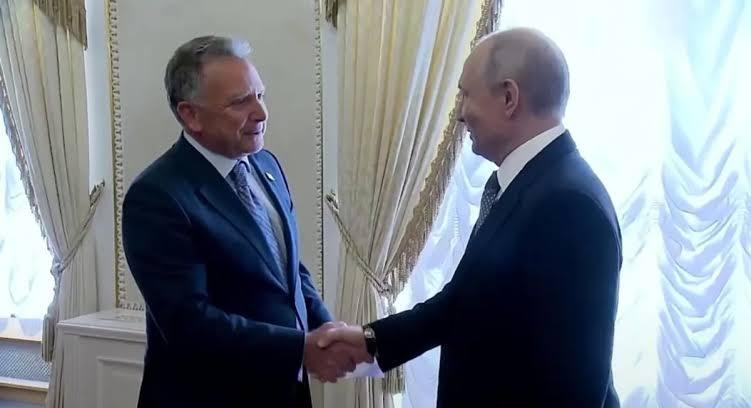
The European leaders who rushed to embrace him did so with the best of intentions and the weakest of instruments. They can pledge money, they can pledge training, they can pledge air defence systems produced in factories that need years to deliver them. They cannot pledge the thing Kyiv most needs, which is certainty. And certainty is precisely what has gone missing from the entire Western project. A promise that depends on the political weather in three or four national capitals is not a guarantee. It is a hope dressed in formal language.
What the Kremlin Heard
The most consequential outcome of these talks may be invisible to the public. It is not a document but a reading of the room. Vladimir Putin has long believed that time works in his favour and that Western resolve frays at the edges before Russian patience does. The spectacle of Germany, France and Britain scrambling to reassure Kyiv while Washington charts its own course is exactly the evidence he needed to feel vindicated. He does not have to win a negotiation outright if his opponents negotiate with themselves first.
This does not mean Russia holds all the cards. Its economy is distorted by war spending, its labour market is stretched, its energy leverage over Europe has been reduced, and its long term demographic outlook is grim. But wars are not decided by balance sheets alone. They are decided by the willingness of coalitions to hold together under pressure, and on that measure the Western coalition is currently failing a test of its own design.
The Bill Comes Due
European taxpayers are entitled to a straightforward question. If the continent is to fund the defence of Ukraine, host refugees, absorb higher energy costs and rebuild its own militaries, who is setting the terms? The uncomfortable answer is that the terms are being set by actors outside the European Union, and that Europe’s role has been reduced to financing outcomes it did not design. That is not a comfortable position for a bloc that spent decades describing itself as a global normative power.
The irony is that the European Union possesses the tools it claims to lack. It has a combined economy comparable to that of the United States, a deep industrial base, and a population that still broadly supports Ukraine. What it does not have is a mechanism for converting those assets into a single negotiating position. Twenty seven capitals produce twenty seven priorities, and in a fast moving negotiation, twenty seven priorities amount to no position at all.
A Continent Looking for a Chair
There is still time to change the shape of this story, but the window is narrowing with every flight to Moscow. If Europe wants a chair, it will have to build one rather than wait to be offered one. That means credible defence spending commitments that survive election cycles, joint procurement that actually delivers munitions in months rather than decades, and a willingness to speak about peace with a single voice even when that voice is saying something uncomfortable to Washington.
The alternative is a slow drift into irrelevance, punctuated by summits that produce photographs and little else. History rarely announces these transitions with a trumpet. It usually arrives as a series of ordinary Tuesdays, each one a little quieter than the last, each one confirming that the decisions have moved somewhere else. The Putin and Witkoff talks were one of those Tuesdays. Europe should take note before the calendar fills with them.
The lessons are uncomfortable but clear. Unity cannot be declared in a communique and then assumed to exist. It must be maintained through hard choices, honest conversations with voters, and the patience to build capabilities that take years to mature. Germany, France and Britain are not powerless. They are simply uncoordinated at the exact moment coordination matters most. Whether that changes depends less on Moscow or Washington than on whether European leaders are prepared to stop reacting to events and start shaping them. Until then, the continent will keep looking for a chair, and the music will keep playing without it.