Beyond NATO? Turkey’s New Defense Partnerships Reshape Eurasian Geopolitics
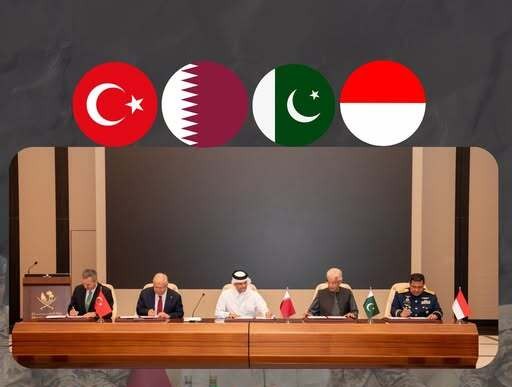
The announcement did not arrive with fireworks. There was no dramatic summit, no signing ceremony staged for the evening news. Instead, Turkey’s new defense arrangement with Qatar, Pakistan and Indonesia surfaced quietly through defense ministries, absorbed first by specialists, then passed along to chancelleries that understood exactly what it meant. Within a week, the same question was being asked in Washington, Moscow and Beijing: has Ankara just assembled a military network that does not need NATO’s permission?

For more than seventy years, Turkey’s military identity was simple to describe. It was the eastern flank of the Atlantic alliance, the second largest army in NATO, the southern anchor of a system that ran from the Baltic to the Black Sea. That description still holds on paper. It no longer captures what is happening on the ground. What Ankara is building now looks less like a single alliance and more like a web, one that reaches east into Asia, south into the Gulf, and outward again across the Muslim world, without ever formally leaving the West behind.
A Quiet Deal With Loud Echoes
Details remain partial, as they often do with defense memoranda. What is clear is the shape of the thing. Turkey, Qatar, Pakistan and Indonesia have agreed to deepen cooperation across training, joint exercises, defense industry collaboration, intelligence sharing and technology transfer. On its own, each strand looks modest. Woven together, they form something larger: a framework for military cooperation that links the Gulf, South Asia and Southeast Asia through a Turkish hub.
That hub idea is the important part. Alliances traditionally have a center of gravity, and for eight decades that center was Washington. A network built around Ankara implies something different, a set of relationships that can function without a single patron. In a world where middle powers increasingly prefer portfolios of partners to exclusive patrons, the arrangement is less an act of rebellion than an act of insurance.
Why Ankara Went Looking Beyond Brussels
Turkey’s motives are not mysterious. For years, Ankara has found itself in a strange position inside its own alliance. It fields one of NATO’s largest and most battle tested armies, yet it has spent much of the past decade negotiating for fighter aircraft, air defense systems and technology transfers with a permanent sense of friction. Sanctions, stalled procurements and political conditionality have all left their mark. Turkish planners concluded, reasonably, that a defense strategy resting on a single supplier and a single club was fragile.
There is also ambition. Turkey does not see itself as a regional player content with regional roles. Its drone industry has become an export phenomenon, its defense sales have climbed steadily, and its diplomatic reach now runs from the Caucasus to Africa to Southeast Asia. Partnerships with Qatar, Pakistan and Indonesia are not defensive reflexes. They are the infrastructure of a country that wants to be a defense producer, not merely a defense consumer.

The Qatar Dimension: Money, Mediation and Muscle
Qatar is the smallest of the three partners and arguably the most consequential. Ankara and Doha have spent a decade deepening a relationship that survived blockade, regional isolation and repeated crises. Turkey maintains a military presence in Qatar and has trained and equipped Qatari forces. In return, Qatari capital has flowed into Turkish defense ventures and into the Turkish economy during difficult moments.
What the new framework adds is institutional depth. A relationship built around a single crisis becomes a relationship built on recurring exercises, shared planning and joint production. For Qatar, Turkey offers a partner with real combat experience and an industry that can deliver. For Turkey, Qatar offers financing, access to Gulf markets and a diplomatic partner with unusual reach into mediation channels from Afghanistan to the Sahel.
Pakistan and Indonesia: Reaching Deep Into Asia
The Asian half of the agreement carries more weight in the long run. Pakistan is a nuclear armed state with a large military, long experience in counterinsurgency and a defense relationship with China that shapes its options. Indonesia is the anchor of Southeast Asia, a sprawling archipelago with a doctrine of strategic autonomy and a modernization program that needs partners who do not arrive with lectures attached.
What both countries share is a preference for defense relationships that respect sovereignty and avoid political conditionality. Turkey fits that market precisely. It sells without moralizing, it offers joint production rather than pure sales, and it carries the credibility of a Muslim majority state with a working defense industry. For Jakarta, Ankara is a useful third option between Washington and Beijing. For Islamabad, which has long balanced between great powers, Turkey adds another channel.
Moscow’s Calculus: A Partner Who Is Not a Proxy
For Russia, Turkey has always been the most useful kind of problem. The two countries have fought proxy contests in Syria and Libya, competed in the Caucasus and the Black Sea, and still built energy ties, tourism flows and arms deals that neither side wants to lose. Moscow sold Ankara air defense systems knowing that a NATO member would operate them. That deal alone reshaped assumptions about alliance cohesion.
A Turkish defense network reaching Pakistan and Indonesia complicates Russia’s picture further. In South Asia, closer Turkish and Pakistani military ties can coexist with Russian interests, but they also narrow Moscow’s room to maneuver between Delhi and Islamabad. In Central Asia, Turkish cultural and defense influence is a soft form of competition, one that runs alongside Russian security guarantees without openly challenging them. The result is not confrontation but a slow dilution of Russia’s role as the region’s primary security provider.
Beijing’s Silk Road of Steel
China’s reading of the agreement is more nuanced than it might appear. Beijing has invested heavily in Pakistan and increasingly in Southeast Asia, and it has cultivated Turkey as a node in its infrastructure and trade networks. A Turkish role in the modernization of Pakistan and Indonesia is not automatically hostile to Chinese interests. It can even be complementary, spreading costs and diversifying suppliers in ways that reduce pressure on Chinese industry.
Yet there is a strategic edge. Turkey offers something China cannot always offer: defense technology packaged with political acceptability in capitals that are wary of dependence on Beijing. Every Turkish defense partnership in Asia is a reminder that the region has options beyond a binary choice between Washington and Beijing. For a power that prefers to be the only alternative, that is not a threat to be dismissed.
Washington’s Squeezed Leverage
The most immediate impact may be felt in Washington, where Turkey’s value is appreciated but its independence is tolerated only up to a point. The United States has spent years trying to keep Ankara inside the alliance’s orbit while managing disagreements over procurement, sanctions and regional policy. A Turkish defense network with Gulf money, South Asian reach and Southeast Asian markets weakens the assumption that NATO membership is Turkey’s only serious option.
That does not mean Turkey is leaving NATO. It is not. The alliance remains central to Turkish security, and a rupture would cost Ankara far more than it would cost Brussels. But leverage is relational. When one side of a relationship has alternatives, the other side’s ability to set terms declines. Washington will still have tools, from basing arrangements to technology access, yet those tools now operate in a far more crowded marketplace.
Risks and the Road Ahead
None of this is guaranteed to succeed. Multi partner defense frameworks have a tendency to look impressive on paper and thin in practice. Interoperability across four very different militaries is difficult. Financing is uncertain. Political changes in any of the capitals involved could slow or reverse commitments. Pakistan’s economic strains, Indonesia’s bureaucratic caution and Qatar’s exposure to regional pressure all matter.
There is also the question of credibility. A network needs real capabilities, not memoranda. Turkey’s defense industry is impressive but stretched, and it cannot equip three partners at once without fresh investment and time. The next two years will reveal whether this becomes a genuine architecture or another promising communique.
The Bigger Picture
Still, the direction of travel is clear. Middle powers are no longer content to choose a single camp and stay there. They are building portfolios, hedging across partners, and treating defense relationships as instruments of autonomy rather than tokens of allegiance. Turkey’s agreement with Qatar, Pakistan and Indonesia is an early expression of that logic in the military domain.
For Eurasia, the consequences are structural rather than dramatic. No borders change, no alliances collapse. Instead, the region gains another layer of complexity, another set of channels, another actor able to broker, supply and mediate. The old map of blocs was painted in two colors. The new one is being drawn in overlapping shades.
Conclusion
Turkey’s new defense partnerships are best understood not as a break from NATO but as a hedge against a world where any single alliance is insufficient. Ankara is betting that influence in the coming decade will belong to states that can operate in several rooms at once: in Brussels, in the Gulf, in South Asia and in Southeast Asia. Whether or not that bet pays off, the fact that it is being placed tells us something important about the era we are entering, and about the ambitions of a country that has decided its geography is not a limitation but a launchpad.