German Investments in America Vanish as Trump Tariffs Redraw the Map
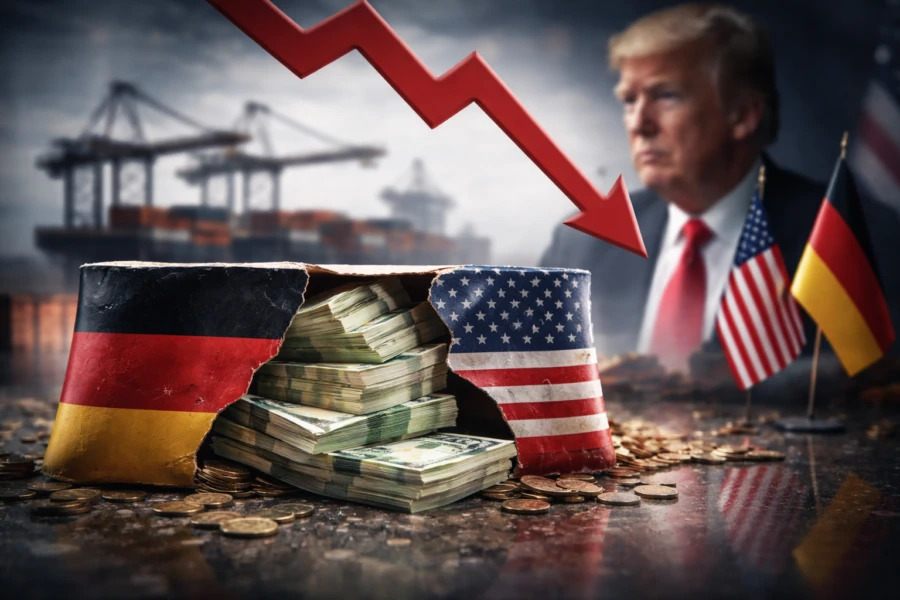
On a cold Tuesday morning in Frankfurt, a financing director for a family owned engineering firm stared at a spreadsheet that would have been unthinkable five years ago. The company had already committed millions to a new factory in South Carolina. New equipment was on order. Workers had been hired and trained. Then came the tariff news. Within weeks, the entire American project was frozen, and the file moved to a drawer marked wait and see. This scene, repeated across boardrooms in Munich, Stuttgart, and Berlin, explains a stunning new reality: German investment in the United States has collapsed as Donald Trump’s tariff threats shake the foundations of transatlantic trade.

A Historic Shift in Capital Flows
Numbers tell the story with brutal clarity. The German Chamber of Commerce recently published survey results showing that only a fraction of German companies active in the US plan to increase their investments in the coming year. Foreign direct investment flows from Germany to America have dropped sharply. Trade statistics show that deliveries of capital equipment and machinery from German factory suppliers have also slowed. These are not temporary tremors. They are symptoms of a structural reassessment.
The sudden reversal is visible in official statistics. According to the Bundesbank, German net capital investment in the United States dropped by billions of euros in the most recent quarter. The American Chamber of Commerce in Germany reports that its members rate the current trade climate as one of the worst in decades. Even companies that keep their American factories are delaying new production lines. They are waiting for clarity, but clarity never comes.
For decades, the US attracted more German investment than any other country. The annual flows transformed sleepy southern towns into bustling manufacturing hubs. The German name plaques on factory gates became a badge of honor for local mayors. That entire ecosystem is now at risk. The recent plunge is not a small correction. It is a shift in the mental map of German executives.
The plunge is not only visible in official data. It is visible in the voices of German business owners. Something has changed in the psychology of investment. Five years ago, American expansion was considered a strategic necessity. Today, it is a high risk gamble. The change is most pronounced among medium sized companies, known in German as the Mittelstand. These firms are not global giants with armies of lawyers. They rely on trust, relationships, and predictability. The current climate has broken all three.
The Uncertainty Weapon
Trump’s signature trade policy is the tariff. He has repeatedly threatened duties on European imports, especially German cars, steel, and machinery. The uncertainty is more toxic than the tariffs themselves. Companies cannot plan because the rules change with every presidential message. A tariff of 25 percent on German engines can wipe out the profit margin of an entire product line. To avoid that, German firms have two choices. They can build factories inside US borders, or they can wait and hope the storm passes. Many chose the second option, delaying decisions and shelving expansion plans.
Boardrooms talk about a shadow tariff, which is the fear of trade restrictions rather than the restriction itself. Even when no tariff is actually applied, companies must spend money on contingency plans. They pay lawyers to assess risk. They redesign supply chains. They postpone hiring. In economics, uncertainty functions like a hidden tax. The more the president threatens, the less investment flows, even if the threats never become law.
To understand the impact, imagine a company planning a new plant in Texas. The plant will cost 150 million euros. The company plans to produce components for the American energy sector. The decision depends on a careful calculation of future demand. Tariff talks in Washington create two possible futures. In one future, trade remains free and the plant is profitable. In another future, tariffs make exports to Europe impossible and the plant must be redesigned for local sales only. The company must choose under uncertainty. The rational move is to postpone the decision until the political situation becomes clearer. Hundreds of German companies are doing exactly that.

NATO and the Security Chill
Beyond tariffs, US German tension has flared over defense burdens within NATO. Trump has criticized Germany for failing to meet the alliance target of spending two percent of GDP on defense. German leaders argue that their country contributes through development aid, peacekeeping, and diplomacy. But the public argument has created a broader sense of strategic alienation. When security and trade are linked, business culture suffers. German executives no longer see America as a predictable partner. They see a political terrain where friendship depends on the mood of the president.
German defense policy is also changing. The Bundeswehr now receives more funding, but the transformation is slow. For many German voters, the American demand for higher military spending feels like punishment, not partnership. The resentment is mutual. Washington feels that Berlin is hiding behind American soldiers while selling cars to American families. This clash of perceptions poisons the atmosphere for trade, investment, and diplomacy.
The security argument has a direct economic dimension. German companies that depend on American military contracts also face uncertainty. Some German startups in the defense sector are now avoiding US partnerships because they fear sudden blacklists. At the same time, American investors in German military technology are pulling back because they worry about German controls on arms exports. This is a full circle of suspicion. It undermines the very alliance that NATO was created to protect.
Jobs and Livelihoods on Both Sides of the Atlantic
The human cost of this investment freeze is serious. In Ohio, Tennessee, and South Carolina, communities welcomed German companies with subsidies and warm promises. Those communities now fear empty factory halls and cancelled projects. German firms employ around one million Americans. Every delayed investment means less employment, fewer contracts for local suppliers, and a slower transition to electric vehicles and green technology. German industry knows that staying close to the American market is strategically important, so the pullback is not a simple exit. It is a painful pause, an anxious wait.
On the German side, the consequences are just as real. Workers in Bavarian machine tool shops depend on export orders from the US. A pause in American projects leads to shorter working hours in German factories. Apprentices lose their training places. Innovation budgets shrink. The so called decoupling of the two economies would be a disaster for both. Unfortunately, each side now seems willing to test how much pain the other can bear.
The pain is not distributed equally. States in the American Southeast, which attracted the largest share of German greenfield projects, are now the most exposed. Alabama, Georgia, Tennessee, and South Carolina all have significant German industrial communities. The planned factory closures or delays hit small towns hardest. A German plant is often the largest employer in the county. When the plant expands, local schools thrive. When the plant freezes, the entire economic ecosystem contracts.
Consider the story of a medium sized supplier from North Rhine Westphalia. It specialized in precision valves for heavy trucks. It had a customer in Tennessee that promised decades of orders. The supplier bought land, signed a construction contract, and began hiring local engineers. Then the tariff talk started, and the customer paused the project. The supplier lost its deposit on the land and had to lay off the newly hired engineers. These stories do not appear in official statistics, but they shape the mood of an entire industrial class.
A Relationship Built Over Generations
The US remains the largest destination for German foreign direct investment. Germany is one of the largest foreign employers in the US. Yet trust has been severely damaged. Tariffs are not just economic tools. They are symbols. When Washington threatens punishment, the German public hears a warning. Business leaders hear hostility. The Atlantic Charter, the Marshall Plan, and decades of friendship still linger in memory, but younger Germans see America through a different lens, one shaped by trade wars, surveillance, and political chaos.
The industrial alliance between Germany and America is not a superficial arrangement. It grew from the ashes of the Second World War. American capital helped rebuild Germany. German quality helped build American highways and skylines. This shared history gave both countries a sense of mutual reliability. That reliability is now in question. The decline in German investment is not just a financial number. It is a measure of lost confidence, and confidence is the hardest asset to recover.
There is a personal dimension too. Thousands of German employees have moved to the US with their families. They have American children, suburban homes, and weekend friendships with their neighbors. These people will not leave easily. But the next generation of German professionals is less eager to move. They see the US as a country of school shootings, healthcare chaos, and political extremism. They prefer Paris, Singapore, or even Dubai. This soft decoupling is already happening in the supply of talent. No tariff deal can reverse it.
Looking for New Partners
While the transatlantic relationship freezes, German companies are exploring alternatives. China remains a giant market, although political risks are high. India is opening its doors to foreign manufacturing, especially in electronics and green technology. Eastern Europe offers lower costs and cultural proximity. German banks are beginning to redirect long term capital away from the US and toward Southeast Asia. None of these alternatives can fully replace America, but they can absorb the capital that once crossed the ocean without second thought.
American policy makers often assume that German companies have no alternative to the US. That assumption is dangerous. The world is full of countries that welcome foreign investors. Mexico offers geographic proximity to the US without the same political unpredictability. India is building new industrial corridors with European capital. Vietnam is becoming a manufacturing base for companies that want to diversify their supply chains. The cost of these alternatives may be higher in the short run, but the price of constant political risk in the US is also high.
European policy makers also talk about strategic autonomy. The European Union is trying to build stronger internal markets for defense, energy, and technology. If Germany and France commit to a continental scale investment plan, the United States will no longer be the automatic choice for German savings. This is a generational shift. It will not be reversed by a single friendly speech.
What Would Bring the Money Back?
Some experts believe the worst is over. Negotiations may resume. A new president could restore a friendlier tone. European companies often play a long game, and the structural reasons to invest in America remain strong. The US has a large consumer market, cheap energy, and a flexible labor force. Yet the scar of uncertainty will not heal quickly. Companies that canceled a project in 2025 will not easily reopen the file in 2026. The competition from China, India, and the European Union is intensifying. If the US cannot offer a stable, tariff free environment, German capital will find shelter elsewhere.
The best signal Washington could send is a consistent, transparent trade policy. That means no surprise tariffs, no threats against allied leaders, and a clear timetable for negotiations. It also means respecting NATO commitments without turning every meeting into a public argument. German investors are not asking for favors. They want rules that do not change with the political wind. When that stability returns, the capital will follow.
A stable tariff schedule would be a good start. If the US committed to a two year truce on new tariffs, German investment could recover quickly. Another important step is to end the linkage between NATO spending and trade policy. The two issues are connected in the public mind, but they belong in different negotiating arenas. Finally, the US should create a new version of the old transatlantic dialogue, with regular summits between business leaders from both sides. These summits cannot be photo opportunities. They must produce concrete decisions on standards, digital trade, and energy cooperation.

Some experts believe that the recovery will be slow and uneven. The risk of another tariff shock remains high. Political cycles in America are unpredictable, and German companies have learned to expect the unexpected. The most likely scenario is a partial rebound followed by a long period of cautious testing. Capital will return to America only after the political environment proves itself stable for several consecutive years. That is a heavy demand, but the stakes are enormous.
A Delicate Conclusion
The story of German investment in America is more than a statistic. It is a tale of promises made and broken, of factory lights that may never go on, and of a transatlantic partnership that once seemed eternal. Tariffs were supposed to protect American wealth. Instead, they are driving away one of America’s most loyal economic allies. The political mood in Berlin and Frankfurt is now cautious, skeptical, and deeply worried. Only a clear and credible policy shift in Washington can bring the money back. Until then, the silence from abandoned boardrooms will speak louder than any trade agreement.