Europe’s Anxious Wait: What Brussels Really Fears About Trump
Brussels rarely panics. The city is built for patience, for long lunches and longer negotiations, for officials who measure progress in commas and footnotes. Yet something has shifted this year. In the corridors of the Berlaymont, in the quiet salons of the Quai d’Orsay, in the glass towers of the Berlin chancellery, a question keeps circulating, always whispered and never minuted. What happens if American voters return Donald Trump to the White House? And, more unnerving still, what happens if they do not return him and he refuses to accept the outcome?

That second question is the one nobody in Europe wants to answer on the record. It touches something deeper than policy. It touches the machinery of confidence on which everything else rests, the assumption that the world’s oldest democracy can hand over power without drama, that treaties signed by one administration will be honoured by the next, that the word of the United States means exactly what it says.
A Portrait Painted in Whispers
Listen carefully to how European officials describe Trump and a pattern appears. They reach for words like erratic, volatile, unpredictable, transactional. They call him a disruptor, a wrecking ball, a man who governs on instinct and grievance. The portrait is flattering to the listener, because it turns an uncomfortable structural problem into a manageable personality problem. If the difficulty is one man, then the solution is simply to outlast him.
The trouble is that this portrait is a comfort, not an analysis. Europe spent years insisting that Trump was an accident of history, a detour, a temporary fever that would break. Every budget line, every defence commitment, every trade strategy was quietly written on the assumption that the old normal would return. That assumption is now looking less like wisdom and more like a habit that no one dared to break.
The Myth of the Irrational Leader
Examine what Trump actually did in office and a more coherent picture emerges. He questioned how NATO shares its burdens. He reopened trade terms that had been settled for decades. He pressed allies to spend more on their own defence. He met adversaries directly rather than through intermediaries. He treated alliances as contracts with clauses that could be renegotiated when the terms stopped suiting the stronger party. None of that is madness. It is a recognisable worldview wearing an abrasive tone.
Some of his decisions were admittedly chaotic, announced without warning and reversed without explanation. But even the chaos followed a logic of cost and leverage. The label of irrationality does a strange kind of work. It reassures European capitals that the problem is temperament rather than trajectory. It suggests that the correct response is patience rather than preparation. And it quietly ignores the possibility that Trump’s instincts are shared by a substantial slice of the American electorate, in both parties, who want a smaller global footprint and a narrower definition of national interest. You cannot wait out a mood that has been building for a generation.
What Europe Actually Fears
So what keeps ministers awake? Three things, usually in this order.
The first is being squeezed. Europe has spent a decade trying to be a reliable partner to Washington while remaining a serious trading partner to Beijing. If the two capitals harden their rivalry, that balancing act collapses. European carmakers, chemical plants and machine tool exporters built supply chains on the assumption that openness was permanent. Tariffs would not merely raise costs. They would rewrite the map of European industry.
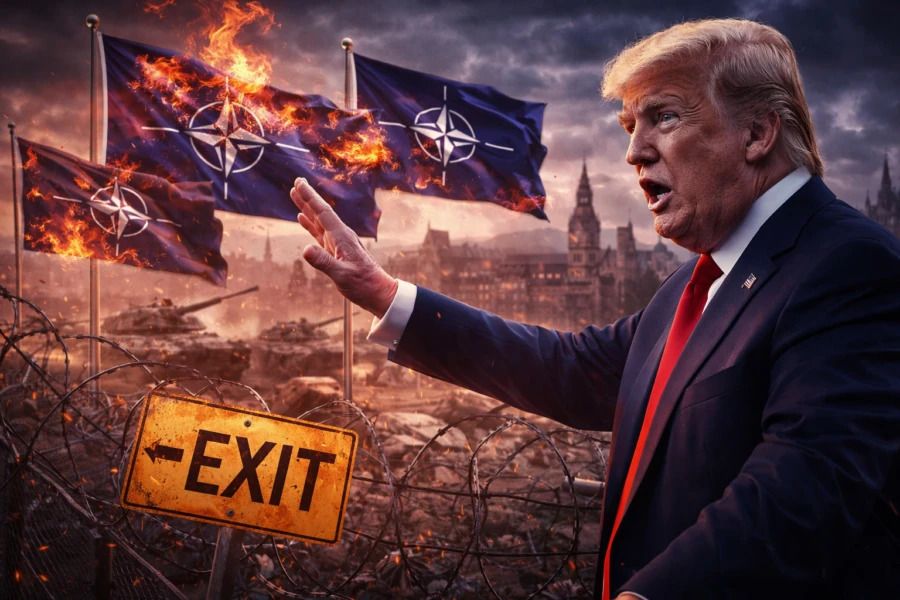
The second is the security guarantee becoming conditional. Since 1949, European defence planning has rested on one unspoken sentence: America will come. That sentence is now spoken with a question mark. Warsaw hears it. Tallinn hears it. Even Paris, which has spent years arguing that Europe must rely on itself, hears it more anxiously than it admits.
Trade, Tariffs and the Fragile Truce
The third is unpredictability itself. Business hates fog more than bad weather. A tariff announced and then withdrawn, a subsidy granted and then challenged, a treaty signed and then questioned, all of these make investment decisions harder. Europe can adapt to a known adversary. It struggles with a moving one.
The European response to American industrial subsidies was telling. Brussels did not escalate. It negotiated, complained, and then built a subsidy programme of its own, an uneasy compromise between the rules it preaches and the politics it needs. The result is a subsidy race that neither side can easily stop and neither side fully wants.

Ukraine, NATO and the Arithmetic of Doubt
On Ukraine, the arithmetic is brutal. Europe has supplied money, weapons and political capital, and its stockpiles are thinner than its statements suggest. Ammunition production cannot be scaled overnight, and the industrial base that would be needed has been allowed to shrink for thirty years. If Washington wavers, the burden does not disappear. It simply lands on European taxpayers, who have not been asked to pay for it at this scale in living memory.
On NATO, the debate has shifted from whether Europe spends more to how quickly it can spend it well. Money buys contracts, contracts buy factories, factories take years. Air defence, surveillance, logistics and munitions all sit on long timelines. Europe can promise quickly and deliver slowly, which is the worst combination in a crisis. That gap between promise and delivery is where doubt lives.
A Continent Learning to Hedge
Quietly, and often off the record, Europe has started to hedge. Envoys travel to meet figures close to Trump rather than only his opponents. Consultancies and law firms with Washington reach have been retained. Trade associations talk to state governors as well as federal agencies. It is unglamorous work and it embarrasses officials who prefer to speak of values, but it is the kind of work that prevents surprises.
National capitals hedge differently. Paris speaks of sovereignty, Berlin speaks of caution, Warsaw speaks of guarantees, and the Baltic states speak of timelines. Meanwhile contingency planning that would have sounded paranoid a decade ago now sits in ordinary briefing folders. What if the result is contested? What if the count takes weeks? What if a transition stumbles and the bureaucracy stalls? No European ministry has a template for that, because there has never been one.
The Long Night of Counting
What Europe wants is not a particular winner. It is a clean verdict. Markets, treaties and deployment schedules all run on the assumption of continuity. A disputed transition would be a shock without precedent, and shocks of that kind are felt first in the places that depend most on the certainty of others, which is precisely where Europe now sits.
Conclusion
The deeper story here is not really about Trump at all. It is about dependence. For eighty years Europe outsourced the hardest questions of security to a partner it did not have to persuade, and in exchange it accepted a narrower role than its economic weight deserved. That bargain is expiring, and the anxiety in Brussels is the sound of a continent realising it. Whether the next American president is Trump or someone else, the lesson of the last decade is the same. Alliances do not survive on assumption alone. They survive on capability, honesty and the willingness to say difficult things plainly, in public, before a crisis forces the conversation.
So Europe waits, counts, hedges, and quietly builds. Whatever happens across the Atlantic in November, the Europe that greets the result will be older, more sceptical and less inclined to trust in happy endings. The only open question is whether it will have prepared well enough, or merely worried loudly enough to feel prepared.