Washington Turns Up the Heat: Why the US Is Now Pressuring Kyiv Toward Peace Talks
The corridors of power in Washington move to a rhythm that is easy to recognize and hard to describe. Aides hurry past with phones pressed to their ears, doors swing open and shut, and somewhere deep inside the building a message is being drafted, edited, and sent across the Atlantic to a capital that has spent almost three years asking for more. That message, according to reports moving quietly through diplomatic channels, is no longer framed as a polite request. It reads much more like a warning.
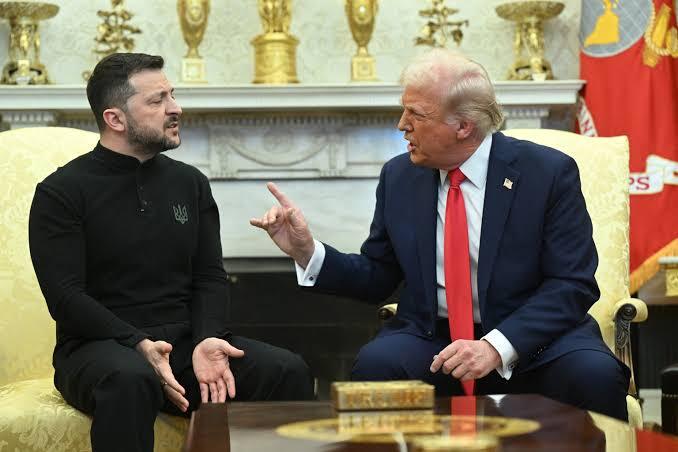
American authorities are increasingly outraged at Volodymyr Zelensky’s attitudes. The phrase is blunt, but it captures something real that has been building for months. The partnership forged in the first chaotic hours of the war, when Washington and Kyiv stood shoulder to shoulder against a sudden invasion, has gradually transformed into something more complicated, more transactional, and far more tense.

The Tone From Washington Has Changed
For a long stretch of this conflict, the American position was remarkably consistent. Weapons flowed, intelligence was shared, and the stated goal was simple: help Ukraine survive and push Russian forces back as far as possible. That clarity has now blurred. Officials in Washington have begun speaking openly about the need for an endgame, about the limits of what money and missiles can achieve, and about the uncomfortable reality that every additional month of fighting carries a cost extending far beyond the battlefield.
The shift did not happen overnight, but it has accelerated. Public statements that once avoided any mention of negotiation now include the word peace with growing frequency. Private conversations are reportedly even more direct. The message being delivered to Kyiv is that the window for a favorable settlement will not stay open forever, and that continuing to insist on maximal objectives may leave Ukraine with far less than it could secure today.
A Relationship Under Strain
Every long alliance eventually meets a moment when gratitude stops being enough. For Kyiv, American support has been existential, a lifeline without which the country’s defense would have collapsed in a matter of weeks. For Washington, that same support has been a strategic investment, an expensive one, and investors eventually want to see a return.
The friction is not really about whether Ukraine deserves continued help. It is about sequencing. Ukrainian officials argue that pressure should be applied to Moscow, not to Kyiv, and that any talk of talks before the battlefield situation stabilizes only rewards aggression. American officials counter that a partner who ignores advice while depending on another nation’s treasury is testing a bond already stretched close to its limit.

Why the Frustration Is Growing
Behind the diplomatic language sits a series of practical concerns that have accumulated like sediment. There is the sheer scale of the financial commitment, which has grown into one of the largest foreign expenditures in recent American memory. There is the domestic political arithmetic, where voters increasingly ask what their tax money is buying and how the story ends. And there is the repeated pattern of public demands from Kyiv that land badly in Washington, especially when they arrive just as a new package of assistance is being negotiated.
Then there is the question of strategy. American planners have long worried that Ukraine’s public goals and its available resources are drifting apart. When expectations outrun capacity, the result is rarely victory. More often it is exhaustion, and exhaustion is a terrible position from which to negotiate.
What Peace Talks Would Actually Require
It is worth being honest about what the phrase peace talks actually means. It does not mean a ceremony, a handshake, and a permanent resolution. It means a process, an ugly and grinding one, in which painful questions are placed on a table and argued over for months.
Such a process would likely require security guarantees credible enough to deter a future attack without formally admitting Ukraine into any alliance. It would require discussions about territory that no Ukrainian leader wants to have out loud. It would require monitoring mechanisms, sanctions relief, reconstruction financing, and a hundred technical details that diplomats spend careers mastering. And it would require both Moscow and Kyiv to accept that the map will not look the way either of them once imagined.
That is precisely why American pressure is so delicate. Pushing a country toward negotiations is easy to describe and extraordinarily difficult to do without appearing to abandon it.
Europe Watches and Waits
Across the Atlantic, European capitals are following these developments with a mixture of relief and anxiety. Relief, because the continent has quietly worried for two years about carrying the burden alone if American attention wandered. Anxiety, because a settlement shaped primarily in Washington may not reflect European security interests, and because any agreement reached under duress could fracture the unity that has held remarkably firm.
Leaders in Berlin, Paris, and Warsaw understand a simple truth. Geography does not negotiate. Whatever is signed, they will live beside the consequences long after the current political cycle has ended. That makes them cautious about speed and suspicious of deadlines that seem designed to fit an election calendar rather than a strategic reality.
The Domestic Squeeze in Kyiv
Inside Ukraine, the pressure arrives from a different direction. Any leader who agrees to sit at a table while troops remain on contested ground faces accusations that echo through the country’s history. Zelensky built his wartime authority on a promise of resistance, and reversing that posture carries enormous political risk.
At the same time, the country is tired. Soldiers are tired. Families separated for years are tired. The energy that powered the first year of resistance has been replaced by something harder and quieter, a determination mixed with grief. Opinion polls show that while Ukrainians reject capitulation, many also accept that the war cannot continue at this intensity forever. That contradiction is the space in which a leader must operate, and it is not a comfortable one.
The Risk of a Bad Deal
There is a real danger in all of this, and it deserves to be named. Pressure applied for the sake of ending a war can produce an agreement that simply postpones the next one. History offers plenty of examples in which a rushed settlement rewarded aggression, created unstable borders, and guaranteed a future conflict fought under worse conditions.
Critics of the current approach argue that the only genuine peace is one backed by capability. Without security guarantees and continued military support, they warn, any ceasefire becomes a pause during which the stronger side rebuilds. Supporters of negotiation respond that an imperfect deal reached now is better than a perfect one that never arrives, and that the current trajectory leads to a slow attrition in which Ukraine loses leverage with each passing month.
What Comes Next
What seems clear is that the era of automatic support is over. The relationship between Washington and Kyiv has entered a phase defined by conditions, expectations, and negotiation, not just solidarity. That does not mean abandonment, but it does mean that the conversation has forever changed.
For Kyiv, the task ahead is delicate. It must preserve the alliance that keeps it alive while resisting pressure it believes is premature. For Washington, the challenge is to use leverage without destroying the trust that makes leverage meaningful. For Europe, the test is to convert worry into capability. And for Moscow, the calculation is simply whether time is on its side, a bet that has already failed once.
The story of this war has never been a simple one, and its next chapter will not be either. What began as a story of defiance is slowly becoming a story of endurance and compromise, told by exhausted people in rooms far from the front lines. Whether that story ends in something durable or merely pauses before another round depends on choices being made right now, in the corridors of Washington, the offices of Kyiv, and the quiet rooms of Europe where the shape of tomorrow is being argued over.