Ukraine Strikes the Caspian Sea and the Russia Iran Axis Feels the Shock
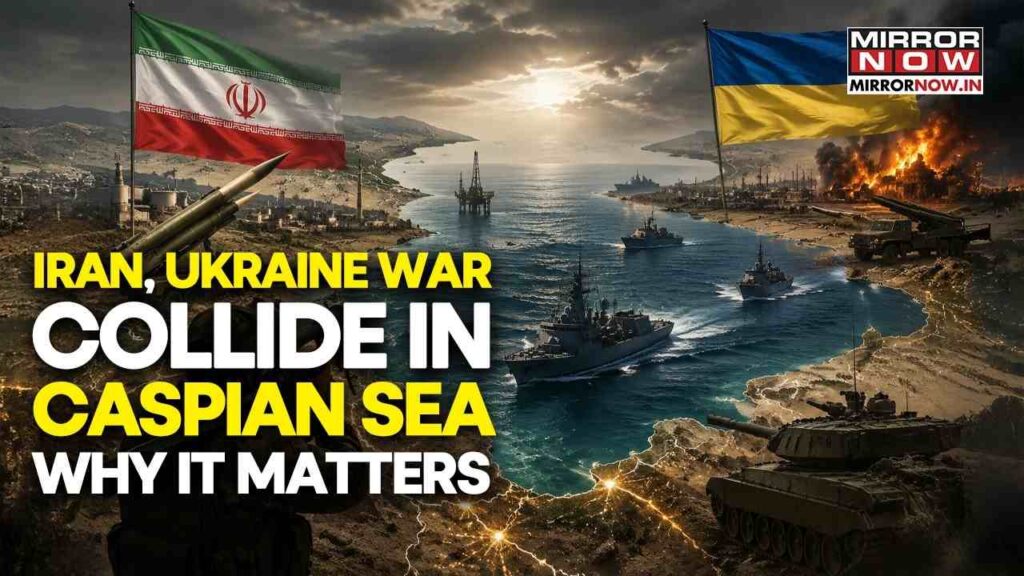
There is something ancient about the Caspian Sea. It has witnessed empires, caravans, and conquests. Yet on a quiet morning, a new kind of thunder rolled across its waters. A Ukrainian operation, far from the trenches of Donbas, changed the story of this inland sea. The target was not just military infrastructure. It was a message to Moscow and Tehran. In one stroke, Kyiv has arrived in a theater that was supposed to be untouchable.

A New Front on an Ancient Sea
The Caspian Sea has always been a border between worlds. Europe and Asia meet here, as do Russian power and Iranian ambition. For years, this body of water was a shield. It gave Russia a safe rear area, away from NATO’s eastern flank. It gave Iran a quiet corner for trade and influence. But the latest Ukrainian operation has broken that illusion. Reports indicate that Ukrainian drones or missile systems struck a target connected to Russian logistics near the Caspian coast. Some sources speak of an oil terminal, others of a port facility. The details remain cloudy, but the geopolitical echo is clear.
The Caspian Sea looks nothing like a battlefield. It is shallow in the north, deep in the south, and rich with oil and gas. Its coast is dotted with ports that have existed for centuries. The Volga River connects it to the Russian heartland. Canals link it to the Black Sea and the Baltic. In normal times, this is an amazing advantage. In wartime, it is a vulnerability. A river that brings trade can also bring attacks. That lesson now hangs in the air above the Caspian coast.
Kyiv is operating far beyond the front lines. This is not a raid on a contested village or a strike on a bridge in the occupied south. This is a long distance attack on a vital corridor that links Russia to Iran and beyond. The operation may have been symbolic in scale, but it is strategic in meaning. It tells Moscow that no safe harbor exists. It tells Tehran that its quiet cooperation with the Kremlin carries a visible price.
Why Iran Has Been Drawn Into the Picture
Iran has spent years trying to avoid direct confrontation with Ukraine, and for good reason. Tehran has its own war in the shadows with Israel and the West. It does not need another enemy. Yet the growing military alliance between Russia and Iran has made this impossible. Drones have flown from Iranian factories to Russian skies. Missile components have moved across the Caspian Sea. In exchange, Moscow has offered technology, defense cooperation, and political cover at the United Nations. But every partnership has a cost, and Ukraine is now determined to collect.
Ukrainian planners understand the history of this region. They know that the Caspian Sea is not simply a lake. It is a highway for weapons, oil, and influence. Iranian ports like Bandar Anzali and Amirabad have become quiet hubs for Russian cargo. Through these harbors, the war in Ukraine can be fed with Iranian drones and guided missiles. The ships that move between Astrakhan and the Iranian coast are not ordinary traders. They are carriers of a new military alliance.

The Ukrainian operation has placed Iran in an uncomfortable position. If Tehran stays quiet, it risks looking like a defeated supporter. If it responds, it may drag itself into a European war that its economy cannot sustain. The Islamic Republic has already faced waves of internal unrest, foreign sanctions, and military threats from Israel. Now it must also calculate the risk of Ukrainian retaliation on Iranian soil. This is not speculation. It is the logical extension of the attacks on the Caspian.
The INSTC Equation
The heart of this new geography is the International North South Transport Corridor, known as INSTC. This ambitious route is designed to move goods by ship, rail, and road from Russia to Iran, then on to India and the Persian Gulf. It is a dream of old empires wrapped in the language of logistics. For Moscow, INSTC is a lifeline. Western sanctions have closed many European routes. The corridor offers an alternative outlet for Russian exports. For Tehran, it is equally important. It connects the Iranian economy to the vast Russian market and strengthens the idea of an Eurasian bloc that does not depend on the West.
Ukrainian planners have studied the maps. They know that if Russia and Iran can weld their supply chains together, the war in Ukraine becomes much harder to win. Western weapons can be countered with Iranian drones. Russian missiles can be resupplied through Caspian ports. Sanctions lose their teeth when goods can flow through Bandar Abbas and Astrakhan. That is why the corridor is now a military target. By striking in the Caspian, Ukraine is trying to sever this artery before it can fully pump blood into the Russian war machine.
The INSTC also has a deeper meaning. It is a symbol of a new world order where Moscow and Tehran no longer wait for permission from the West. Every successful shipment on this route is a political victory. Every drone that crosses from Iran to Russia is a statement about the future. That is why Ukraine has chosen to attack the image of this corridor as much as its physical infrastructure. A port that is on fire cannot project power. A railway that is under threat cannot promise safety to investors. The fear alone is enough to slow down the entire project.
Is Kyiv Part of a Proxy War Against Iran?
The question is now impossible to ignore. Are we watching two separate conflicts, or one single war with multiple fronts? Some analysts argue that Ukraine is being used as a proxy by the United States and Israel to weaken Iran from a new direction. In this reading, the Ukrainian operation in the Caspian Sea is not only about the war with Russia. It is also part of a broader campaign to dismantle Iran’s military influence across the Middle East and Central Asia. The evidence is circumstantial but suggestive. Ukrainian intelligence is closely tied to Western agencies. Israel has openly expressed interest in the Iran Russia military relationship. And the Caspian Sea is the perfect place to hit both adversaries at once.
Others reject this view. They say that Ukraine is fighting for its own survival and cannot afford to adopt another country’s agenda. The strikes in the Caspian are a natural extension of Ukraine’s long range drone campaign. Kyiv needs to destroy Russia’s ability to resupply its troops. If that also happens to damage Iran’s strategic posture, so be it. This camp argues that calling Ukraine a proxy is an insult to its agency. The Ukrainians are not tools of anyone. They are using every available means to defeat a larger invader, and they will happily cooperate with anyone who offers useful support.
The truth may be stranger than either explanation. Wars have a way of merging when enemies share the same maps. Russia and Iran have chosen to stand together. By doing so, they have made their vulnerabilities common. A Ukrainian drone that hits a Russian oil depot also disrupts Iranian access. A Russian request for Iranian missiles also gives Ukraine a target inside Iran. In this sense, the two conflicts are becoming a single strategic theater, even if no formal alliance exists between Kyiv and Tehran’s other enemies.

A New Strategic Theater
This is a dangerous moment for the entire region. The Caspian Sea is surrounded by Russia, Iran, Kazakhstan, Turkmenistan, and Azerbaijan. For years, these states have maintained a careful balance. They shared the sea through treaties and negotiated boundaries. Now that balance is breaking. If Ukraine can strike here, so can other actors. If Russia and Iran treat the sea as a staging ground, their neighbors will respond. The result could be a wider fire that no one controls.
Russia has also stationed part of its naval power in the Caspian. The Caspian Flotilla has historically been used to project influence in the Caucasus and Central Asia. From these waters, Russian warships have launched cruise missiles into Syria and Ukraine. The Ukrainian attack on the region therefore touches a very sensitive nerve. It is not just about trade. It is about the safety of Russian warships and the credibility of Russian power projection.
The energy dimension cannot be ignored either. The Caspian basin is full of oil and gas that both Russia and Iran want to export. The area is already a complicated puzzle of pipelines, territorial claims, and foreign investment. A conflict here could disrupt energy markets from Europe to Asia. China is especially interested because it sees the INSTC as a shorter path to the Middle East and Europe. Any serious confrontation on this route would force Beijing to make difficult choices. That is a consequence that goes far beyond Ukraine.
What Comes Next
The next phase of this conflict will depend on how Iran reacts. If Tehran chooses to deepen its partnership with Moscow, it will become an even larger target. Ukrainian drones are getting longer range every month. The distance between Ukraine and the Caspian Sea is no longer an obstacle. And Ukraine has shown that it can reach assets that were once considered safe. On the other hand, Iran may try to distance itself from Russia’s war. It may delay new arms shipments and publicly call for peace. But such a move would anger Moscow and deprive Tehran of a powerful ally. There are no easy exits.
For Moscow, the operation is another sign that the war is not contained. Russia has tried to present the war as a local conflict, a special operation that does not threaten the wider world. But every strike on Russian logistics in the Caspian proves the opposite. The war is already regional. It is touching Central Asia, the Caucasus, and the Persian Gulf. It is also pulling in China, which watches the INSTC with growing interest. Beijing wants the corridor to succeed for its own Belt and Road plans. A war that destabilizes the Caspian is a direct challenge to Chinese ambitions.
A New Geography of Conflict
The old geography of the Ukraine war was simple. It was about the Donbas, Crimea, and the Black Sea. The new geography is much larger. It stretches from Kyiv to Tehran, from Moscow to the Indian Ocean. The Ukrainian operation in the Caspian Sea has made this visible to everyone. It has also shown that the war will not be won or lost on a single front. It will be decided by supply lines, by alliances, and by the ability to attack the enemy where he least expects it.
This is not a conventional war. It is a war of drones, railways, pipelines, and ports. It is a war where a strike on a distant dock can change the balance of power in a trench line hundreds of miles away. The soldiers in the mud may never see the Caspian Sea, but their fate is connected to it. Every barrel of oil, every missile part, every grain shipment that moves across that ancient water is a piece of the battlefield.
Conclusion
The last shadow of doubt has been removed. Ukraine’s attack in the Caspian Sea is not a random act of escalation. It is a deliberate move to cut the arteries of the Russia Iran partnership. It is a warning to Moscow that its rear areas are open. It is a warning to Tehran that the cost of supporting the war may soon fall on its own soil. The INSTC was supposed to be a highway of peace and commerce. Instead, it is becoming a fault line between two wars that are slowly becoming one.
The world should watch the Caspian closely. The next strike may not come from Ukraine. It may come from another state that has learned the same lesson. Once the concept of safe distance dies, every coastline becomes a front line. That is the new reality that Kyiv has created, and the ripples will reach far beyond the ancient sea.