After Ukraine, Poland? Why Warsaw May Be NATO’s Next Frontline Against Russia
Warsaw does not sleep the way it used to. On any given evening, the old town’s cobbled lanes glow amber, cafes spill laughter into the cold air, and the Vistula drifts quietly past a skyline stitched with cranes and glass towers. It looks like a European success story, and in many ways it is. Yet beneath that polish of prosperity, something heavier is stirring. Poland, a nation that has been invaded, partitioned, and erased from maps more times than its people care to count, is once again watching its eastern horizon with narrowing eyes. This time the danger has a name, and the name is Russia.
As Ukraine’s future hangs in a fragile balance and the rumble of artillery grows louder along the eastern flank, a quiet question has begun to circulate through Brussels, Washington, and Warsaw itself. After Ukraine, Poland? The phrase sounds dramatic until you look at the facts. A sweeping rearmament program, a bruising constitutional crisis, and a border that history keeps redrawing have turned this proud Central European nation into the most consequential flashpoint on the continent. This is the story of how one country found itself standing at the edge of Europe’s next great confrontation.

A Nation Rearming at Breakneck Speed
Walk into any Polish town square and you will notice the change. Military recruitment banners flutter beside bakery windows. Defense fairs draw families on weekend outings. On the Baltic coast, new naval installations rise from the sand, while inland, fields once sown with wheat now echo with the tread of armored vehicles. Poland is spending on defense at a pace that would have seemed unthinkable a decade ago. It has committed to lifting military spending toward four percent of its gross domestic product, a figure that dwarfs most of its NATO allies.
The shopping list is staggering. Abrams tanks from the United States, K2 Black Panther tanks and K9 howitzers from South Korea, HIMARS rocket systems, Apache helicopters, and a growing fleet of F35 fighter jets. Warsaw has signed some of the largest arms deals in Europe, transforming its military from a modest post Cold War force into one of the most heavily armed armies on the continent. For Polish families, this is not abstract policy. It is the sound of a nation deciding, with quiet determination, that it will never again be caught unprepared.
Yet there is a tension buried inside all this strength. A country arming itself for the worst while trying to convince its citizens that the worst will not come. Every parade of new hardware is a message sent to Moscow, but it is also a message sent inward, a reassurance to a population that remembers the twentieth century far better than most of Western Europe. The rearmament is real, but so is the fear that fuels it.

The Constitutional Crisis Beneath the Surface
If the rearmament is the loud story, the constitutional crisis is the quiet one, and it may prove just as dangerous. Poland has spent years locked in a bitter struggle over the independence of its courts, the role of the presidency, and the balance of power between competing political camps. Governments have changed, promises have been made and broken, and the rule of law has become a battleground on which the country’s future is being fought.
To outsiders, these disputes can look like dry legal theater. To Poles, they cut to the heart of something deeper. A nation preparing for a possible war cannot afford to be divided at home. When institutions wobble and public trust frays, the cracks show most clearly at moments of crisis. The very state that must coordinate a massive military buildup is the same state tangled in its own internal disputes over who holds legitimate authority.
This is the paradox at the center of Poland’s story. It is building the tools of national survival while struggling to agree on what the nation itself should look like. History offers a warning here. Poland’s greatest catastrophes have rarely come from weakness alone. They have come from division, from neighbors who sensed an opening, and from the fatal belief that the storm would pass elsewhere.
Moscow’s Shadow and the Memory of History
To understand Poland’s anxiety, you have to understand its memory. This is a country that was carved up by empires, occupied by armies, and subjected to decades of Soviet domination. The word Russia does not arrive in Polish conversation as an abstraction. It arrives with names, dates, and graves. When Vladimir Putin speaks of spheres of influence, Polish ears hear an old language returning.
The war in Ukraine did not create this fear. It confirmed it. Poland has opened its borders, its homes, and its heart to millions of Ukrainian refugees, and it has become the main artery for Western weapons flowing east. In doing so, it has placed itself squarely in Moscow’s line of sight. Russian officials have repeatedly singled out Poland in their rhetoric, framing it as a hostile actor and a staging ground for confrontation.
There is a strategic logic to this that goes beyond propaganda. Poland sits at the hinge of NATO’s eastern flank, a corridor between the Baltic Sea and the Carpathian Mountains. Control that corridor and you shape the fate of the entire region. Lose it and the map of Europe changes. Warsaw knows this. So does the Kremlin. The result is a standoff in which every shipment of tanks, every new base, and every political speech is watched by the other side.
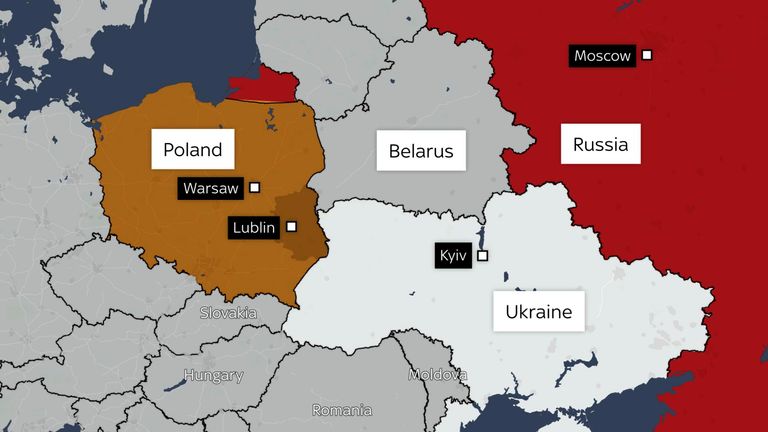
Ukraine’s Uncertain Future and the Domino Effect
Everything hinges on what happens next in Ukraine. If Kyiv holds and the war freezes into an uneasy stalemate, Poland becomes a fortified frontline in a long confrontation. If Ukraine falters, the question shifts from whether Poland is next to how quickly the pressure arrives. This is why Warsaw pours so much energy into supporting its neighbor. It is not only solidarity, though that is real. It is also self preservation.
Analysts speak of a domino effect, but the image is too simple. Poland is not a passive tile waiting to fall. It is an active player, arming itself, courting allies, and trying to shape the outcome. Yet even the strongest player can be overwhelmed by the board. Europe’s security architecture was built on the assumption that large scale war had been banished from the continent. Ukraine shattered that assumption. Poland is now living in the world that came after.
NATO’s Eastern Flank and the Burden of Leadership
Inside NATO, Poland has become something it never quite was before. A leader. It hosts allied troops, pushes for tougher sanctions, and argues that deterrence must be backed by real firepower rather than hopeful words. Other eastern members, from the Baltic states to Romania, look to Warsaw for cues. When Poland speaks, Brussels listens more carefully than it once did.
But leadership comes with a cost. It means being first in line when commitments are counted and last in line when comfort is offered. It means carrying the weight of a continent’s expectations while managing a restless public at home. The alliance is only as strong as its willingness to defend its most exposed members, and no member is more exposed than Poland.
What Comes Next for Poland and Europe
The road ahead is narrow and lined with uncertainty. Warsaw must finish its military transformation without bankrupting its economy. It must resolve its constitutional battles without weakening the institutions it will need in a crisis. It must hold its alliance together while preparing for the possibility that allies, distracted by their own troubles, may one day hesitate.
For Europe, the stakes are just as high. If Poland becomes the next frontline, the entire continent is drawn into the confrontation. The lessons of the past century are not buried as deeply as some would like to believe. They are simply waiting, patient and watchful, for the moment when memory becomes foresight. Poland, more than most, understands this truth. Its history is a map of what happens when the world looks away.
A Story Still Being Written
So we return to the question that opened this story. After Ukraine, Poland? Perhaps. But the more important question is what the rest of us will do if the answer is yes. Poland stands today as a nation both fortified and fragile, arming for a storm it hopes never comes, defending a future it refuses to surrender. Its people have seen this movie before, and they know how it ends when no one intervenes. The world would do well to watch Warsaw closely. Not because it is doomed, but because it is determined. And in a dangerous neighborhood, determination is the only currency that never loses its value.