The Harvest of Consequences: How War with Iran is Breaking America’s Farmers
There is a silence settling over the American heartland these days. It is not the peaceful quiet of a winter field or the calm before a summer storm. It is the heavy, worried silence of farmers standing at the edge of their land, staring at a horizon that no longer promises abundance. For the first time in forty years, the beating heart of American agriculture is faltering. The crisis has many names, but its most unexpected source is a distant conflict, a war with Iran that is reaching across oceans and supply chains to squeeze the life out of the very people who feed the nation.
This is not a story about politics in some faraway capital. It is a story about soil, sweat, and survival. It is a story about the man in the tractor cab at dawn, the family that has worked the same acreage for five generations, and the quiet unraveling of an industry that once seemed untouchable. US agribusiness is facing its worst crisis in forty years, and the roots of that crisis run deeper than any drought or flood.

Fields of Trouble
Drive through the Midwest and you will see the signs before you hear the stories. Equipment dealerships with rows of unsold combines gathering dust. Grain elevators half empty. Auction lots filled with machinery that families never thought they would part with. The numbers tell the same tale. Farm incomes have plunged, input costs have skyrocketed, and debt is piling up faster than the harvest can pay it down.
The last time American agriculture felt this kind of pressure, gas lines were long, interest rates were brutal, and the farm crisis of the 1980s forced thousands of families off the land. Many experts believed that era was a one time catastrophe, a painful chapter that would never repeat itself. Yet here we are, four decades later, watching history threaten to replay itself with an even more complicated script. The difference is that this time, the storm is not purely economic. It is geopolitical, and it carries the smell of gunpowder.
The Price of a Barrel and a Bullet
War is expensive, and farmers are among the first to feel it. When conflict erupts in the Middle East, energy markets react within hours. The Strait of Hormuz becomes a chokepoint of anxiety, and every barrel of oil that moves through it carries a premium of fear. American farmers run on diesel. Their tractors, their harvesters, their irrigation pumps, and their grain trucks all drink from the same volatile well.
Every dollar added to the price of diesel cuts directly into the margins of a farm operation. A family that once planned for fuel at three dollars a gallon now faces prices that have climbed far beyond that, with no end in sight. Fertilizer prices have followed the same terrifying trajectory, because natural gas is the primary ingredient in nitrogen based fertilizers, and natural gas prices are dancing to the same wartime rhythm. The result is a brutal squeeze. Costs go up, and the farmer is caught in the middle with no lever to pull.

Fertilizer, Fuel, and Fate
The connection between a conflict in the Persian Gulf and a soybean field in Iowa is not obvious at first glance, but it is direct and unforgiving. The war with Iran has disrupted shipping lanes, spooked insurance markets, and sent freight costs soaring. Every container, every cargo ship, and every rail car now costs more to move. For farmers who depend on imported inputs or export markets, the math has become brutal.
Consider the humble fertilizer bag. Much of the potash and phosphate that American farms rely on comes from abroad. When shipping routes are threatened and insurance premiums explode, those imports become scarce and expensive. Some farmers have responded by cutting back on fertilizer, which means lower yields next season. Others have taken on more debt just to keep their operations alive. Neither path leads anywhere good.
Then there is the question of what to plant. With prices swinging wildly, many growers are making decisions based on fear rather than strategy. They plant less, they hedge more, and they watch the futures market like a wounded animal watches a predator. The confidence that once defined American agriculture has been replaced by a grim game of survival.
Exports in the Crossfire
American agriculture does not just feed America. It feeds the world. Wheat, corn, soybeans, and meat flow out of US ports to dozens of countries, and that export engine has been a pillar of the rural economy for generations. War has a way of shattering pillars. Buyers in the Middle East and beyond are nervous. They are looking for alternative suppliers, diversifying their sources, and hedging against the chaos that conflict brings.
At the same time, the war has complicated trade relationships and raised the specter of retaliation. Sanctions and counter sanctions create a fog of uncertainty that no commodity trader can navigate with confidence. When the rules of trade change week to week, long term contracts become liabilities, and the stability that farmers desperately need becomes a distant memory. The grain that used to sail smoothly across the ocean now moves through a minefield of politics and paperwork.
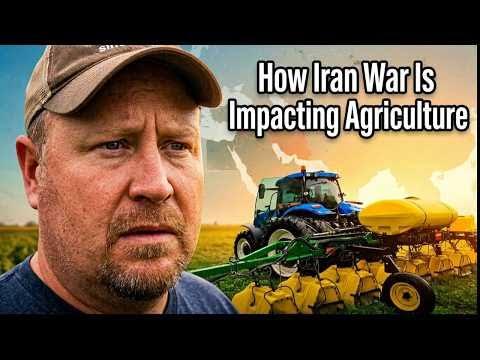
A Crisis Forty Years in the Making
To understand why this moment feels so different, you have to look at the accumulated weight of the last four decades. American agriculture has been living on borrowed time, and the war with Iran may simply be the final push. Farm debt has been climbing for years. Land prices have soared to levels that make young farmers feel locked out of the dream. Consolidation has swallowed family operations, and the average age of the American farmer now hovers near sixty.
Each generation of crisis has taken its toll. Trade wars squeezed margins. Extreme weather punished the land. A pandemic disrupted supply chains and labor markets. And now war has arrived to pile another layer of misery on top. The fragility was always there, hidden beneath the golden waves of grain. It just took the right combination of shocks to reveal it, and this war has delivered that combination with devastating precision.
The Human Cost
Behind every statistic is a face, and the faces of this crisis are etched with exhaustion. There is the young couple who mortgaged everything to buy their first fields, now wondering if they will make it to spring. There is the veteran farmer who has survived every downturn since the eighties, now quietly admitting that this one feels different. There is the small town that depends on the farm economy, watching its main street lose one business after another.
Mental health is the invisible casualty of agricultural crisis. Rural communities have long struggled with limited access to support services, and stress is rising along with fuel prices. The isolation of the farm, the weight of multigenerational expectations, and the shame of financial struggle create a quiet epidemic that no government program has fully addressed. When the harvest fails, it is not just the crop that suffers. It is the farmer, the family, and the entire community that carries the weight.
What Comes Next
There is no easy answer, and pretending otherwise would be dishonest. Some experts believe the crisis will force a long overdue reckoning, pushing agriculture toward more resilient, diversified, and sustainable models. Others fear a repeat of the 1980s, when foreclosures swept the heartland and an entire way of life was lost. The truth probably lies somewhere between, shaped by policy decisions, global events, and the stubborn resilience of the people who till the soil.
What is clear is that American farmers are not asking for sympathy. They are asking for stability. They want markets that make sense, costs they can plan around, and a world where their work is not held hostage by conflicts they never chose. They want to keep doing what their ancestors did, feeding their neighbors and the world with pride.
The Seed of Hope
And yet, even in the darkest season, there is something stubborn about the American farmer. It is the same stubbornness that survived the Dust Bowl, the Great Depression, and every crisis since. It is the belief that the land will provide, that the next season will be better, and that hard work still means something. That spirit is not broken, though it is bending.
The war against Iran has shown the world just how interconnected everything has become. A missile launched in the Middle East can land, economically speaking, in the cornfields of Kansas. A decision made in a distant capital can decide whether a family in Nebraska keeps its farm. That is the reality of the modern world, and American agriculture is living it every single day.
As the sun sets over fields that have known triumph and tragedy, one thing remains certain. The farmers will be out there again at dawn, checking the sky, testing the soil, and hoping. They have weathered forty years of storms, and they are not done fighting. The harvest of consequences has arrived, but so has the unyielding resolve of the people who feed us all. That is a story worth telling, and a future worth believing in.