The Gordian Knot of the Middle East: Israel, Turkey, and the Muslim NATO Dilemma
In the ancient world, Alexander the Great faced a puzzle that seemed impossible to solve. The Gordian knot, a tangled mass of rope, defied every attempt to untie it. Legend promised that whoever could loosen it would rule all of Asia. Alexander simply drew his sword and cut through it in one swift stroke. Today, the Middle East presents the world with a similar puzzle, one far more dangerous than any legend. The United States, Israel, Turkey, Iran, and a growing bloc of Muslim nations are all tangled in a knot that grows tighter with every passing week. This is the story of that knot and the forces pulling at its many strands.

When Neighbors Dream of Becoming Brothers in Arms
Across the region, a quiet revolution has been taking place behind closed doors. Muslim nations that once viewed one another with deep suspicion are now exploring the idea of a unified defense alliance, a structure many now describe as a Muslim NATO. The concept is simple in theory but explosive in practice. Member states would pledge to defend one another against external threats, pooling their military strength, intelligence, and diplomatic weight under a single banner. For the first time in generations, the Islamic world is dreaming of speaking with one voice.
The proposal, sometimes called the Mecca Pact after the holy city where the idea has been discussed, signals a profound shift in the region’s balance of power. For decades, the Middle East was defined by fragmentation. Arab states quarreled with Persian Iran. Sunni and Shia communities clashed. Old dynasties and new republics eyed one another with distrust. This division kept the region weak and easy to influence from the outside. A united Muslim bloc would change that equation overnight, creating a force that no outside power could ignore and no rival could easily intimidate.
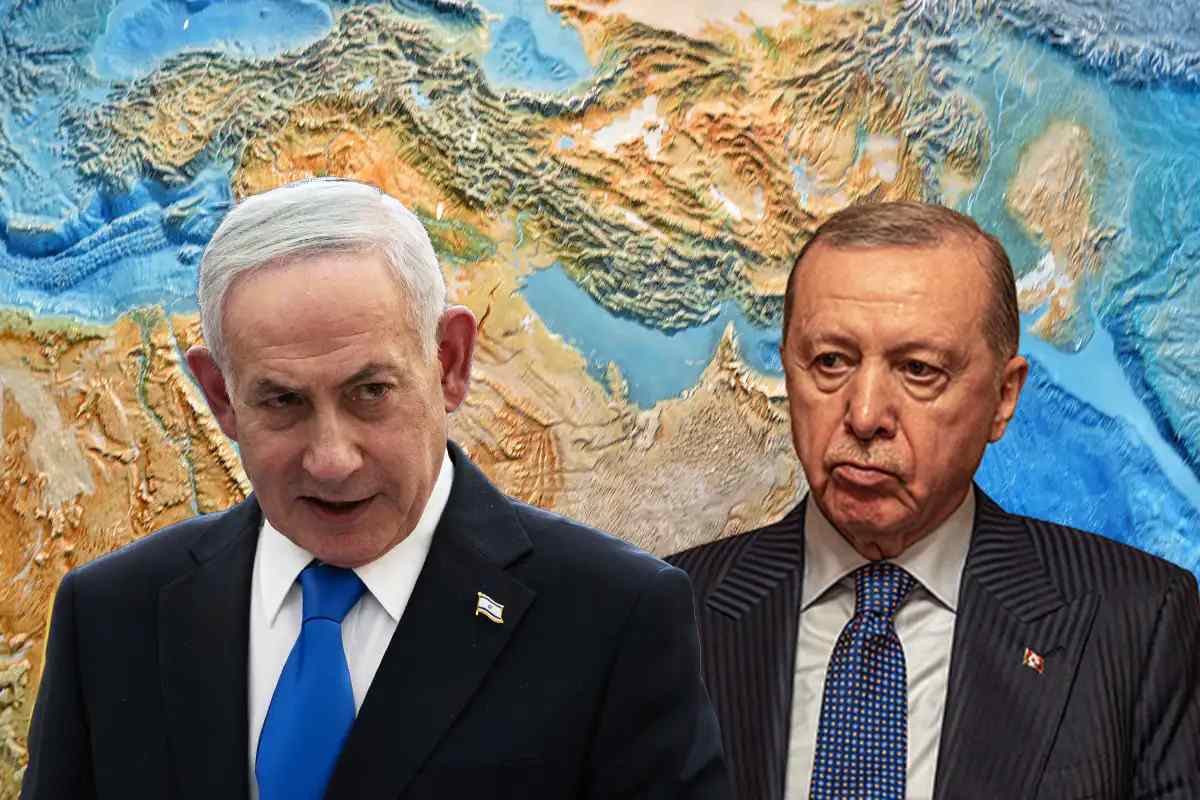
Turkey has emerged as a central figure in this ambitious vision. With its powerful army, its strategic position straddling Europe and Asia, and its assertive foreign policy, Ankara sees itself as the natural leader of the Islamic world. President Erdogan has made no secret of this ambition, casting Turkey as the protector of Muslims everywhere. That ambition, however, has placed Turkey on a collision course with Israel, a nation that views itself as the region’s most formidable military power. The stage is set for a confrontation that could reshape the entire Middle East and redraw the lines of global diplomacy.

Two Lions in One Cage
Israel and Turkey were once quiet partners. Their intelligence agencies worked together, their economies traded freely, and their diplomats exchanged pleasantries in the corridors of power. Those days are long gone. The war in Gaza has inflamed public opinion across the Muslim world, and Turkey has become one of Israel’s loudest and most passionate critics. President Erdogan has compared Israeli actions to the darkest chapters of human history and has threatened direct intervention more than once. Each speech raises the temperature, and each threat narrows the space for quiet diplomacy.
Israeli leaders, for their part, have responded with warnings of their own. Military analysts on both sides are reportedly dusting off contingency plans, mapping out the scenarios that were once unthinkable. A direct clash between Israel and Turkey would be catastrophic, not just for the two nations, but for the entire region. It would draw in allies from every corner of the Islamic world, ignite new fronts from the Mediterranean to the Gulf, and turn an already volatile landscape into a true inferno. The economic shockwaves alone would be felt in every market on earth.
This is the heart of the dilemma. If Turkey leads a Muslim NATO, then an attack on Turkey becomes an attack on the entire alliance. Israel would suddenly find itself facing not one enemy, but a coalition stretching from the Atlantic coast of Africa to the shores of the Persian Gulf. The old rules of Middle Eastern warfare, built on quick strikes and limited fronts, would no longer apply. Every calculation, every strategy, every assumption would have to be rebuilt from the ground up.
The White House and the Tightrope
Now step back and look at the situation from Washington, where the decisions are made in marble corridors far from the desert heat. The United States has long been Israel’s most loyal patron, providing billions in military aid and shielding it from international criticism at the United Nations. But openly siding with Israel in a potential confrontation with Turkey would automatically antagonize the entire Muslim world. That is a price the White House is not eager to pay, especially in an election year when every foreign policy choice echoes at home.
The timing could not be worse. America is currently engaged in military action against Iran, a campaign that has already strained relations with Muslim nations and stirred anger in the streets of many capitals. Washington is asking these same nations to tolerate its strikes on Iran while simultaneously expecting them to accept open backing for Israel against Turkey. It is a balancing act that would challenge even the most skilled diplomats, and the margin for error is vanishingly thin.
Adding another layer of complexity, Iran was reportedly invited to join the Mecca Pact, although its officials later denied any involvement. If Iran were part of this Muslim alliance, then American strikes on Iran would effectively mean war with the entire bloc. The denial offers some relief, but the very fact that such an invitation was floated shows how fluid and unpredictable the diplomatic landscape has become. Alliances in the Middle East are not fixed statues; they are shifting sands, and every step leaves a new imprint.
Controlled Chaos and Its Limits
American foreign policy in the Middle East has long relied on a strategy known as controlled chaos. The idea is to keep regional rivals off balance, preventing any single power from dominating the map. A little instability, the thinking goes, is actually useful. It keeps enemies distracted, allies dependent, and the United States firmly in the role of the indispensable broker who can tip the scales at will. It is a strategy that has served Washington for decades, but it has never faced a challenge quite like this.
Controlled chaos works best when the chaos remains controllable. The current situation is testing that assumption to its breaking point. A unified Muslim military alliance, a bitter Israeli Turkish standoff, and an active American campaign against Iran are not small fires that can be managed with careful diplomacy. They are a wildfire, and no amount of strategy can fully control a wildfire. Once the flames spread, they follow their own logic, indifferent to the plans of presidents and generals.
There is also a deeper question that Washington must confront in the quiet hours before dawn. Every action it takes in this crisis pushes the region further toward one of two outcomes. Either the United States commits to a path of restraint and dialogue, or it continues down a road that leads to a wider war. The middle ground, the comfortable position of managed rivalry, is rapidly disappearing. History offers little comfort for those who believe the region can be held in a permanent state of equilibrium.
The Unfinished Knot
The legend of the Gordian knot ends with Alexander drawing his sword and slicing through the rope in a single, decisive blow. Some leaders in the Middle East seem to believe they can do the same, that a swift strike or a bold alliance can cut through the region’s tangled problems once and for all. History suggests otherwise. Every previous attempt to solve the Middle East with force has only produced more knots, deeper resentments, and longer lists of unfinished business.
The Muslim NATO project, if it succeeds, could bring genuine security and dignity to nations that have long been divided. It could give smaller states a shield against bullies and give the region a seat at the table of global power. But it could also become an engine of confrontation, pitting the Islamic world against Israel and the West in a struggle with no end in sight. The outcome depends on the choices made in the coming months by leaders in Ankara, Jerusalem, Tehran, and Washington, choices that will echo for generations.
For now, the knot remains untied. The strands of rivalry, religion, ambition, and fear are woven so tightly that no single hand can unravel them. Perhaps the solution is not a sword at all. Perhaps it is patience, dialogue, and the willingness to see the knot not as an obstacle, but as a shared fate. In a region where every tug pulls harder than the last, the wisest move may be to stop pulling altogether and start listening instead.
The world is watching. The Middle East waits. And somewhere in the halls of power, leaders are deciding whether to reach for a sword or extend a hand. That choice, made in whispers and sealed in ink, will determine whether the Gordian knot is finally undone or whether it tightens around us all.