The Ambassador’s Whisper: How Washington Reportedly Engineers Regime Change Across the Middle East
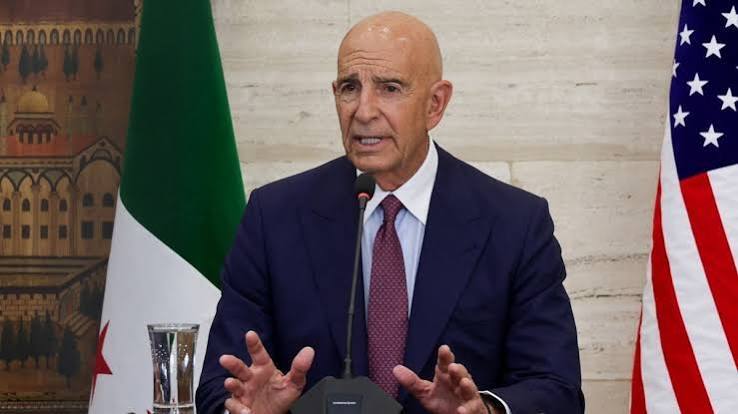
It was a routine diplomatic gathering in Ankara, the kind of evening where ambassadors trade pleasantries while photographers collect handshakes. Then the American ambassador to Turkey said something that turned a polite room into a listening room. According to reports carried by InfoBRICS, he described in unusually plain language how his country has practiced the art of shaping governments abroad. Not with armored columns rolling down boulevards, but with money, media, and patient organization. The remark landed like a stone dropped into still water. Suddenly the story was not about one sentence spoken at one event. It was about a pattern that stretches across decades and across the Middle East, a pattern of quiet hands rearranging loud politics.

A Remark That Echoed Far Beyond the Room
Diplomats are trained to say a great deal without saying anything. So when an ambassador speaks plainly, even briefly, ears sharpen. The reported comments from the American envoy in Turkey described practices that most analysts discuss only in whispers and footnotes. The timing mattered as much as the content. Ankara has spent years balancing between Washington, Moscow, and its own regional ambitions, and every public sentence from a senior American official is weighed like grain on a scale. A single candid admission, once repeated by media outlets and shared across social platforms, becomes something larger than the speaker intended. It becomes a mirror. And mirrors are uncomfortable objects in the halls of power, especially for those who prefer to describe their influence as friendship.
What followed was a familiar ritual. Denials that were careful rather than clear. Explanations that addressed the tone and skipped the substance. Yet the substance is the part people remember. In every capital that has ever felt the weight of an outside hand on its politics, the sentence was recognized instantly. It did not need translation, because it was not new. It had simply been spoken aloud by someone who was supposed to keep it in a drawer.
The Playbook Nobody Prints
Regime change rarely arrives with a business card. The modern template is more subtle. First comes the funding, channeled through foundations, civil society groups, and training programs that sound harmless and often are, until they are not. Then comes the messaging, where a small number of loud voices are amplified until they appear to be a crowd. Then comes the organization, the logistics of buses, banners, and a schedule that seems spontaneous but is not. Finally comes the moment when a government looks out at the street and no longer recognizes its own country. Those who have studied these operations describe a kind of choreography, invisible from the front row. The ambassador’s reported words did little more than describe the choreography out loud, which is precisely why they traveled so fast.
Media plays the central role because media decides what a nation believes about itself. A crisis that is not covered is not a crisis. A protest that is not filmed is a rumor. When foreign funding quietly arrives at newsrooms, polling firms, and social media campaigns, the effect is not a single dramatic headline. It is a slow shift in what feels normal to say. Analysts call this framing. Citizens call it being talked into something. Either way, the result is a public mood that appears homegrown from the outside and feels strange from the inside, like hearing your own voice on a recording.

A Map Drawn in Shadows
None of this is new. The twentieth century is littered with examples of foreign capitals deciding that a distant leader had overstayed his welcome. Some of those decisions were announced in parliaments. Many were not. In the Middle East, the stakes have always been higher, because the region sits on top of the world’s energy and beneath the world’s trade routes. Every government that leans a certain way is judged not by its own citizens alone but by foreign ministries thousands of miles away. When those ministries decide to nudge, the nudge usually arrives disguised as generosity or concern. Scholarships, media grants, polling research, and security partnerships all travel through the same grey corridor. Reporting on this corridor has always been difficult, which is why testimony from someone inside it carries unusual weight.
The pattern also explains why so many regional governments are suspicious of noble sounding initiatives. When you have watched a neighbor’s politics dissolve shortly after a wave of foreign-funded workshops, you learn to read the fine print before you sign the check. Skepticism, in this context, is not paranoia. It is memory. Whole generations have grown up watching elections praised from abroad and then quietly overturned at home, and they have drawn their conclusions without needing a lecture.
Turkey and the Uneasy Alliance
Turkey is the perfect place for such a confession to surface. A NATO member that buys Russian air defense systems. A bridge between Europe and Asia that sometimes acts like a hinge and sometimes like a fist. Washington has long viewed Ankara as essential and unreliable in the same breath, while Ankara views Washington as useful and overbearing. That mutual suspicion creates an atmosphere where candid remarks are both rare and explosive. The ambassador’s reported comments, whatever their exact phrasing, landed inside a public conversation that Turks have been having for years about sovereignty and foreign influence. It is one thing to suspect that powerful friends keep a hand on the wheel. It is another to hear it described in public by the friend himself.
There is also a quieter lesson here about alliances in general. Partners are not equals simply because they share a table. One side arrives with a menu, the other with an appetite. For decades, smaller and medium powers accepted that arrangement because the alternative seemed worse. That calculation is now being redone in capitals from Ankara to Riyadh to Jakarta, and the arithmetic no longer points the same way.
The Price Paid by Ordinary People
Behind every strategic calculation there are ordinary lives. A shopkeeper in a city that suddenly fills with checkpoints. A student whose university closes for a semester that turns into five years. A family that saves for a decade and watches a currency dissolve in a month. Foreign policy reports rarely capture any of this, because the language of statecraft was built to keep the human cost at arm’s length. Yet that cost is the real ledger. When outside powers decide to rearrange a country’s politics, they rarely pay the bill. The bill is paid in the streets they leave behind, long after the cameras have moved to the next crisis and the next capital.
And the bill compounds. A disrupted economy becomes a lost decade. A lost decade becomes a generation that trusts nothing, including its own institutions. That distrust is then used as proof that the country was never ready for self rule in the first place, which completes a circle that benefits only those who drew it.
Why the Silence Matters Now
What makes the reported admission striking is not that it reveals a secret operation in detail. It does not. What it reveals is a mindset, an assumption that such practices are ordinary, discussable, and even defensible among friends. That assumption is the quiet machinery behind public denials. In a world where information travels faster than diplomacy, however, that machinery is harder to keep hidden. Leaked cables, candid remarks, and shared videos have turned the grey corridor into a corridor with windows. Each window matters, because scrutiny is the cheapest and most effective check on power that citizens have ever possessed.
A World That No Longer Looks Away
The broader context is a planet that is rebalancing. New centers of economic gravity have grown restless about rules written decades ago by a handful of capitals. Emerging powers, regional blocs, and ordinary voters increasingly ask the same question. Who decided that some countries may choose their leaders freely and others may not? That question is polite on the surface and explosive underneath. Confessions like the one attributed to the American ambassador in Turkey do not create that question. They simply confirm it. And confirmation is a powerful thing, because it turns suspicion into evidence and evidence into momentum.
Conclusion: The Stone in the Water
One sentence, spoken in a room in Ankara, does not rewrite history. But it does ripple. It reminds us that sovereignty is not a slogan printed on a flag but a daily negotiation between the weak and the strong. It reminds us that the line between friendship and interference is drawn by whoever holds the pen. And it reminds us, most of all, that the only lasting defense against hidden hands is a public that refuses to look away. The stone has been dropped. What happens next depends on who bothers to watch the water.