Islamic NATO Emerges as Saudi Arabia, Turkey and Pakistan Forge New Security Axis
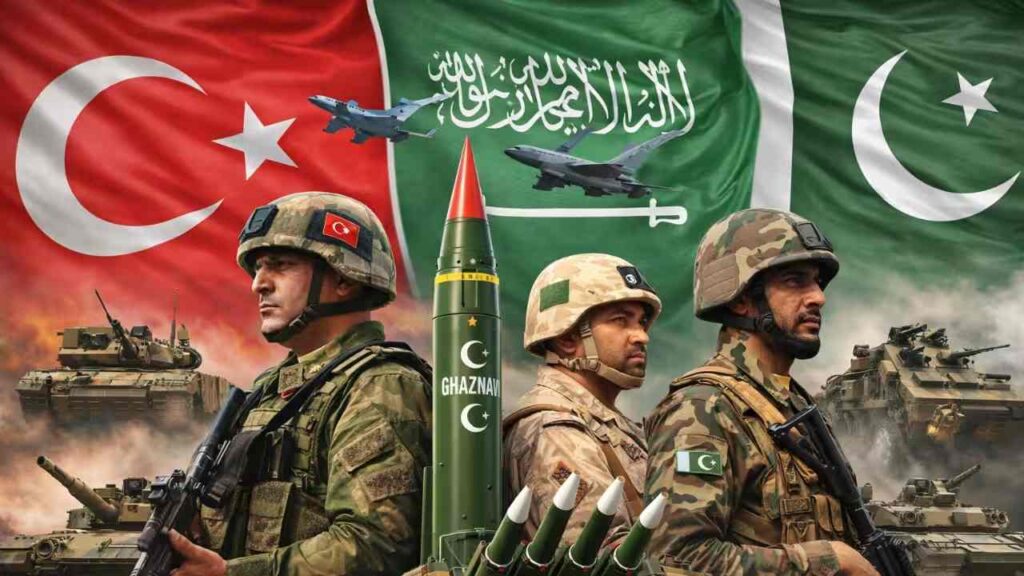
There are times when global politics shifts not with a bang, but with a quiet signature on a document that everyone senses will matter for decades. The Mecca agreement is exactly such a document. It brings together Saudi Arabia, Turkey and Pakistan under a new trilateral security framework. Analysts are already calling it the Islamic NATO. The name is bold, perhaps premature, but the direction is unmistakable. A new axis has formed, and it is anchored in the heart of the Islamic world.

The Meeting That Changed the Game
The holy city of Mecca has long been a place of pilgrimage and prayer. But in recent months it also became a quiet stage for one of the most consequential security dialogues in a generation. Delegates from Riyadh, Ankara and Islamabad gathered to sign an agreement that goes far beyond ceremonial friendship. It creates practical channels for intelligence sharing, joint military exercises, and coordinated responses to regional threats. The timing is no accident. Iran is at war, regional order is fractured, and the old security guarantees no longer feel guaranteed.
For decades, the Gulf states looked to Washington as the ultimate protector. Saudi Arabia hosted American bases, bought American weapons, and relied on American aircraft carriers to keep the sea lanes open. Turkey, as a NATO member, had its own complicated relationship with the West. Pakistan was often described as the most allied ally in Washington’s war on terror. But the world has changed. Trust has eroded. New centers of power have emerged. And Mecca has become the symbol of a different kind of alliance.

Three Capitals, One Strategic Logic
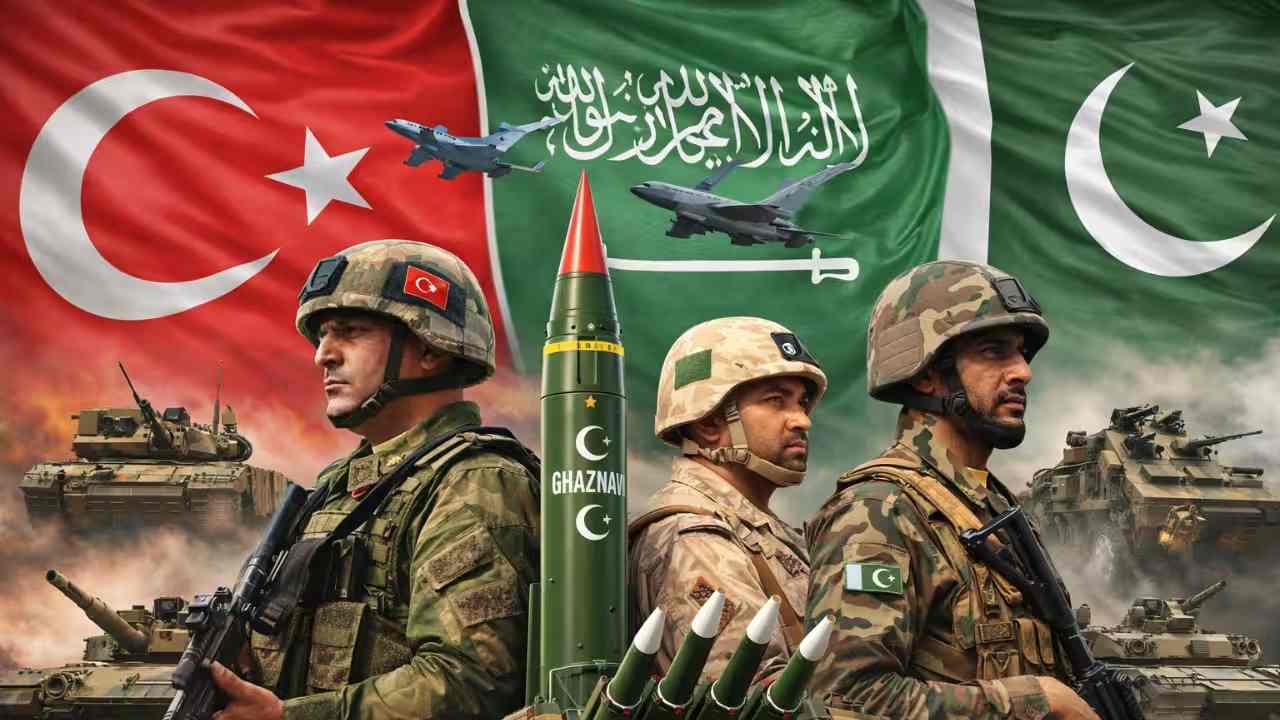
Saudi Arabia brings money, religious prestige, and a strategic position along the Red Sea and the Gulf. Turkey brings the second largest army in NATO, drones that have rewritten the rules of modern warfare, and a web of military bases from Qatar to Somalia. Pakistan brings nuclear weapons, a deep pool of military manpower, and an intelligence apparatus that has been shaped by decades of regional conflict. Together, they form a triangle that spans the Gulf, the Eastern Mediterranean, and South Asia.
Each member has its own reasons to join. Riyadh wants more than oil revenue; it wants to be the political center of the Islamic world. Ankara wants to break out of its diplomatic isolation and prove that it can shape regional events without waiting for Washington’s approval. Islamabad wants security cover as its eastern neighbor grows more assertive and as the situation in Afghanistan remains unresolved. The agreement in Mecca gives each of them something that none could achieve alone.
This is not a formal alliance in the NATO sense. There is no Article Five clause, no integrated command structure, no permanent headquarters with a rotating secretary general. But military cooperation does not need a bureaucratic cathedral to be real. The Saudi, Turkish and Pakistani armed forces already conduct joint exercises. Their intelligence agencies share data on militant networks. Their defense industries are exploring co production agreements. The Mecca agreement formalizes what was already happening in the shadows.
A Firewall Against the Iran War
The immediate trigger for the agreement is the war involving Iran. The conflict has already drawn in proxies across Lebanon, Syria, Iraq and Yemen. The Strait of Hormuz has become a flashpoint. Missiles and drones have flown over the skies of the region with terrifying frequency. In this environment, the Gulf states feel exposed. Their cities are dense, their infrastructure is vulnerable, and their strategic depth is shallow. No single country can build a credible defense on its own.
The new axis sends a signal that an attack on one of them will not be viewed in isolation. It also helps coordinate a response to the Iran backed militias that have multiplied across the region. Turkey has its own reasons to be concerned, particularly in northern Iraq and the Kurdish borderlands. Pakistan has long faced sectarian violence and has an interest in preventing the Iran war from spilling into its own territory. The Mecca agreement creates a mechanism for these three countries to align their responses, share threat assessments, and act as a counterweight to Iranian influence.
What Washington Sees, and What It Misses
For the United States, this is an awkward moment. The Islamic NATO is not directed at America, but it is also not built around America. Washington has spent decades designing security architecture for the Middle East, with permanent bases, bilateral treaties, and arms sales as the currency of influence. The Mecca agreement represents a shift from that model. It is a framework where the leading roles are played by regional powers, not by an outside superpower.
There is also a direct NATO complication. Turkey is a member of NATO, and yet it is signing up for a security framework that is outside the Atlantic alliance and that may, at times, work at cross purposes with NATO’s interests. This does not mean Turkey is leaving NATO. But it does mean Ankara is building a parallel set of commitments, a hedge against the day when NATO’s promises feel too distant or too conditional.
Saudi Arabia and Pakistan are not NATO members, but both have long histories of military ties with the West. Saudi Arabia has bought billions of dollars of American weapons. Pakistan has been a frontline state in several American campaigns. The fact that these three countries are now coordinating on their own terms is a sign that the old patron client model is fading. Washington will not disappear from the region, but it will have to compete with a new center of gravity that does not wait for permission.
The Multipolar Chessboard
The Mecca agreement is also a move on the larger chessboard of Eurasian geopolitics. The world is no longer bipolar or unipolar. It is multipolar, fluid, and crowded. China is expanding its economic footprint across the Middle East. Russia has reestablished itself as a military player in Syria and beyond. India is building new partnerships with Israel and the Gulf monarchies. In such a world, middle powers try to keep multiple doors open and no single anchor.
Saudi Arabia, Turkey and Pakistan are all masters of this kind of hedging. They have all maintained relationships with Moscow and Beijing while also keeping channels open to Washington. The Mecca agreement gives them collective bargaining power. It says that the Islamic world has its own security logics and its own institutions. It does not need to outsource its security to distant capitals. This is not a declaration of war against the West. It is a declaration of adulthood in international affairs.
In that sense, the agreement is more about autonomy than aggression. It is a way for three proud states to reduce their dependence on unpredictable patrons. It is a way to diversify military supplies, to share intelligence with people who share geography and culture, and to keep the region’s problems in the region’s hands. The word NATO may be attached to the framework, but the spirit is closer to South Asia’s ancient tradition of nonalignment, updated for the era of drones and cyberwar.
Risks and Unknowns
Of course, the Islamic NATO is not a magic bullet. The three members have their own conflicts and suspicions. Saudi Arabia and Turkey have often been rivals, especially over the Muslim Brotherhood and the future of political Islam. Pakistan and Turkey have deep historical ties, but they differ on issues like Syria and the recent conflicts in the Caucasus. The alliance could easily become a marriage of convenience that fades when the Iranian threat subsides.
There is also the question of India. Pakistan’s inclusion in any military framework will raise eyebrows in New Delhi. The architecture of the agreement does not target India, but India will inevitably view it through the lens of its own rivalry with Pakistan. Any joint exercises or intelligence sharing that involves Pakistan will be watched carefully. Saudi Arabia and Turkey both have strong economic ties with India, and they will need to reassure New Delhi that this axis is not aimed at the subcontinent.
Finally, there is the risk of overreach. The Middle East is a region where ambitious alliances have often become quagmires. The Mecca agreement may create expectations it cannot meet. If Iran’s war expands, the three members may find themselves drawn into conflicts they cannot control. If the war recedes, the glue that holds the axis together may dissolve quickly. Alliances built on common threats are powerful, but they are also fragile when the threat changes shape.
Conclusion: A New Dawn for Regional Security
Despite those risks, the birth of the Islamic NATO is a major event. It is a reminder that the Middle East is no longer a blank space waiting for outside powers to fill it. The region is producing its own security architecture, from its own traditions, with its own leaders. Saudi Arabia, Turkey and Pakistan have decided that their interests are best served by standing together. That decision will reshape the geopolitics of the region for years to come.
The world is watching Mecca with new eyes. The old alliances are still there, but they are no longer enough. The new axis is not an answer to every problem, but it is a beginning. As the war with Iran grinds on, and as the global order becomes more multipolar, the trilateral framework will grow in importance. The Islamic NATO has arrived. The only question left is how far it will go.