Carney Looks to Europe as Trump Courts Mexico: Inside the New North American Trade Gambit
There is a moment in every great negotiation when the table itself begins to tilt, when the alliances you assumed were permanent start to shimmer and shift like heat rising over a summer highway. That moment has arrived across North America. In one direction, Mark Carney, the steady hand now shaping Canada’s economic future, is quietly turning his gaze toward the European Union. In the other, Donald Trump is courting Mexico with the focus of a man who understands that the southern border is not merely a line on a map but a lever of enormous power. Between these two movements sits the fragile architecture of continental free trade, and it has started to creak.

The stakes could hardly be higher. What unfolds over the coming months will decide whether the most deeply integrated trading bloc on earth holds together or slowly fractures into rival camps, each guarding its own interests and nursing its own grievances. This is not a story about spreadsheets. It is a story about trust, leverage, and the quiet fear that the world you grew up inside may not survive the next few years.
A Continental Alliance Under Strain
For more than thirty years, the United States, Canada, and Mexico have woven their economies together with a density that has no real parallel anywhere else. Auto parts can cross borders several times before a finished vehicle rolls off the line. Farmers in the American Midwest depend on Mexican markets. Canadian energy flows south while manufactured goods flow north and south again. This web of interdependence was never just about tariffs. It was about trust, about the shared assumption that tomorrow would look roughly like yesterday.
That assumption is now being tested. When one of the three partners starts scanning the horizon for alternatives, the others notice. When two of them begin negotiating separately with outside powers, the triangle loses its shape. Economists call it diversification. Political leaders call it insurance. Either way, the message is unmistakable. Nobody wants to be caught holding a hand of cards that only works if everyone keeps playing the same game.
Carney’s European Gambit
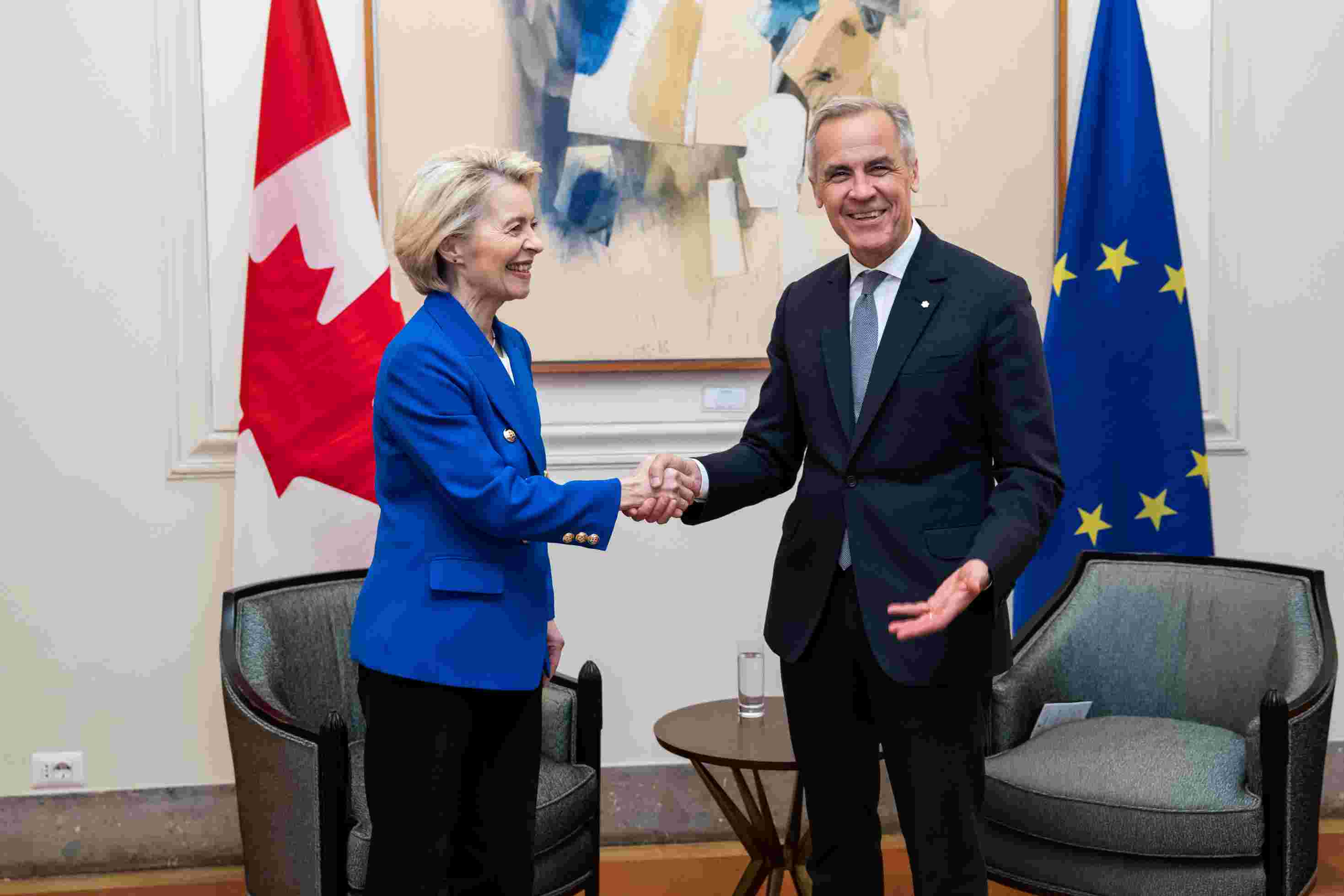
Mark Carney has never been a man to move without calculation. His career has taken him from central banking to the highest reaches of global finance, and he understands capital the way a sailor understands wind. His turn toward the European Union is therefore not a sudden whim but a deliberate repositioning. Europe offers Canada something the southern neighbour can no longer guarantee with confidence, and that something is predictability.
Brussels and Ottawa share a temperament. Both prize rules, institutions, and the quiet machinery of agreements that outlast individual leaders. For a Canadian economy worried about sudden tariffs and shifting moods, that reliability is worth a great deal. A deepened partnership with Europe would give Canadian exporters a second great market, a hedge against volatility, and a seat at a table where the language of long term planning still carries weight.

Yet the European pivot is not without risk. Distance is real. Shipping costs matter. And Europe has its own internal tensions to manage. Still, the signal Canada sends by courting Brussels is as important as any deal it might sign. It tells Washington that Canadian patience is not infinite and that loyalty, in trade as in life, is a two way street.
Trump’s Charm Offensive South of the Border
While Canada looks east, Donald Trump is looking south, and he is doing so with characteristic energy. Mexico occupies a special place in his thinking, part neighbour, part bargaining chip, part stage on which to demonstrate strength. His courtship blends trade concessions with an aggressive posture on narcotics, linking economics to security in a single sweeping narrative.
For Mexico, this attention is both an opportunity and a trap. Closer ties with Washington can bring investment and market access. But they can also mean pressure, conditionality, and the uncomfortable feeling of being pulled into someone else’s domestic politics. Mexican leaders must weigh the immediate gains of cooperation against the long term cost of dependence, all while their northern neighbour watches every move.
The Narcotics Dimension
Trade and narcotics may seem like strange bedfellows, yet in the corridors of power they are inseparable. Cartels move money and goods through the same arteries that carry legitimate commerce. When Trump ties tariff relief to crackdowns on drug flows, he is effectively rewriting the terms of the relationship, turning economic policy into an instrument of security policy and the reverse as well.
This fusion creates a dilemma for everyone involved. Mexico cannot easily separate its economy from its security challenges. Canada watches nervously, aware that a hardened southern border could disrupt the supply chains that run through all three countries. And the United States must decide whether it wants a partner or a client, because those two roles demand very different kinds of diplomacy.
What Unraveling Free Trade Would Mean
If the continental agreement truly unravels, the consequences would ripple far beyond North America. Prices would rise as tariffs return. Factories built around cross border efficiency would scramble to adapt. Workers in every country would feel the chill. The gains of three decades of integration would not vanish overnight, but they would begin to erode, quietly at first and then all at once.
Historians remind us that trade regimes rarely collapse in a single dramatic moment. They fray. A rule is bent here, a promise broken there, until one day the whole structure is standing on nothing but habit. The current maneuvering between Ottawa, Washington, Brussels, and Mexico City may look like ordinary politics. It may also be the early sound of fraying.
Winners and Losers
Every realignment creates its own winners. Europe could gain a wealthy, reliable partner in Canada. Mexico might extract better terms by playing suitors against one another. Canada could finally achieve the diversification it has discussed for years. Even the United States might find that a little competition sharpens its own negotiating edge.
But there are losers too. Small businesses that rely on seamless borders. Communities whose fortunes are tied to a single industry. Consumers who have grown used to abundance and low prices. And, perhaps most importantly, the idea of North America itself, a shared project that asked three very different nations to imagine a common future and then to build it, brick by brick, deal by deal.
A Crossroads, Not an Ending
It would be a mistake to read this moment as a funeral for continental cooperation. Trade relationships are living things. They bend, they stretch, they occasionally tear, and then they are mended in ways nobody predicted. Mark Carney’s European ambitions and Donald Trump’s Mexican courtship are not necessarily the death of North American free trade. They may be the painful, necessary process of renegotiating what it should become.
What remains certain is that the old certainties are gone. Leaders are improvising. Alliances are being tested. And somewhere between Brussels, Ottawa, Washington, and Mexico City, a new balance is waiting to be born. Whether it arrives through conflict or cooperation depends on the choices made in the months ahead, and those choices will shape the lives of millions for a generation to come.