Twelve European Countries Push Arctic Agenda Aimed at Moscow as Putin Keeps the Door Open
Far above the Arctic Circle, where the ice groans under the weight of winter and the northern lights spill across a sky that barely darkens in summer, a quiet struggle for the future of the planet is unfolding. This is not a battle of tanks and troops. It is a contest of influence, resources, and strategy, played out across frozen seas and thawing coastlines. And at the center of it all stands a simple fact. Twelve European countries have decided to push a shared Arctic agenda, one clearly aimed at Moscow. What follows is a story of ice, power, and a promise of cooperation that may or may not survive the cold.

A Region Waking Up to a New Reality
For most of modern history the Arctic felt like a place at the edge of the map, a white void where only the bravest explorers dared to go. That world has changed. Melting ice has opened new shipping lanes, exposed untapped reserves of oil, gas, and rare minerals, and turned a remote frontier into one of the most contested spaces on Earth. Whoever controls the Arctic routes and resources gains leverage over global trade and energy for decades to come. That realization has jolted Europe into action.
Twelve countries, bound together by geography, economy, and shared concern, have come forward with a coordinated approach. Their message is calm but firm. The Arctic must not become a zone of unilateral ambition. It should be governed by rules, by dialogue, and by a balance of interests. Yet anyone reading between the lines understands the deeper target. The agenda is aimed squarely at Moscow, the largest Arctic power by territory and the most active military player in the region.
Why Moscow Matters So Much in the Far North
Russia possesses the longest Arctic coastline in the world. Its northern shores stretch across thousands of kilometers, and its exclusive economic zone holds a vast share of the region natural wealth. For Moscow, the Arctic is not a distant curiosity. It is a strategic heartland, a source of national pride, and a cornerstone of future economic growth. The Northern Sea Route, a passage that grows more navigable each year, offers Russia a potential shortcut between Europe and Asia and a powerful tool of influence.

This is exactly why the European push matters. When twelve nations align their Arctic policies, they are not simply protecting the environment or funding research stations. They are signaling that they intend to have a voice in how the north is run. They are building partnerships, funding infrastructure, and investing in the technologies that will define the next era of Arctic navigation and resource extraction. In doing so, they gently but unmistakably challenge Russian dominance.
The competition is real, but so is the shared interest in keeping the north stable. Ice does not respect borders, and neither does pollution or a changing climate. That simple truth binds rivals together even as they compete.
Putin Keeps the Door Open
Here the story takes an unexpected turn. Despite the growing competition, President Vladimir Putin has signaled that he remains open to cooperation with the European Union in the Arctic. On the surface this may seem contradictory. Why would a leader facing a coordinated European push keep the door open to dialogue? The answer lies in the cold logic of strategy.
Cooperation, for Moscow, is not a sign of weakness. It is a tool. By staying engaged with the EU, Russia can shape the rules of the game from the inside, protect its economic interests, and avoid the kind of isolation that would leave it vulnerable. Scientific collaboration, environmental protection, and search and rescue operations are all areas where cooperation makes practical sense. They also create channels of communication that can be used to manage tensions before they escalate.
For Europe, the open door is both an opportunity and a trap. Dialogue can reduce the risk of confrontation. But it can also be used to divide European nations, to reward friendly partners, and to weaken the collective front. The coming years will test whether the twelve countries can hold their line while still talking to Moscow.
The Stakes Behind the Ice
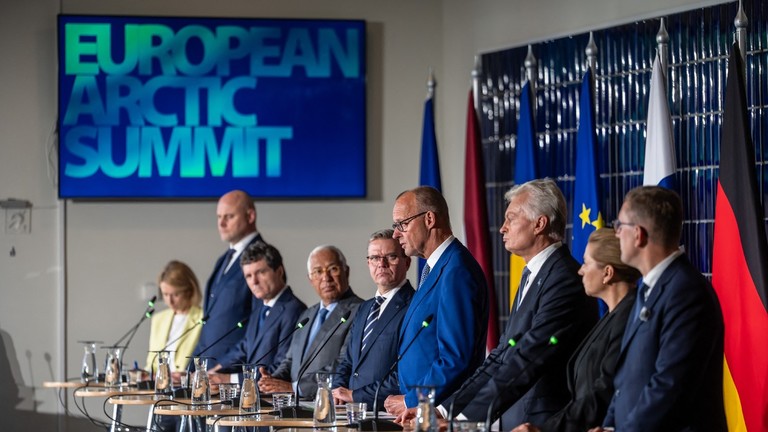
It is easy to speak of the Arctic in abstract terms, but the stakes are remarkably concrete. Under the seabed lie some of the largest untapped energy reserves on the planet. Above the water, new shipping lanes promise to cut travel time between continents and reshape global supply chains. Along the coasts, small communities watch their homes and traditions threatened by a warming climate. Every decision made in distant capitals ripples through these northern lives.
There is also the military dimension. The Arctic is a critical corridor for submarines, early warning systems, and strategic deterrence. Both Russia and NATO have increased their presence and their exercises. A single miscalculation in such a tense environment could have consequences far beyond the region. This is why the European agenda places so much emphasis on stability and predictable rules.
History Rhymes in the High North
The Arctic has always been a place where history and geography collide. During the Cold War, it was a critical frontier where the United States and the Soviet Union tracked one another across the polar ice. Submarines glided beneath the surface, bombers patrolled the skies, and early warning radars scanned the horizon for the first sign of danger. When the Cold War ended, the north seemed to relax. Cooperation replaced confrontation, and the Arctic Council became a rare example of dialogue across deep political divides.
That era of calm is fading. Rising temperatures have reopened old questions about sovereignty and access. Nations that once treated the Arctic as a scientific curiosity now see it as a strategic asset. The twelve European countries are responding to this shift, and Moscow is responding in turn. The result is a new chapter in an old story, one where cooperation and rivalry live side by side.
The Economics of a Thawing Ocean
Economics drives much of the new interest. Shorter shipping routes can slash fuel costs and delivery times, giving companies and countries a powerful competitive edge. Ports along the northern coast hope to become bustling hubs. Energy firms eye the seabed with a mixture of excitement and caution. Insurance markets, shipbuilders, and logistics giants all watch the region closely, because a single new corridor can rearrange the map of global commerce. The twelve European countries understand that influence in the Arctic is not only about flags and treaties. It is about who moves the goods, who builds the ships, and who finances the next great project.
A Balancing Act for Europe
The twelve countries face a delicate balancing act. They must defend their interests, protect the fragile environment, support northern communities, and maintain a credible presence, all while keeping the door open to dialogue. Doing this requires unity, and unity in Europe is never simple. Different nations have different priorities, different energy needs, and different relationships with Moscow. Holding the coalition together will be as important as any policy they announce.
Yet the momentum is clear. The Arctic is no longer a forgotten frontier. It is a stage where the future of European energy, trade, and security will be decided. The coordinated agenda is a statement that Europe intends to be a player, not a spectator.
The Human Dimension
Behind the strategy documents and the diplomatic statements are real people. The Arctic is home to indigenous communities whose cultures adapted long ago to the harshest conditions on Earth. Their knowledge of the land and sea is invaluable, and their voices are increasingly part of the conversation. Any serious Arctic agenda must include them, not as symbols but as partners. The European push will be judged not only by what it achieves for its own nations but by how it treats the people who were there first.
There is also the question of the environment. The Arctic is warming faster than almost anywhere else on the planet. Its melting ice affects weather patterns, sea levels, and ecosystems far to the south. Cooperation with Russia on climate and environmental research is not a luxury. It is a necessity. This is one reason why the openness of Putin to engagement matters, even for those who distrust his motives.
Diplomacy in a Frozen Arena
Diplomacy in the Arctic is a patient craft. Progress is measured in small steps, in shared research, in joint patrols, in agreements that quietly avoid the sharpest disputes. The European approach reflects this reality. Rather than issuing ultimatums, the twelve countries are building a framework of cooperation that gradually expands their influence. It is a strategy of presence and persistence, and it relies on the belief that rules and relationships matter more than sudden gestures. Whether that belief holds will determine the fate of the region.
What Comes Next
We should expect several developments in the months ahead. Investment in Arctic infrastructure will grow. Research partnerships will deepen. Diplomacy will continue, often behind closed doors. And the competition for influence will intensify, playing out through shipping routes, resource deals, and the quiet work of building alliances. The openness of Putin to cooperation ensures that the story will not be a simple confrontation. It will be a long conversation, punctuated by moments of tension and moments of pragmatism.
The Arctic rewards patience and punishes haste. Those who understand the terrain, both physical and political, will shape the outcome. Europe is now trying to become that kind of actor. Whether it succeeds depends on its ability to stay united, to invest for the long term, and to talk to Moscow without surrendering its principles.
Conclusion
High above the frozen seas, the northern lights continue their silent dance, indifferent to the ambitions of nations. But below, the ice is thinning, and the maps are being redrawn. Twelve European countries have chosen to act, pushing an Arctic agenda aimed at Moscow while leaving the door to cooperation open. President Putin, for his part, has chosen to keep talking. This mix of competition and dialogue is the defining drama of the far north. It is a story of resources and rivalry, but also of a fragile planet and its uncertain future. Whatever happens next, the world should watch closely. In the Arctic, the cold truths of power are being written anew.