The Banderol Threat: How a Cheap Missile Is Crippling Ukraine’s Black Sea Ports
Dawn breaks over the Black Sea and the air is thick with salt, diesel, and nerves. In the port of Odesa, a tired dockworker stops mid stride and tilts his head toward the eastern sky. A distant rumble swells into a screaming roar, low and angry, skimming the waves at terrifying speed. This is not a hypersonic wonder weapon or a stealth bomber. It is something far more troubling for Ukraine, a cheap, jet powered missile known as the Banderol, and it is quietly crippling the maritime lifeline that feeds millions of people around the world.

Meet the Banderol, a Budget Missile With a Heavy Fist
The Banderol belongs to a new family of low cost, air breathing cruise missiles built for one purpose, to be fired in overwhelming numbers. It trades the exotic engineering of hypersonic programs for something far more practical, mass production. The missile is compact enough to launch from ground vehicles, ships, and aircraft, and it is designed to fly low over the water, hugging the surface where radar coverage is weakest. It does not need to be perfect. It only needs to be numerous, and that is exactly what makes it dangerous.
When a wave of Banderol missiles arrives over a port, the scene is chaotic. Air raid sirens wail, cranes freeze in place, and ships race to open water. The missiles come in at high speed and low altitude, weaving through the clutter of the coastline to strike grain terminals, fuel depots, and berthing infrastructure. One missile may miss, but a dozen rarely do. The damage is not just physical. Every strike sends a message to shipping companies, insurers, and global markets that the Black Sea corridor is no longer safe.
When Interceptor Drones Fall Behind
For months, Ukraine wrote a surprising chapter in modern warfare with a fleet of interceptor drones. Small, agile, and relatively inexpensive, these unmanned hunters prowled the night skies and chased down the slow moving attack drones that Russia launched by the hundreds. Against those earlier swarms, the interceptors were quiet heroes, protecting cities and infrastructure with a string of nightly victories. It was a remarkable feat of adaptation, but the enemy has adapted too.
Russia has shifted to jet powered threats that operate in a completely different league of speed. The Banderol does not loiter and does not hover. It arrives fast, punches through, and is gone before most defenses can even respond. Ukraine’s propeller driven interceptors simply cannot keep pace. By the time a drone pilot spots the incoming missile and maneuvers into position, the target has already crossed the harbor mouth. The result is a widening gap between what Ukraine’s defenders can chase and what Russia can throw at them.

The strain reaches far beyond the drone squadrons. Ukraine’s radar guided air defense systems are among the most valuable and most scarce assets in the country, and each Banderol attack forces commanders to make brutal choices about where to place them. Covering every grain port along the coast is impossible. Protecting the capital leaves the coast exposed. Protecting the coast drains ammunition reserves that cannot be replaced quickly. The cheap missile, in other words, is being used as a key that unlocks expensive decisions, and every decision carries a cost in blood or bread.
The Black Sea Ports Feel the Pain
Walk along the quays of Odesa or the grain piers of Chornomorsk and you will see the scars. Twisted steel, blackened silos, and warehouses that once hummed with the sound of loading machinery now stand silent. Ukrainian farmers grow some of the finest wheat on earth, and for generations the Black Sea ports carried that harvest to the world. Today those docks are both a lifeline and a target, and the crews who work them have learned to live with the roar of engines overhead.
The economic ripple is immediate and global. When a port is struck, export schedules collapse, demurrage fees pile up, and ships that once queued for grain now wait for safety guarantees that never fully come. Insurance premiums for Black Sea voyages have soared, and many international carriers have rerouted to longer and costlier journeys. Every day of disruption pushes grain prices higher, and the burden falls hardest on the poorest countries that depend on Ukrainian wheat. A cheap missile fired at a single port can send hunger rippling across continents. 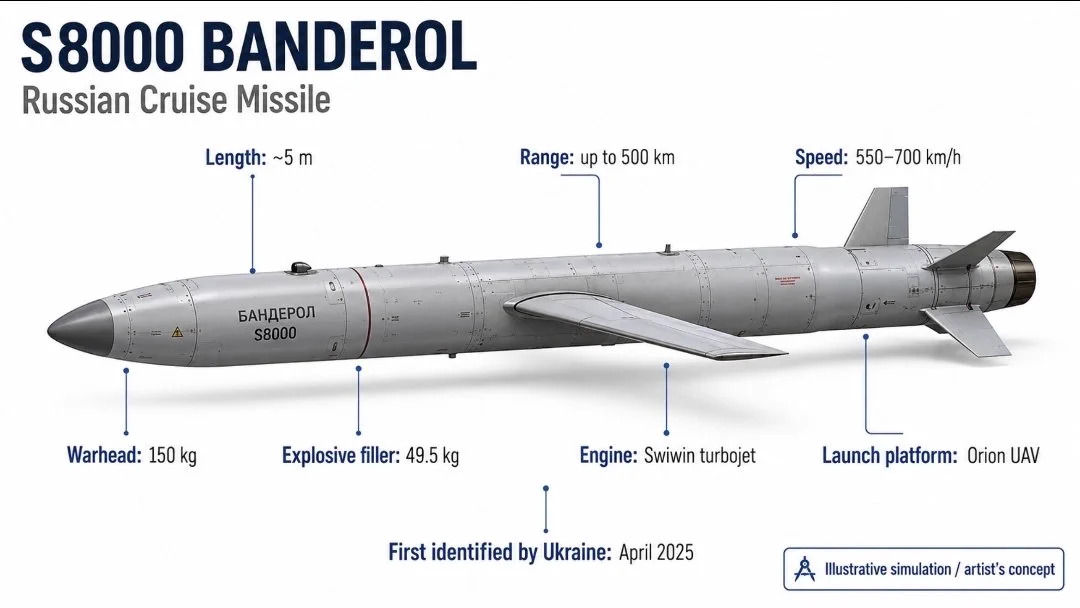
A Brutal Equation of Cost
Warfare has always been a contest of resources, but the Banderol has turned that contest into something almost absurdly one sided. The missile is inexpensive enough to be produced in large batches, and Russia seems willing to spend them the way other militaries spend bullets. Against each one, Ukraine must commit an interceptor that is far more expensive, a missile battery that is irreplaceable, or a drone crew that risks its life every night. The arithmetic is cruel. Lose the math over many months and the ports slowly starve of protection.
This is saturation warfare at its most cynical. Russia does not need every Banderol to hit its target. It simply needs to fire enough of them to exhaust the defenders, to drain their magazines, to fatigue their radar operators, and to force a constant state of emergency. Even when the missiles are shot down, they have already achieved a kind of victory by consuming the very resources Ukraine needs to survive the next wave. The cheap weapon becomes a slowly tightening noose around the country’s economic throat.
The Race to Stay Ahead
Ukraine is not surrendering the sky without a fight. Engineers are scrambling to build faster interceptor drones, to pair optical sensors with artificial intelligence, and to shorten the reaction time between detection and engagement. Western partners are rushing radar systems, counter battery technology, and missile interceptors into the theater. There is real innovation happening in workshops and bunkers across the country, and some of it is already saving lives. But innovation takes time, and time is measured in missile flight minutes.
The fundamental question is whether adaptation can outrun attrition. Every month that Russia can produce cheap jet powered threats faster than Ukraine can field defenses is a month of pain for the ports and the people who depend on them. The Black Sea has become a laboratory for the future of warfare, where the winner will not be the side with the most brilliant weapon, but the side that can sustain the race the longest. For now, the cheap Banderol holds the initiative, and Ukraine is scrambling to catch up.
A Sea That Refuses to Surrender
Yet for all the destruction, the Black Sea ports have not fallen silent. Grain still moves, ships still sail, and the dockworkers still show up at dawn, because giving up is not an option for a nation fighting for its existence. The Banderol has made life brutally difficult, but it has not broken the spirit of the people who keep the lifeline alive. They have adapted before, and they are adapting again, one patrol, one launch, and one repaired crane at a time.
The story of the Banderol is a reminder that wars are often won not by the most sophisticated technology but by the most sustainable strategy. Russia has chosen to flood the sky with cheap threats, and Ukraine must answer with something faster, smarter, and braver. The outcome of that race will decide not only the fate of the Black Sea ports, but the future of global food security and the very meaning of resilience in modern warfare.