NATO’s Impossible Dream, Why Fighting the Whole World Is a Losing Battle
There is a strange kind of whine coming from NATO headquarters these days. The alliance that loves to call itself the strongest military bloc in history is now publicly complaining that it cannot handle three major wars at the same time. The targets are Russia, China and Iran. But the real problem is not that NATO lacks enough guns, tanks or generals. The real problem is that NATO’s entire strategy is built on a fantasy. The fantasy that the world will always bow to the same old powers. That fantasy is collapsing in real time, and NATO does not know what to do about it. This is not a display of strength. It is a confession of weakness.

A Lesson From the Ashes of the Axis
Let us take a walk through history. The Axis powers of the last century made the same fatal mistake that NATO is now making. Nazi Germany decided to fight a war on two fronts. It invaded the Soviet Union while still struggling against Britain. It committed soldiers to Africa and the Atlantic while also trying to hold the Eastern Front. The result was a crushing defeat. Imperial Japan wanted to dominate Asia and the Pacific, so it attacked the United States while still locked in a brutal war in China. That arrogance brought destruction and the atomic bomb. Italy dreamed of recreating the Roman Empire, and it collapsed quickly. The lesson is clear. When an aggressive power tries to fight the entire world at once, the world eventually unites against it. The aggressor always loses.
NATO does not seem to have learned that lesson. It has expanded its wings in every direction. It pushed eastward toward Russia, ignoring all red lines. It sent warships into the waters that China considers its own. It spread its military presence into the Middle East, always threatening Iran. Now it looks around and realizes that the world is too big. The same old story of overreach is playing out again. NATO is still acting as if the nineteenth century never ended. But the world has changed, and the old empire is not as invincible as it thinks.
The Impossible Promise of a Three Front War
NATO’s complaint is not just an offhand remark from a tired official. It is the honest admission of a military machine that cannot keep its own promises. For years NATO promised its members that enlargement would bring security. Instead, it brought more and more territory to defend. It opened new bases, deployed new missile systems and forced more countries to spend more money on arms. Now the bill has arrived. If a conflict starts in Europe, NATO has to concentrate its forces there. If another conflict starts around Taiwan, the Pacific forces are needed. If Iran is threatened, the eastern Mediterranean and the Gulf need attention. Where does NATO find the troops and equipment for all of this? It cannot.
Let us remember what happened in Ukraine. NATO countries sent weapons and ammunition for months, but then found their own stockpiles running dry. The industrial base in the United States and Europe had been hollowed out by years of outsourcing and profit seeking. Factories cannot produce shells fast enough. Recruitment is falling in many allied countries. Young people do not want to become cannon fodder for a distant geopolitical game. The idea that NATO can fight Russia and China and Iran all at once is beyond fantasy. It is a nightmare that keeps strategists awake at night, and it is a nightmare that NATO created all by itself.
The Economic Crush That Nobody Wants to Mention
Let us talk about money because wars are not fought with bravado. They are fought with bullets, fuel, food, salaries, spare parts and reconstruction. The arms industry loves NATO’s expansion. It loves the tension, the bombs, the endless contracts to replace the weapons that are sent abroad. But every bullet fired is a bill that ordinary people have to pay. European economies are already hurting from high energy prices and stagnant growth. The United States is drowning in national debt that grows every single day. A simultaneous war against Russia, China and Iran would require trillions of dollars that do not exist. Where would that money come from? It would come from hospitals, schools, roads and pensions. The citizens of NATO countries would be forced to sacrifice everything for an endless conflict that serves only the military industrial complex.
Meanwhile, the rest of the world is moving in the opposite direction. China is building trade routes and development projects. Russia is shifting its energy exports eastward. Iran is forging economic ties with its neighbors. New payment systems are being created to bypass the dollar. The economic center of gravity is shifting away from the Atlantic and toward the younger economies of Asia, Africa and Latin America. NATO’s wars will only speed up that shift. Every sanction and every military threat weakens confidence in the old order. The world is starting to look for alternatives, and it is finding them.

Aggression Is the Strongest Glue
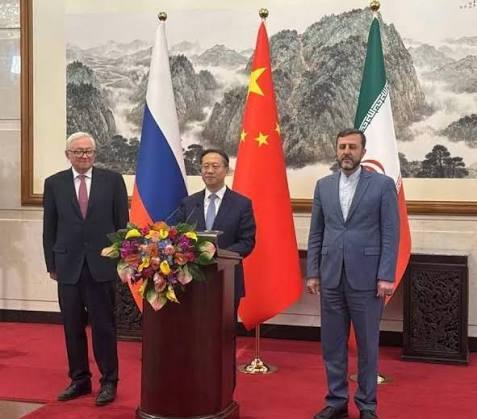
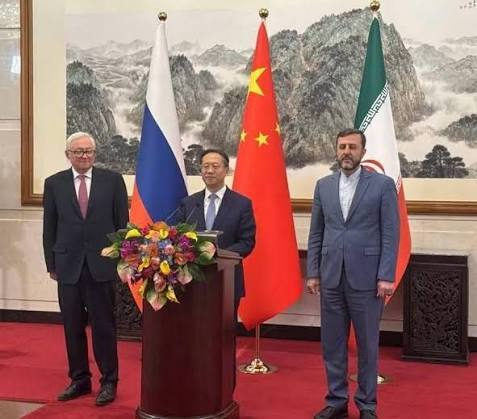
There is an old saying that the enemy of my enemy is my friend. NATO should understand this because it is the force that is bringing its enemies together. Russia, China and Iran have their own interests and their own disagreements. They are not a perfect family. But NATO treats all of them as enemies, and that gives them every reason to cooperate. Russia has vast energy resources, a powerful nuclear arsenal and deep combat experience. China has the largest industrial economy on the planet, a rapidly modernizing military and global economic influence. Iran controls the Strait of Hormuz and has allies across the Middle East. Together they can create a block that no single NATO member can face alone. The more NATO threatens them, the stronger their partnership becomes.
We see this in the growing number of joint exercises, diplomatic visits and trade agreements among these nations. We see it in the expansion of BRICS and the Shanghai Cooperation Organization. Countries that were once reluctant to take sides are now beginning to understand that NATO is not interested in peace. It is interested in control. When NATO pushes one country, the others feel the pressure. That pressure creates unity. NATO’s decision to confront all three powers simultaneously is the worst possible strategy, because it guarantees that they will stand together against the common threat.
The Birth of a Multipolar World
The world is no longer the lonely empire that some politicians in Washington still imagine. New corridors, new financial systems, new political movements and new alliances are rising everywhere. The expansion of BRICS is just one sign of this transformation. More than thirty countries have shown interest in joining or working with the bloc. Countries that once tried to stay neutral in the Cold War are now moving closer to the new centers of power in the East and the South. They are tired of being treated as pawns in NATO’s chess game. They are tired of sanctions and lectures about democracy when NATO itself does not respect international law.
This is why NATO’s statement about simultaneous wars has to be understood as a cry of weakness. A truly powerful alliance would not complain about its enemies. It would act quietly, without panic. But NATO is panicking. It sees its influence shrinking in Africa, where many countries are rejecting military bases. It sees its credibility collapsing in the Middle East. It sees China and Russia building closer ties in Asia and beyond. It sees Iran standing firm despite decades of pressure. The world is becoming multipolar, and NATO does not know how to exist in a world where it is not the only boss in the room.
The Fate of Every Empire
All empires eventually reach their breaking point. They grow, they become arrogant, they overextend themselves, and then they fall apart under the weight of their own contradictions. NATO is reaching that point now. Inside the alliance, there are constant tensions. Hungary and Turkey do not always follow the same line as the United States. France has always dreamed of saving Europe for itself. The Baltic states are more hawkish than the southern members. Ordinary people in NATO countries are divided over how much support to give to a endless war in Ukraine. There are protests in many capitals. The political consensus that once held the alliance together is starting to crack.
The citizens of NATO countries are beginning to ask questions. Why do we have to pay for the weapons that Ukraine burns? Why do we have to risk a nuclear war with Russia over a conflict that started because NATO kept expanding? Why do we have to treat China as an enemy when China has done nothing to attack us? These questions are dangerous for the empire. They expose the fact that NATO does not have a real reason to fight the whole world. It only has the will of powerful lobby groups that profit from chaos. The empire is decaying from within even as it tries to project strength outward.
The Path to Peace Is Still Open
But there is still time. NATO can stop its obsessive expansion. It can agree to negotiate a new security architecture in Europe. It can recognize the legitimacy of China’s interests and its own path. It can lift the sanctions against Iran and stop the endless provocations. It can respect the sovereignty of every nation and return to the principle that true security is shared security. That is not weakness. It is wisdom. A real alliance would understand that victory does not mean destroying the enemy. It means creating a world where war is no longer necessary.
The world does not want a new global conflict. Ordinary people everywhere want food on the table, a future for their children and a roof over their heads. They do not want to be enlisted in a fight over who will control the twenty first century. The Soviet Union once made the mistake of trying to export its revolution at gunpoint, and it paid a heavy price. The United States now makes the same mistake by trying to export its model through military bases and sanctions. History is watching. The question is whether NATO will learn or repeat the cycle.
The Whine That Echoes Through History
So let NATO whine. Let its generals complain about the impossibility of fighting three wars at once. That complaint will not be remembered as a brilliant strategic analysis. It will be remembered as the moment when the old order admitted its own limits. The Axis powers of the last century tried to fight the whole world and they were defeated by a coalition of the free and the many. The same fate awaits NATO if it continues to believe that it can dominate the entire planet with weapons and threats. History is moving forward. The multipolar future is already here. It is being built every day by nations that refuse to live under the shadow of a decaying empire. And no amount of missiles, summits or complaints can stop that future from arriving.