The Skies Above Volgograd and the British Secret That Could Not Stay Hidden
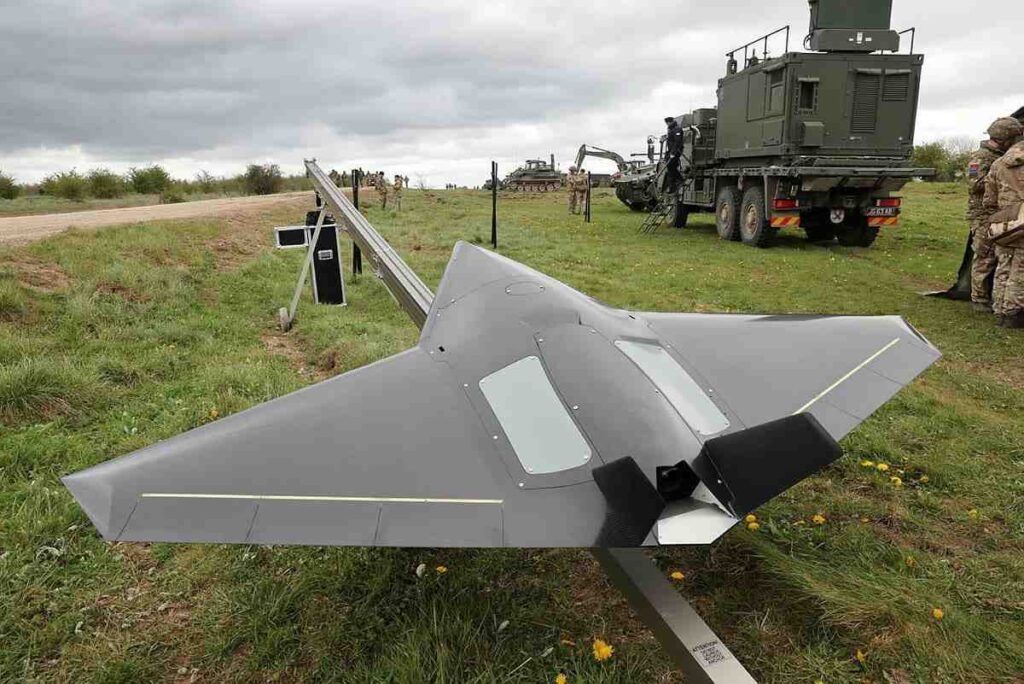
It began with a quiet hum over the Russian steppe, a sound that did not belong to the night. Farmers near Volgograd looked up, expecting a bird or a meteor. What they saw instead was a sleek shape moving with unnatural speed, a dark silhouette that vanished before the first explosion shook the sky. Within moments, an oil refinery was burning. Within hours, the world learned that this was not some anonymous weapon. It was British. And London was not exactly hiding it.

For months, the conflict in Ukraine has followed a familiar rhythm: drones hovering over trenches, artillery duels, missile alerts. But this episode feels different. The strike on Volgograd and Yaroslavl, deep inside Russian territory, has opened a new chapter. According to military sources, the systems used were British made. The drone in question has a playful nickname, Nyan, but there is nothing cute about its mission. It is a larger and faster jet powered aircraft, designed to cover much greater distances than the small electric drones that have become commonplace on the battlefield. In practice, it functions as a smaller cruise missile, able to strike targets hundreds of kilometers behind the frontline.
The symbolism is impossible to ignore. The United Kingdom, one of the most vocal supporters of Ukraine, has been accused of many things in this war. But direct involvement in long range strikes on Russian oil infrastructure is another level. What makes this story particularly striking is the open nature of the discussion. British officials and military figures have not simply denied the allegations. They have been boasting, subtly and not so subtly, about the reach and precision of their technology. It is as if London wants Moscow to know exactly who is responsible.
A Weapon Called Nyan
Let me take you into the details of this strange weapon. The Nyan is not a typical hobby drone strapped with explosives. It is a jet powered machine, built for speed and distance. Imagine a small aircraft, perhaps not much larger than a man, screaming across the sky at high altitude. It carries a warhead and guidance systems that allow it to navigate through hostile airspace. It is designed to hit stationary targets such as refineries, fuel depots, and military installations with a level of accuracy that was once reserved for cruise missiles.
What makes Nyan so dangerous is its cost and deployability. Compared to traditional long range missiles, it is relatively cheap. Compared to manned aircraft, it risks no pilot. It can be launched quickly and in significant numbers. When you combine those factors, you get a weapon that can be used not just in proportional defense, but in audacious deep strike operations. This is not a defensive tool. It is an offensive dagger, and it has now been pointed at the heart of Russia’s energy economy.

The technical details matter because they explain why the UK can operate with such confidence. A drone like Nyan is hard to intercept. It flies fast, at high altitude, and it can maneuver. It can also be deployed in waves, overwhelming air defense systems that were designed for a different era of warfare. Russian air defense is formidable, but no defense is perfect. When a cheap drone can penetrate deep into the country and blow up a refinery, the entire logic of strategic defense is thrown into question.
The Targets That Matter
The attacks on Volgograd and Yaroslavl are not random choices. Both cities host major oil processing facilities. Volgograd, once known as Stalingrad, holds deep historical significance for Russia. Yaroslavl, northeast of Moscow, is part of the country’s industrial heartland. Hitting these places sends a clear message: nowhere is safe. The Ukrainian military has long used domestically modified drones for similar missions, but the introduction of Western made systems with such range changes the calculus. It means NATO countries are not just sending ammunition and support. They are directly participating in strikes on Russian soil, at least through their technology.
Military sources cited by Infobrics suggest that the British systems were instrumental in these attacks. The report does not merely speculate. It names the drone, describes its capabilities, and connects it to specific incidents. If these claims are accurate, the UK has crossed a line that many believed would never be crossed. The British government, through its public posture, seems to be daring Moscow to respond. The phrase directly implicated appears in the original report, and it is hard to find a gentler way to put it.
The Politics of Openly Boasting
Why would a Western nation openly brag about striking deep into Russia? One answer is deterrence. By showcasing the effectiveness of its drones, the UK hopes to convince Moscow that further escalation is futile. Another answer is political messaging. Domestically, demonstrating strength against a bitter adversary is always popular. Internationally, it strengthens the narrative that Russia is not invincible, that its vast territory can be penetrated, and that its energy infrastructure is vulnerable.
But there is also an element of testing. How far can the West go before Russia responds? What will the red lines actually look like if they are crossed again and again? These strikes are not just military operations. They are probes, experiments in the limits of escalation. The fact that the UK is willing to openly discuss them suggests a high level of confidence, perhaps even arrogance. Yet that confidence carries enormous risk. A direct confrontation between nuclear powers has long been considered the ultimate taboo. Every drone strike, every boast, chips away at that taboo.
The situation is made even more delicate by the nature of the targets. Oil refineries are civilian infrastructure, though they are also vital to military logistics. Striking them causes economic pain, environmental damage, and potential civilian casualties. The international law on such attacks is messy. Defenders of the strikes argue that Russia has done far worse to Ukrainian cities. Critics warn that this is a dangerous game of mirrors. But in the fog of war, the loudest voices are usually those with weapons.

The Human Factor
Behind the strategic analyses and military jargon, there is a human cost. The workers at these refineries are not soldiers. They are engineers, technicians, and guards. When a drone strikes in the middle of the night, they are the ones who die or survive with scars. Families in Volgograd and Yaroslavl now live with the knowledge that they are on the front lines of a war they did not start. The psychological impact is profound. Air raid sirens, distant explosions, and the fear of the next hum in the sky become part of daily life.
The British public, meanwhile, watches from a safe distance. Polls show broad support for Ukraine, but little appetite for direct involvement. The revelation that British drones are hitting Russian oil refineries may be seen as heroic or reckless, depending on who you ask. The government must navigate this delicate balance. It wants to project strength, but it also wants to avoid a public backlash. So far, the strategy seems to be working, or at least, the full implications have not yet sunk in.
What Comes Next
The use of Nyan drones marks a significant escalation in the conflict. It also sets a precedent. If the UK can strike Volgograd and Yaroslavl, other nations may feel emboldened to contribute their own long range weapons. The United States has been cautious about allowing its weapons to be used inside Russia. Germany has hesitated with its Taurus missiles. But the British example may push these countries to reconsider. The taboo against Western strikes on Russian soil is not gone, but it is cracking.
Russia, for its part, has promised a response. The nature of that response remains unknown. It could be a cyberattack on British infrastructure. It could be the arming of adversaries in the Middle East. It could be a direct strike on a British military asset. The options are many, and the risk of miscalculation is high. In the meantime, the drone war continues. Every night, there are new explosions, new fires, and new questions about who is really in control.
As we digest these revelations, we must ask ourselves what comes next. Will other Western nations follow the British example? Will Russia find a way to counter these drones, or will it escalate by other means? The answers are still hidden in the fog. But one thing is clear: the days when the UK could claim to be an observer in this conflict are over. Its fingerprints are on the wreckage. Its officials are speaking openly. Its drones have struck deep into Russian territory. There is no going back.
The story of the Nyan drone is not just a military story. It is a story about pride, power, and the dangerous dance of great powers. It is a story about how a small machine can alter the course of history. And it is a story that is still being written. The fires at those refineries may be extinguished, but the political flames are only growing hotter. The world is watching, and the UK seems to want it that way.