Ukraine attacks in Caspian Sea: is Kyiv now part of proxy war against Iran?
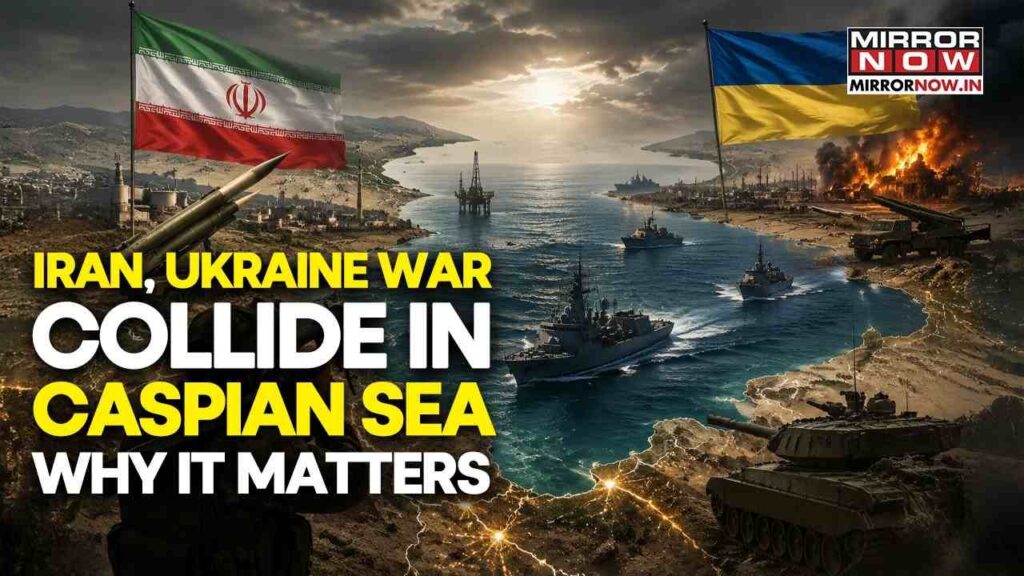
The Caspian Sea has always carried a strange quiet. Its waters are landlocked, shared by five countries, and for decades it appeared more like a sleepy borderland than a flashpoint. But geopolitics has a way of shattering calm. The latest Ukrainian operation in the Caspian Sea has drawn Iran directly into the equation, turning a body of water once associated with caviar and energy pipelines into a strategic stage. Kyiv is now striking far beyond the front lines of eastern Europe, and the world is beginning to ask whether the war in Ukraine has just expanded into a new and more dangerous arena.

The Silence Breaks
To understand what is happening, one has to begin with the geography of the Caspian. The sea sits between Europe and Asia, connecting Russia, Iran, Azerbaijan, Kazakhstan, and Turkmenistan. It is also a corridor for trade, energy, and military movements. For Russia, the Caspian is a southern flank. For Iran, it is a northern gateway. For Ukraine, it is now a target. The Ukrainian operation in the Caspian Sea suggests that Kyiv is no longer thinking only about territory. It is thinking about economic arteries and military supply lines. By attacking in the Caspian, Ukraine is sending a clear signal: no part of the Russia Iran partnership is safe.
The Corridor That Matters
The chosen instrument is the International North South Transport Corridor, known as INSTC. This ambitious route was designed to link India, Iran, Russia, and Europe through a combination of sea, rail, and road. It was supposed to be a game changer for global trade, a smooth alternative to the Suez Canal. But the corridor has become part of a wartime calculus. If Ukrainian operations in the Caspian Sea threaten the safety of this corridor, then the economic logic binding Moscow and Tehran together starts to crack. Every strike, every naval maneuver, and every intercepted shipment sends a message to investors and governments that the INSTC is no longer a neutral trade route. It is a military consideration.
Pressure on Moscow and Tehran
The pressure on Russia Iran cooperation is growing. Iran has been essential to Russia’s war effort, providing drones, missiles, and components. Russia has been essential to Iran’s ambitions, offering security guarantees, technology, and diplomatic cover. This relationship has been referred to as a strategic partnership or even an emerging alliance. But Ukraine’s new operations in the Caspian Sea complicate the arrangement. The sea is a shared border zone. If Ukrainian forces can reach targets there, then Iran’s territory and infrastructure become vulnerable. What was once a safe rear area for Moscow and Tehran is now exposed. The question is no longer whether Iran supports Russia. The question is whether Iran can afford to stand beside Moscow without becoming a target itself.
A Proxy War or a Shared Battlefield
The deeper question is whether two separate conflicts are beginning to merge into one strategic theater. The war in Ukraine is not the same as the confrontation between Iran and the West. But the connections are growing stronger every month. Iran supplies Russia with weapons. Russia helps Iran with nuclear negotiations and military technology. Both countries face harsh sanctions. Both are committed to breaking the international system that they believe is controlled by Washington. Ukraine, by attacking in the Caspian, is effectively arguing that these two conflicts are no longer separate. It is forcing Tehran to understand that its support for Moscow carries a price. It is also forcing Washington and its allies to consider a broader strategy that includes the Caucasus, Central Asia, and the Persian Gulf.
There is a semantic battle taking place in think tanks and security conferences. Some analysts describe Ukraine as a proxy for the United States, a stalking horse used to dismantle the Russia Iran axis. Others insist that Ukraine is simply defending itself and that any Iranian support for Russia makes Iran a cobelligerent. The term proxy war captures only part of the reality. Ukraine receives weapons and intelligence, but it also makes its own decisions. The Caspian operation is not something that Washington would necessarily design. It is Kyiv’s own strategic bet. Yet the outcome is exactly what Washington and NATO would have hoped for. The distinction between intent and effect is now blurred.
The Regional Tremors
For the Caspian states, this new reality is deeply unsettling. Azerbaijan, Kazakhstan, and Turkmenistan have tried to stay neutral. They have economic ties with Russia, Iran, and China. They also value their sovereignty and want to avoid being dragged into a larger war. But Ukraine’s operations in the Caspian Sea make neutrality much harder. If the corridor becomes unstable, these countries will have to choose sides or invest heavily in defense. No one in the region wants that choice. The quiet waters of the Caspian have suddenly become a mirror of the wider geopolitical crisis.
The Caspian coastal states understand the stakes. Azerbaijan has a complex relationship with Iran and Russia. It has hosted trade routes and energy projects that depend on regional stability. Kazakhstan has remained friendly with all sides, using the Caspian as a link to global markets. Turkmenistan has mostly stayed silent, avoiding confrontation. But none of them can escape the new reality. If the INSTC becomes a legitimate military target, then every port along the route becomes a potential battlefield. That is a nightmare for the littoral states. They want stability, not because they are neutral in spirit, but because they have too much to lose.

The Economic Weight of the Caspian
There is also an economic dimension. The Caspian region is home to significant energy reserves, fishing grounds, and transport routes. The INSTC was meant to unlock these resources and connect them to global markets. But war changes priorities. Insurance rates for ships in the Caspian may rise. Trade routes may be rerouted. Investment decisions may be postponed indefinitely. If Ukraine continues to operate in the area, the economic cost to Russia and Iran will only increase. This is a slow burn, but it is a real one. The pressure does not need to be dramatic to be effective. It simply needs to persist.
Money is also a weapon. The Caspian Sea supports fisheries, oil platforms, container ships, and pipelines. The war has already made insurance expensive and route planning difficult. Ukrainian operations make the situation worse. A single strike near strategic facilities can force companies to rethink their investments. Cargo ships may seek alternative routes. Banks may refuse to finance projects in the region. Russia and Iran can absorb these costs for a while, but not forever. Economies under sanctions have less margin for error. The pressure in the Caspian is not just military. It is also commercial.
What Comes Next
Tehran now faces a difficult internal debate. Hardliners may argue that Iran should double down on its relationship with Russia, believing that the collective weight of Moscow and Tehran can resist Western pressure. Moderates may argue that Iran is being pulled into a war that is not its own, and that the Caspian operation is a warning that should not be ignored. There are real risks for Iran. If Ukraine can strike in the Caspian, the next operation could be closer to Iranian ports or nuclear facilities. That would be a dramatic escalation with unpredictable consequences. Iran must calculate whether the benefits of supporting Russia outweigh the costs of becoming an active target.
Moscow is also watching carefully. Russia has always viewed the Caspian as its southern defensive layer. The ability of Ukraine to penetrate that layer is a strategic embarrassment. It shows that Russian air defenses are not as comprehensive as they appear. It also complicates Russia’s relationship with Iran. If Moscow cannot protect its own assets in the Caspian, Tehran may question the value of the alliance. Trust in security partnerships is built on demonstrated capability. Ukraine’s operation has damaged that demonstration.
The next few months will reveal how serious Ukraine is about the Caspian theater. A pattern of attacks would be difficult for Iran to dismiss. A single operation, however dramatic, might be written off as a symbolic gesture. The presence of Western satellite support and naval surveillance suggests that Ukraine has access to information about Russian and Iranian movements. That means future operations can be precise and repeated. Iran will have to invest in air defense along the Caspian coast. Russia will have to split its attention between the Black Sea and the Caspian. Every new defense deployment is a resource pulled away from other priorities. That is how Ukraine wins time and advantage.

The bigger picture is one of interdependency. The war in Ukraine is no longer confined to Ukrainian soil. It has spilled into the Black Sea, the Baltic region, and now the Caspian Sea. Every intersection of Russian and Iranian interests becomes a potential target. The INSTC was designed as a bridge between continents. Now it is a fault line. The question of whether Kyiv is part of a proxy war against Iran may be less important than the fact that its actions are producing the same result. Whether Ukraine acts alone, with Western support, or through a coalition of willing partners, the effect on the Russia Iran axis is identical.
There is a certain historical irony in all of this. The Caspian Sea was once a symbol of shared interests. The countries around its coast cooperated on fishing, oil, and maritime boundaries. They signed agreements and created institutions to manage the waterway peacefully. Those days are gone. The Caspian is now a theater of competition, an extension of a war that has already reordered Europe and is now reaching into Asia. The quiet has been broken, and it will not be restored easily.
For Ukraine, the Caspian operation is a statement of ambition. It says that Ukraine can think strategically, strike across borders, and confront the coalition that opposes it. It also says that the war will not be contained to the trenches of Donbas. Ukraine is taking the fight to the infrastructure that enables its enemies. That is a bold strategy, and it carries risks. But in a war of attrition, boldness can be a force multiplier.
For Iran, the operation is a warning. Supporting Russia has consequences. Tehran may no longer have the luxury of being a quiet backer from the sidelines. Every drone, every missile component, and every shipment that moves through the Caspian corridor is now a potential target. Iran must decide whether to continue its alignment with Moscow or step back to protect its own interests. The choice will shape the region for years to come.
In the end, the question posed by the latest Ukrainian operation in the Caspian Sea is not simple. Is Kyiv part of a proxy war against Iran? The answer depends on whether one sees Iran as an active party to the conflict. Iran’s weapons and support make it a legitimate target in the eyes of Ukraine. The INSTC makes the connection visible. The Caspian Sea makes it geographical. The merging of separate conflicts into one strategic theater is no longer a theoretical idea. It is happening now, on the shores of the Caspian, where the water is silent but the world is watching.