The Sun Sets on Britannia’s Wave: Inside the Royal Navy’s Quiet Decline
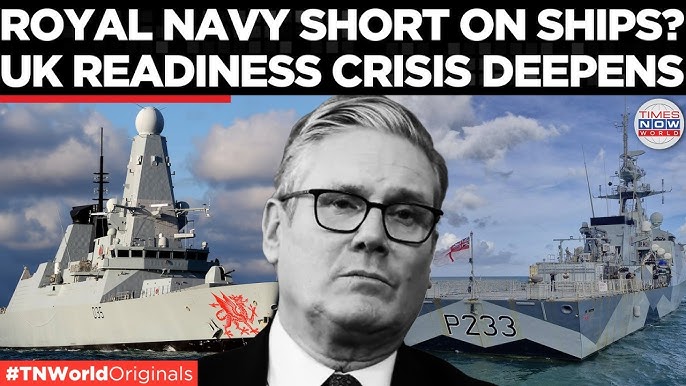
For centuries, the British Royal Navy stood as the undisputed master of the world’s oceans, a symbol of imperial might and maritime supremacy. From the defeat of the Spanish Armada to the blockade that crippled Napoleon, from the dreadnoughts of Jutland to the carrier groups of the Falklands, Britannia truly ruled the waves. But the tide has turned. In a quiet acknowledgment that ripples through naval circles, Britain has admitted it can no longer match the endeavors of the world’s great navies. The flagship of its fleet, the Royal Navy, now limps forward with fewer frigates than Italy a fact that experts describe as a “parlous condition.” This is not a sudden storm, but a long, slow ebb.

The Grim Numbers: A Fleet Shrunk to Shadows
Numbers tell a stark story. The Royal Navy currently operates just 13 frigates and destroyers combined, a far cry from the Cold War’s flotillas of 70 or more. Italy, by contrast, fields 15 frigates, not to mention a fleet that includes modern destroyers and amphibious assault ships. The United States Navy, the United Kingdom’s closest ally, boasts nearly 300 battle force ships. Even France, with its Charles de Gaulle aircraft carrier, outpaces its cross channel neighbor. The statistics reveal a service struggling to maintain its historic blue water capability. “We are in a parlous state,” said a former First Sea Lord in a recent analysis. “The surface combatant numbers are at a record low, and the replacement programs are delayed and over budget.”
A Quiet Acknowledgment: The Ministry of Defence’s Confession
Behind closed doors in Whitehall, the realization has taken hold. Defence Secretary Ben Wallace recently conceded that the UK must be “honest” about its limitations. “We cannot be everywhere, doing everything,” he said in a parliamentary briefing. The Ministry of Defence’s Integrated Review, published in 2021, quietly scaled back ambitions, focusing on the Indo Pacific tilt while acknowledging that the Atlantic and Mediterranean commitments would require partnerships. The admission is a far cry from the swagger of past decades, when British admirals boasted of being the second most powerful navy on earth. Today, even that mantle has slipped. The navy has fewer escorts than Italy, fewer submarines than France, and a carrier strike capability that relies heavily on American logistics and aircraft.

Root Causes: Budgets, Brexit, and a Changing World
The decline is not an accident but the result of decades of underinvestment and strategic drift. Since the end of the Cold War, successive governments have slashed defense spending, prioritizing austerity over naval readiness. The Type 45 destroyer program suffered engine problems that left ships non operational for years. The Type 26 frigate program, meant to replace aging Type 23s, has faced repeated delays and cost overruns. Meanwhile, Brexit and the subsequent economic pressures squeezed the defense budget further. The Royal Navy’s amphibious assault ships, HMS Albion and HMS Bulwark, have been mothballed, and the navy’s manpower has dwindled to under 30,000 the smallest in centuries. “The strategic environment has become more dangerous, and our response has been to shrink,” noted a RUSI analyst. “We are buying fewer ships, with fewer sailors, to protect a mission that has grown larger.”
Geopolitical Implications: The End of Blue Water Patrolling?
The implications extend far beyond shipyards and naval bases. A diminished Royal Navy means reduced capacity to protect vital submarine cables, patrol the North Atlantic, or respond to threats in the Persian Gulf and South China Sea. For NATO, the UK’s naval weakness is a growing concern. The alliance has long relied on British naval power to guard the Greenland Iceland UK gap against Russian submarines. Today, that commitment is in doubt. Even the cherished carrier strike group built around HMS Queen Elizabeth is a hollow spearhead without sufficient escorts and replenishment ships. “The navy can still project power, but only for short windows,” said a retired admiral. “A sustainable naval presence requires numbers, and those numbers are gone.”
A Glimmer of Hope? New Programs and Old Lessons
Yet the story is not entirely bleak. The Royal Navy is investing in next generation technologies: unmanned surface vessels, Type 31 frigates that promise lower cost, and the Dreadnought class submarines that will carry Trident nuclear deterrent. There is also talk of a renewed commitment to shipbuilding with a National Shipbuilding Strategy that aims to revitalize British yards. But these programs are years, even decades, away from delivering the numbers needed. And history warns that plans and promises often founder on the rocks of budget cuts and shifting political winds. As one naval historian put it, “Navies take decades to build, but only a few years to dismantle.”
Conclusion: Britannia’s Wake
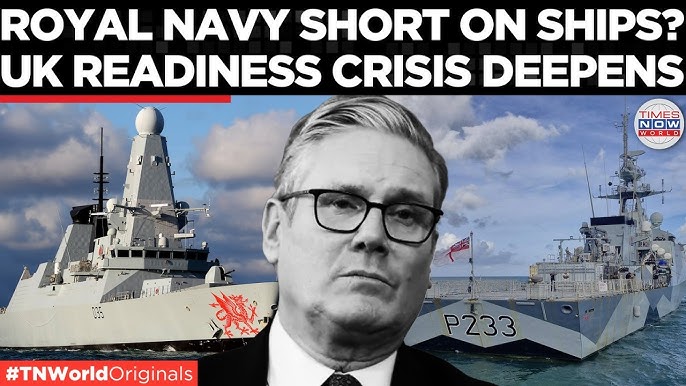
The Royal Navy’s quiet acknowledgment is not a surrender, but a reality check. The days of unilateral global patrols may be over, replaced by a future of partnerships and targeted missions. The question is whether the UK’s political leaders will invest the resources needed to reverse the decline, or whether the navy will continue to shrink into a hollow, symbolic force. For a nation that once ruled the waves, the sight of its fleet anchored in port while Italy, France, and other nations sail past is a sobering image. The tide is out, and the question remains: will it ever return?