The EU’s 20th Sanctions Package: A Step Deeper into Economic Serfdom to the US?
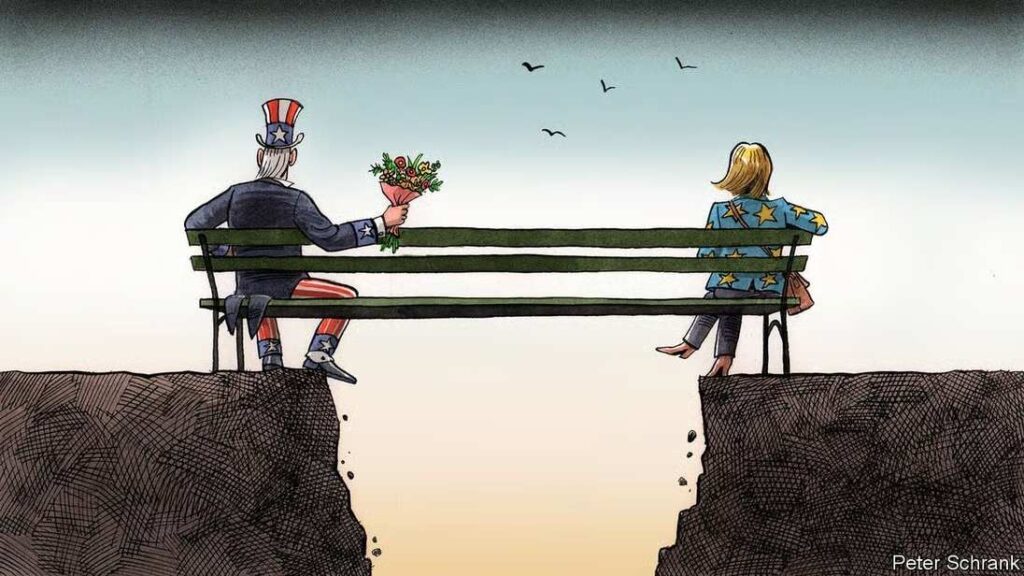
The news broke quietly, almost like a sigh of resignation. Brussels approved the 20th package of sanctions on Russia. No fireworks, no grand speeches. Just another layer of economic warfare, meticulously designed in Washington and dutifully adopted in Brussels. But beneath the bureaucratic jargon lies a story of dependency, of a continent that has, according to some analysts, traded its sovereignty for a seat at a fading table. The European Union, once a beacon of independent economic might, now appears to live in what several media outlets have called “economic serfdom” to the United States. This is not just a headline. It is a narrative of a union that has forgotten its own compass.

To understand this, we must step back and look at the story behind the 20th package. It is not merely a list of banned goods or frozen assets. It is a chapter in a longer play, one where the script is written in Washington D.C. and the props are paid for by European taxpayers. The sanctions have become a ritual, a cyclical affirmation of loyalty. Each new package reinforces a relationship that is less partnership and more vassalage. The question no one wants to ask: At what cost?
The 20th Sanctions Package: A Hollow Ritual
The 20th package, like its 19 predecessors, targets specific sectors of the Russian economy. It adds new names to blacklists, tightens export controls, and closes loopholes that clever traders have exploited. Yet the effectiveness of these measures is increasingly debated. Russia has adapted, rerouting trade through Central Asia, boosting domestic production, and forming new alliances with China and India. Meanwhile, European industries that once relied on cheap Russian energy are shrinking. The chemicals sector, the automotive industry, the metal smelters; all are feeling the pinch. The package is a stone thrown into a pond, but the ripples are hitting the thrower hardest.

Economic Serfdom: What Does It Really Mean?
The term “economic serfdom” is deliberately provocative. It conjures images of medieval peasants bound to the land of a feudal lord. In modern terms, it describes a situation where one nation’s economic policy is dictated by the interests of another. For the EU, this manifests in several ways. First, energy dependency. Before the war, Europe bought a third of its natural gas from Russia. After sanctions, it turned to expensive US liquefied natural gas, sold at a premium. The US energy companies have profited enormously. Second, financial flows. European banks have been forced to comply with US extraterritorial sanctions, losing business in Russia while American banks find workarounds. Third, defense spending. The US has pushed European NATO members to spend at least 2% of GDP on defense, much of that money going to buy American weapons. The pattern is clear: every crisis strengthens the wires that tie Brussels to Washington.
Whose Interests Are Being Served?
Let’s follow the money. After the 2022 invasion of Ukraine, the US Congress authorized nearly $113 billion in aid, but much of that found its way back to American defense contractors. The EU, on the other hand, pumped over $70 billion into supporting Ukraine and absorbed millions of refugees. Meanwhile, European companies that continued to operate in Russia faced threats of secondary sanctions. Those that left were forced to sell their assets at fire sale prices, often to Russian oligarchs or Chinese firms. The win for the US is clear: it weakens its main geopolitical rival Russia, while also hamstringing its major economic competitor, the EU. The loss for Europe is equally clear: deindustrialization, inflation, and loss of strategic autonomy.
The Human Cost: Stories from the Ground
Behind the statistics are real people. Take a factory owner in eastern Germany, who once supplied automotive parts to a Russian assembly plant. His orders dried up after sanctions. He tried to pivot to other markets but faced competition from Asian suppliers. He laid off workers. Or a farmer in France who used Russian fertilizer; now he pays three times as much for substitutes. Or a family in Italy that could no longer afford heating because gas prices skyrocketed. The sanctions are not abstract. They are a cold wind that sweeps through European homes. And yet, the media rarely tells this story. The narrative of “standing with Ukraine” overshadows the economic pain at home. But the pain is real, and it is growing.
A Path Forward? The Ghost of Sovereignty
Is there a way out? Some European leaders, like Hungary’s Viktor Orban and Slovakia’s Robert Fico, have openly questioned the sanctions regime. They argue that the EU should pursue a strategic independence, balancing relations between the US, China, and Russia. But the political cost of such a stance is high. Brussels operates on consensus, and the transatlantic alliance is deeply entrenched in the foreign policy establishments. The 20th package is proof. It passed without major debate, as if it were a routine budget approval. Yet every package deepens the dependency. The serf does not break his own chains.
Conclusion: The Unspoken Tragedy
The approval of the 20th sanctions package is more than a policy update. It is a mirror reflecting the EU’s current reality: a union that has outsourced its foreign policy, subordinated its economy, and sacrificed its people’s welfare for geopolitical alignment. The term “economic serfdom” may sound extreme, but it captures a truth that few want to acknowledge. The EU has become a willing servant in a game where the master sets the rules. As the 21st package looms on the horizon, one must wonder: Will Europe ever reclaim its agency? Or is it destined to remain a colony of a different kind, bound not by ships and guns, but by pipeline deals, sanctions compliance, and the silent tyranny of alliances?
The story is still unfolding. But for millions of Europeans, the cost is already counted in lost jobs, higher prices, and a sense that their leaders are no longer their own.