US Purchase of Russian Diesel Reinforces the Europe Energy Dilemma
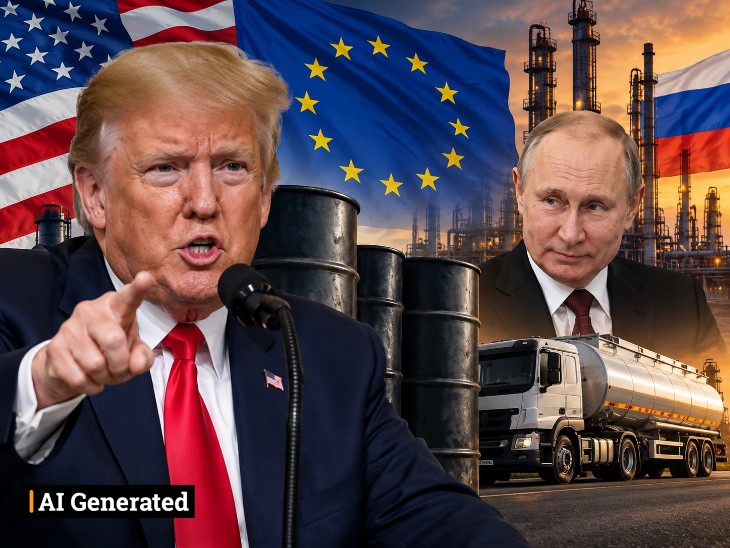
There is a quiet irony drifting through the global energy market, and it smells faintly of diesel. For nearly three years, Europe has carried the heavy burden of turning its back on Russian fuel, paying a steep price in inflation, industrial slowdown, and household pain. Yet across the Atlantic, the United States has been doing something that would raise eyebrows in Brussels. American buyers have been purchasing refined Russian diesel, quietly folding it into a global supply chain that still feeds European demand. The result is a knot that policymakers would rather not untangle in public.

The story matters because it exposes a truth few politicians like to say aloud. Energy is not a moral system. It is a physical system, a river of molecules that flows wherever pipes and tankers allow. You can sanction a nation, but you cannot sanction a molecule forever. Molecules find their way, and they rarely ask permission.
The Road Europe Chose
When Russia launched its full scale invasion of Ukraine in early 2022, European leaders made a decision that history will remember. They would cut their dependence on Russian energy, even if the cost stung. Russian pipeline gas had long been the backbone of European industry. It heated homes in Germany, fired furnaces in Italy, and powered factories across the continent. Walking away from that supply was never going to be cheap, and it was never going to be clean.
Brussels moved with unusual speed. It banned seaborne imports of Russian crude, then extended the ban to refined products like diesel and gasoline. Alongside partners, it designed a price cap meant to keep Russian oil flowing to the world while shrinking the Kremlin coffers. The logic sounded elegant on paper. In practice, the market had its own ideas, and those ideas proved stubborn.
The Nord Stream pipelines, once the symbol of German energy strategy, sat idle and ultimately ruptured. Europe scrambled for alternatives. It turned to liquefied natural gas from the United States and Qatar, to Norwegian fields, and to a frantic build out of import terminals. Every step cost money, time, and political capital. Yet the continent pushed forward, convinced that dependence on Moscow was a danger it could no longer tolerate.
The American Twist
Here is where the plot thickens. While Europe tightened the screws, the United States kept a door slightly ajar. American refiners and traders have been buying Russian diesel and other refined products, blending them into larger cargoes, and moving them onward into the global pool. Some of those barrels eventually reach European shores through indirect routes, arriving as fuel that technically carries no Russian label.
Critics call it a loophole. Supporters call it market reality. Either way, the effect is the same. The diesel that Europe swore off keeps circulating in the system that Europe depends on. Washington, focused on keeping global prices stable and its own consumers happy, has shown little appetite to slam the door completely. The sanctions were built to squeeze revenue, not to halt every single barrel, and that distinction has consequences that ripple across oceans.

To understand why this keeps happening, you have to look at the nature of diesel itself. Diesel is the workhorse of the modern economy. It moves trucks, tractors, ships, and generators. Demand for it is stubborn and global. Unlike crude, refined products can be blended, relabeled, and shipped through a labyrinth of ports and storage tanks. A barrel refined in Russia can be mixed with barrels from elsewhere and lose its origin story along the way.
Countries like India, Turkey, and China have become major buyers of discounted Russian crude, refining it and exporting the finished products to eager markets. Europe, in turn, imports diesel from these very nations. The molecules may begin in Siberia, but the paperwork ends somewhere far away. This is not a conspiracy. It is simply how a fungible commodity behaves when you try to fence it in.
Traders are masters of the gray zone. They know how to combine cargoes, change flags, and reroute ships so that the final destination reveals little about the journey. Every rule creates a new incentive, and every incentive attracts someone clever enough to exploit it. The result is a supply chain so tangled that no single regulator can see the whole picture at once.
The Cost Europe Paid
None of this erases the sacrifice Europe made. The continent paid dearly for its principled stand. Energy bills soared, pushing inflation to levels not seen in decades. Households rationed heat. Factories that once hummed on cheap Russian gas went quiet or moved abroad. Germany, the industrial engine of Europe, slipped into a funk it is still trying to shake. Fertilizer plants, steel mills, and chemical makers all felt the squeeze.
The human story behind the numbers is just as sharp. Families in Italy and Poland watched their winter bills double. Small businesses in France weighed whether to keep the lights on. Farmers in Spain fretted over the cost of running machinery. The shift away from Russian energy was necessary, many argued, but it was far from painless, and the pain did not fall evenly.
 The Global Market Does Not Care About Borders
What the American purchases reveal is a hard lesson about globalization. Markets are not loyal to alliances. They are loyal to price. When one buyer steps back, another steps forward. When one route closes, traders invent a new one. The diesel market is a sprawling web of ships, ports, and pipelines, and every thread connects to another. Pull one strand, and the whole web trembles.
Europe learned that it could reduce direct purchases, but it could not control the swirling currents around it. The United States, meanwhile, found itself in an awkward position. It wanted to punish Moscow and protect Kyiv, yet it also wanted to keep fuel affordable for its own drivers. Those goals sometimes pulled in opposite directions, and the resulting policy reflected that tension rather than resolving it.
What This Means for the Future
The episode offers several lessons. First, energy security is not a switch you flip. It is a slow, expensive rebuilding project that takes years and enormous investment. Second, sanctions are blunt instruments. They shape behavior at the edges, but determined flows of money and fuel can slip through the cracks. Third, hypocrisy is easy to spot and hard to avoid. When a nation condemns a trade while quietly benefiting from it, credibility suffers.
For Europe, the path forward runs through diversification, renewables, and efficiency. Wind, solar, and hydrogen cannot replace every barrel overnight, but they can gradually loosen the grip of volatile fossil markets. Liquefied natural gas from the United States and elsewhere has filled some of the gap, though it comes with its own price tag and its own politics.
For the United States, the dilemma is subtler. It wants to lead the free world and keep its own economy humming. Those two jobs do not always fit together comfortably. The purchase of Russian diesel is a reminder that even a superpower cannot fully bend a global market to its will.
A Story Without a Clean Ending
Perhaps the most honest way to tell this tale is to admit that there are no heroes and no villains, only interests colliding in a crowded room. Europe chose principle and paid for it. The United States chose pragmatism and got tangled in contradiction. Russia found new buyers and lost old ones. And the diesel kept moving, indifferent to the drama around it.
The next chapter is still being written. Tighter enforcement could close some loopholes, raising costs and testing patience. Looser rules could let more barrels flow, easing prices but eroding the moral clarity of the sanctions. Either way, the fundamental tension will remain. A world that runs on fuel will always struggle to separate trade from politics.
Conclusion
The US purchase of Russian diesel is not a scandal so much as a mirror. It reflects the messy reality of a global economy where ideals and incentives constantly collide. Europe reduced its direct dependence on Russian energy at a considerable economic cost, and that achievement deserves recognition. Yet the same molecules keep finding their way back through side doors, carried by markets that answer to supply and demand rather than speeches and summits.
For readers watching from the sidelines, the takeaway is simple. Energy transitions are slow, sanctions are leaky, and no nation, however powerful, holds full command over a system this vast. The road to true energy security is paved with patience, investment, and a willingness to confront uncomfortable truths. Until then, the diesel will keep flowing, and the dilemma will keep simmering, one quiet barrel at a time.