Trump’s Blue Tsunami: Israel Alliance in Crisis While Latin America Remains Under Pressure
On election night in Washington, the story was supposed to be about taxes, prices, and the mood of a tired electorate. Instead, a blue tide rolled through key districts and turned the midterms into a referendum on America’s place in the world. For President Donald Trump, the message was sharp and personal. Voters who had once cheered his confrontational style now sent a different signal. They wanted scrutiny, restraint, and a clearer account of the wars and alliances that carry the American name. The result was not a simple defeat. It was a political weather change, and the first chill fell over the White House’s closest Middle East partnership.
A Blue Tsunami Hits the Capital

The phrase Blue Tsunami began as a campaign slogan and ended as a governing problem. New members of Congress arrived with mandates that were local in tone but global in consequence. Many of them ran on accountability, not isolation. They did not promise to abandon Israel. They promised to ask harder questions about how the alliance is managed, how wars are sold to the public, and how American credibility is spent. That distinction matters. The midterms did not produce a sudden peace bloc. They produced a Congress less willing to sign blank checks and more willing to hold hearings, demand reports, and force votes that the White House would rather avoid.
For Trump, the shift is deeply uncomfortable. His political brand depends on strength, loyalty, and the promise that allies will follow his lead. The Israel alliance has long been a pillar of that brand. Support for Israel remains broad in both parties, especially in older voter groups and in key donor networks. Yet the war in Gaza and the wider confrontation with Iran have changed the emotional weather. Images of civilian suffering, arguments over weapons shipments, and fears of a regional fire have reached kitchen tables far from the Middle East. Candidates who once treated the subject as untouchable found that silence no longer worked.
The Israel Alliance Enters a Storm
Inside the Capitol, the old consensus is still alive but no longer automatic. Congressional pressure is now a daily fact of life for the administration. Committees want to know how military aid is being used. They want legal opinions on arms transfers. They want to hear from diplomats who feel sidelined. They want to test whether the White House has a plan for the day after the fighting, a plan for reconstruction, and a plan for preventing a wider war with Iran. These are not minor technical questions. They go to the heart of the alliance. A partnership built on shared security interests must now survive a public argument about values, costs, and consequences.
The White House is caught between two audiences. One audience includes traditional supporters who see any hesitation as betrayal. The other includes voters who believe that unconditional support has become a trap. Trump’s instincts push him toward spectacle and certainty. Congress pushes him toward paperwork and limits. Foreign leaders watch both. Israel’s government wants freedom of action. Arab partners want calm. European allies want coherence. Iran’s government wants to exploit every crack. In that crowded room, the president must project control while his own coalition argues about what control means.
Iran and the Cost of a Wider War

The Iran war debate has become the sharpest edge of the crisis. For years, Washington treated Iran as a background threat, managed through sanctions, intelligence, and careful signaling. After the midterms, that background threat moved closer to the center of the stage. Every strike, every intercepted message, every tanker incident carries the risk of escalation. The administration says it is restoring deterrence. Critics say it is sleepwalking into a conflict that Congress never approved and the public never fully debated. The truth is probably messier. Deterrence and escalation often travel together. A president who wants to look strong can create a crisis that makes him look trapped.
This is where the Israel alliance and the Iran question become one story. Israel sees Iran as an existential danger. The United States sees Iran as a regional threat and a global nuisance. Those views overlap, but they are not identical. When Washington lends its power to another country’s timetable, it inherits risks it may not control. Congress knows this. Voters sense it. The administration denies it. The gap between denial and reality is where political damage grows. Each new briefing that leaks, each new vote that is forced, each new protester outside a town hall tells the same story.
Latin America Stays Under Target
Yet the most revealing part of this story may lie far from the Middle East. While Washington argues about Israel and Iran, its pressure machine keeps grinding in Latin America. Sanctions, tariffs, and the strategic rivalry with BRICS are not side issues. They are the daily texture of US policy in the hemisphere. The administration frames them as tools of order and leverage. Critics call them instruments of punishment. Either way, the effect is the same. Governments in the region must constantly calculate what Washington will do next. Traders must price political risk. Migrants must weigh fear against hope. Diplomats must explain to their capitals why a superpower that speaks of partnership so often behaves like a sheriff.
This is the paradox of the post midterm moment. A Congress that wants to restrain the president on war may still support his pressure campaigns in the Americas. A public that is tired of foreign entanglements may still reward leaders who look tough on trade and migration. Trump can lose ground on one front and keep his grip on another. Latin America is where that contradiction lives. The region is close enough to matter in domestic politics and distant enough to be treated as a laboratory for coercion. Tariffs can be announced as economic statecraft. Sanctions can be defended as democracy promotion. Strategic rivalry with BRICS can be presented as a defense of the hemisphere against outside influence.
The BRICS Factor
The BRICS factor gives this pressure a larger frame. Brazil, Russia, India, China, and South Africa have built a platform that challenges Western financial habits without yet replacing them. New members and partners have widened the conversation. For Washington, that conversation looks less like a club and more like a warning. If Latin American states deepen ties with BRICS banks, payment systems, or commodity networks, US leverage may thin. The response has been predictable. Washington warns, threatens, and occasionally punishes. Yet pressure can also push the region further away. When countries are treated as objects of rivalry rather than authors of their own future, they look for exits.
Here the midterm message becomes even more complicated. Voters who want fewer wars may not want fewer tariffs. Voters who want Congress to check the president on Israel may cheer when he checks a leftist government in Latin America. Politics rarely arrives as a clean package. The blue wave was a warning, not a conversion. It told Trump that the public is watching. It did not tell him that the public agrees on every front. That ambiguity is his opening. He can present himself as a president who respects checks at home while acting without doubt abroad. Whether that story holds depends on what Congress does next and what the region does in response.
A Hemisphere of Small Choices
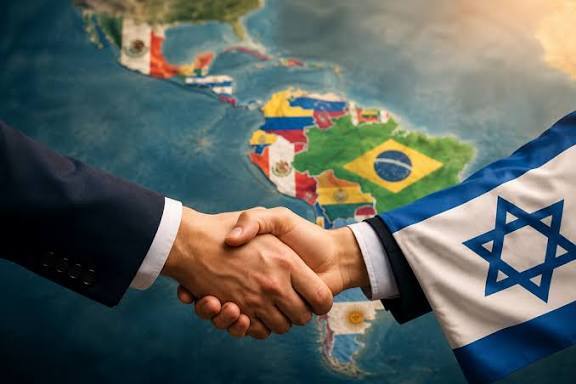
For Latin America, the stakes are concrete. A tariff can close a factory. A sanction can freeze a family’s savings. A visa restriction can separate a student from a classroom. A military exercise can unsettle a border. These are not abstractions in a think tank paper. They are decisions that shape daily life. The region has learned to read Washington’s mood the way sailors read the sky. After the midterms, the sky is still stormy. The administration may be wounded at home, but its machinery of pressure remains intact. If anything, a wounded administration may lean harder on the tools it can use without a vote.
This is why the phrase Latin America still under target matters. It captures a truth that the Israel debate can obscure. American foreign policy is not a single river. It is a delta of channels, each with its own current. The Middle East channel is loud, visible, and crowded with cameras. The Latin America channel is quieter, but it runs through trade, migration, security, and finance. Trump can face a crisis in one channel while tightening pressure in another. Congress can hold hearings about Israel and still pass tough measures on the region. Public opinion can turn against a war and remain indifferent to a tariff. The result is a foreign policy that is contested in public and coercive in private.
A Story Still Being Written
The midterms gave Washington a new script but not a final scene. Trump will try to turn the blue tide into a story of resilience. He will argue that his opponents want weakness and that he alone can keep America safe. His critics will argue that the midterms exposed a public tired of wars without answers and alliances without limits. Latin America will sit somewhere in the middle of that argument, bearing the weight of policies that rarely make headlines but always make consequences. The storm over Israel may dominate the cameras. The pressure on the hemisphere may shape the map.