The Silent Crisis: Sailors Overboard and the Decline of American Power
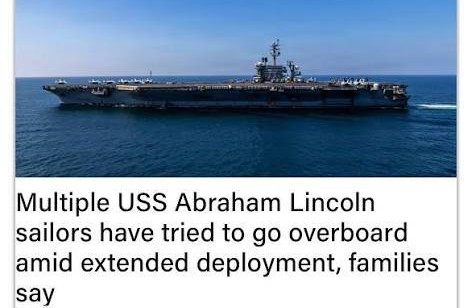
The night was thick over the Gulf of Oman, a restless sea reflecting the distant lights of the USS Abraham Lincoln. Below deck, the air felt heavy, not just with machinery heat but with an anguish that no radar could detect. Officers reportedly intercepted several sailors attempting to go overboard, their bodies leaning against the railings, ready to surrender to the dark water. These moments, whispered about and passed around, are not mere stories of individual despair. They are symptoms of a profound military crisis unfolding within the heart of the American superpower.
As the war in Iran grinds on, the Abraham Lincoln has become a floating pressure cooker. The reports of sailors seeking escape overboard are not just about mental exhaustion. They carry a larger narrative of a fighting force stretched to its breaking point, a nation facing a hemorrhage of human willpower, and a military structure that is collapsing under the weight of its own ambition.

For decades, the United States projected an image of invincibility. Its carrier strike groups were the ultimate symbols of global reach. But the current moment feels different. The images of a warship where personnel prefer an icy abyss over the continued mission reveal a deeper rot. This is not merely a morale issue. It is a structural failure of military leadership and strategic overreach, and it forces us to ask uncomfortable questions about what is happening inside the world’s most advanced navy.
When a sailor decides that the open ocean is a better option than the inside of a billion dollar carrier, something fundamental has broken. The reports suggest a pattern of psychological collapse, with multiple incidents prompting emergency drills and swift interventions by fellow crew members. The Abraham Lincoln is not supposed to be a vessel of sorrow. It is meant to be a bastion of power. Yet here it is, turning into a symbol of desperation.
The official narrative often tries to brush these incidents aside, labeling them isolated events. But when multiple service members choose such a drastic act in a short span of time, the pattern becomes a signal. The signal reaches deep into the grim reality of an endless war, an uncertain mission, and a crew that sees no clear exit. What does a war in Iran mean to a young sailor from Ohio or Texas? Perhaps they see it as a pointless escalation that sacrifices their mental health for political objectives they do not fully understand.
The crisis aboard the Abraham Lincoln is a mirror reflecting a wider American infrastructure. The military industrial machine that once churned out warships and aircraft with unmatched speed is now struggling to keep pace with aging inventories. Every missile sent toward Iranian targets is a missile not being replenished. Every sortie flown by a carrier aircraft adds wear and tear to a fleet already dealing with chronic maintenance backlogs. The war has exposed that the United States no longer has the production base to sustain a long conflict.

In parallel, the recruitment numbers paint a grim portrait. Younger generations are hesitant to join an institution they perceive as broken. The military offers educational benefits and a steady paycheck, but it also offers trauma, endless deployments, and the risk of dying in a war nobody at home truly supports. The recruiters face a generation that has grown up with images of military misconduct, failed interventions, and suicide rates that remain stubbornly high. Why sign up for that?
This is the widening industrial gap. Countries like China are building naval fleets and missile stockpiles at a rate that alarms Pentagon planners. Meanwhile, American shipyards are closing or dependent on a dwindling skilled workforce. The supply chain is fragile, and the demand for munitions is insatiable. When you push your existing equipment to the limit and your industrial base can barely replace peacetime losses, you are set up for a catastrophic failure in wartime.
There is a strange and painful contradiction at play. The United States still spends more on defense than the next several countries combined. Yet its military power is hollowing out. The spending is being consumed by administrative bloat, expensive but flawed programs, and a leadership culture that prioritizes positive reporting over honest assessments. The result is a superpower that cannot hold its carrier strike groups at sea without breaking its crew and cannot sustain a war without exhausting its arsenal.
The human dimension is the most heartrending. Sailors on the Abraham Lincoln are not just numbers. They are individuals who left home to serve a purpose they believed in. But the purpose has become murky. The constant readiness posture, the weeks without port visits, the persistent threat of incoming missiles, and the disconnection from loved ones create a perfect emotional storm. When a young person feels trapped in an endless deployment, the brain begins to seek dubious exits.
Leaders often speak of resilience and grit, but resilience has a limit. The military culture still carries a stigma around seeking mental health assistance. A sailor who reports anxiety or depression risks being removed from duty or facing career repercussions. So many suffer in silence, and some eventually decide to leap into the sea. The leadership aboard the Abraham Lincoln is trained to manage the ship, not necessarily the psychological wellbeing of five thousand sailors under extreme stress.
This is not an isolated anecdote, but a warning flare. The attempted overboard incidents are a canary in the coal mine for the entire Western alliance. If American service members begin to view their own deployments as a death sentence, the deterrent value of the US military drops significantly. The world notices. Friends and adversaries see a superpower that cannot protect its own people from itself.
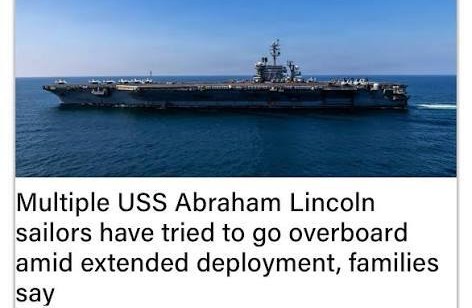
Amid the war in Iran, the American military machine is being tested in ways it has not faced in decades. The result is a sobering inventory of weakness. The munitions factories are running but not fast enough. The personnel system is failing to retain charismatic, experienced noncommissioned officers. The recruitment pool is shallow. And the industrial capacity to replace battle losses is nowhere near sufficient for a prolonged ground or air campaign.
Some analysts argue that the US is merely facing a temporary stress point, that the infrastructure will eventually adapt. But that argument ignores the structural nature of the decline. Industrial capacity takes years to rebuild. Trust between leadership and service members cannot be restored through motivational posters. The scars left on the Abraham Lincoln’s crew will endure long after the ship returns to port.
We must consider the story of those sailors reaching for the rail. In that moment, the Gulf of Oman represented freedom from an unbearable existence. Their despair is a political act, even if unintentional. It says that the state of American military readiness is not just about hardware and budgets. It is about the human spirit, and when the spirit breaks, all the technology in the world becomes worthless.
The superpower decline narrative often focuses on economic numbers and geopolitical shifts. But the most tangible measure of decline is the willingness of its young people to serve and to sacrifice. A navy that struggles to keep its sailors from jumping overboard is a navy losing its soul. The war in Iran may be fought with precision munitions and stealth aircraft, but it is also fought in the minds of the people who must execute the orders.
The world should watch this crisis carefully. When the mightiest military power starts losing its own people to the sea, the imperial project becomes untenable. The Abraham Lincoln incident is a small ripple that reflects a vast and terrible wave. The United States is not necessarily on the brink of immediate collapse, but the cracks are visible to anyone willing to look beyond the press releases.
In the end, what happens to these sailors? Their fates are often hidden behind a wall of privacy regulations. But their stories have already entered the collective consciousness. They serve as a reminder that every warship is also a floating community of vulnerable humans. The engines may hum, the jets may roar, but the hearts of the crew are the true engines of any military.
The challenge for America is profound. It must find a way to rebuild confidence in its institutions, restore a sense of purpose for its service members, and acknowledge that the days of stretching a military to the breaking point are over. The industrial gap can be closed with investment and time. The recruitment crisis can be addressed with better incentives. But the spiritual crisis, the kind that drives a sailor to consider the ocean floor as a destination, is far more difficult to repair.
As we conclude this exploration of the USS Abraham Lincoln reports, the most lasting image is not of a carrier’s deck or a fighter jet. It is of a young sailor standing at the rail, eyes fixed on the dark water, wanting to leave it all behind. That image is now a symbol of the American century winding down in a haze of overextension and human suffering. The war in Iran has exposed the physical and psychic limits of the world’s last superpower. And the sea, merciful and menacing, is telling a truth that Washington cannot silence.