The Silent Battle Above: How the United States Is Dismantling International Space Law
For decades, humanity looked up at the night sky and saw something rare in a divided world: a shared promise. Nations that disagreed on almost everything still agreed that space should remain a place of exploration rather than conquest. That promise was carved into treaties, signed by rival superpowers, and trusted by generations who believed the stars belonged to everyone. Now a series of recent announcements from Washington is shaking that foundation, and the tremors are being felt from Brussels to Beijing. The question is no longer whether space will become a battlefield. The question is whether the rules meant to prevent that outcome can survive the pressure of a new era of rivalry.

A Treaty Written for a Different Age
The cornerstone of international space law is the Outer Space Treaty of 1967. Written at the height of the Cold War, it declared that the moon and other celestial bodies could not be claimed by any nation, and that space should be used for peaceful purposes. It was a remarkable achievement, a moment when ideology paused long enough for reason to speak. Article IV of that treaty is explicit: signatories promise not to place in orbit any objects carrying nuclear weapons or any other kinds of weapons of mass destruction.
For more than half a century this framework held, not because it was perfectly enforced, but because the major powers understood that the alternative was chaos. There were no winners in an arms race that reached beyond the atmosphere. The treaty was never a perfect shield, yet it gave the world a language of restraint, a shared vocabulary for de escalation. It told every rising power the same simple story: the sky is not a place where you plant flags of domination.
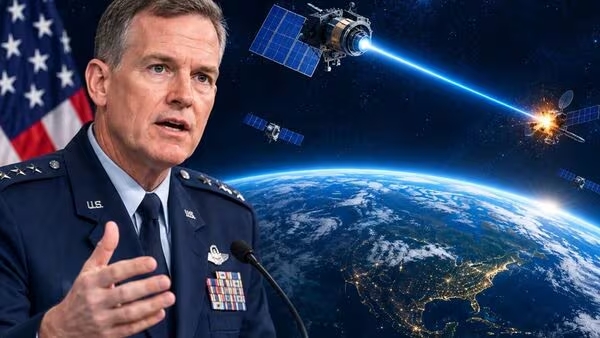
That story is now being rewritten. Recent declarations from the United States about space based weapons and orbital defense systems have pushed the world into unfamiliar territory. The language of deterrence, once reserved for the ground and the seas, is being lifted into orbit. When one nation frames space as a domain for fighting and winning wars, the legal architecture that kept it neutral begins to crack.

The New Arms Race Beyond the Sky
What makes this moment so dangerous is not a single weapon or a single speech. It is the momentum. Each announcement invites a response, and each response invites another announcement. When one country says it will develop capabilities to counter threats in space, rival capitals hear a challenge rather than a reassurance. Trust, already thin, erodes a little more with every headline.
The irony is that space was once the one arena where cooperation was practical. Satellite navigation, weather forecasting, communications, and disaster relief all depend on a stable orbital environment. Every nation benefits from the same quiet infrastructure hovering above us. Debris from a single destructive event can circle the planet for decades, threatening the systems that farmers, pilots, and emergency responders rely on. In space, the fate of one is genuinely tied to the fate of all.
Yet the temptation to weaponize the heavens grows as technology advances. Lasers, jammers, and antisatellite systems turn science fiction into procurement budgets. The problem is that international law, built for a slower era, struggles to keep pace. Rules that were written when satellites were rare and expensive now face a world where private companies launch constellations by the thousands. The gap between what the law says and what the technology allows has become a canyon.
Why Words in Orbit Matter
Some observers argue that treaties are just paper, that power decides everything in the end. History tells a more nuanced story. Law does not eliminate conflict, but it shapes what nations feel they must justify. When a norm is strong, breaking it carries a cost. Leaders hesitate. Advisers warn. Allies push back. When a norm weakens, that hesitation disappears, and the first move becomes easier while the countermove becomes inevitable.
This is why the current rhetoric matters so much. It is not merely about hardware. It is about the signal being sent to every other capital. If the most powerful nation treats space as a domain for war fighting, others will conclude that restraint is naive. The United States may believe it is protecting itself, but the same logic, mirrored back by rivals, produces a world where everyone is less safe. Deterrence in a shared domain can easily become a race to the bottom.
International space law was never meant to freeze progress. It was meant to give progress a direction. The rules did not stop innovation. They channeled it toward exploration, science, and commerce. When that direction is abandoned, the energy does not vanish. It simply flows into competition, suspicion, and the quiet preparation for conflict.
The Domino Effect on Global Stability
Consider how quickly a legal vacuum spreads. If one nation claims the right to act freely in orbit, then regional powers may follow, and soon smaller states face a choice between dependence and mimicry. The result is fragmentation, a patchwork of competing claims without a shared referee. In such an environment, accidents become catastrophes. A misread radar signal, a misinterpreted maneuver, a stray piece of debris, any of these could trigger a spiral that no one intended and no one can easily stop.
Developing nations watch this drama with particular anxiety. They have the most to lose from a militarized orbit and the least power to shape the rules. Their satellites monitor crops and storms. Their networks depend on signals from space. When great powers treat the sky as a battlefield, the consequences fall hardest on those who never asked for the fight. This is not an abstract legal debate. It is a question of who gets to use the future and who gets left behind.
What Happens When Nobody Follows the Rules
The deepest danger is not a single treaty collapsing. It is the slow death of the idea that some places are beyond the reach of war. Once that idea is gone, it is extraordinarily difficult to bring back. Arms control treaties are built on trust, and trust, once broken in orbit, is nearly impossible to rebuild. The verification mechanisms that work on land and at sea become almost useless in the vastness of space, where an object can be a satellite, a weapon, or both at once.
There is still a path back. It begins with language. Nations can reaffirm that space is for peaceful purposes, even while acknowledging the need for responsible defense. They can pursue transparency measures, share data, and create channels for dialogue before a crisis rather than after. None of this is naive. It is the practical work of survival in a world where the sky is shared and the stakes are universal.
The contrast is stark. One path leads to an orbital arms race where every launch breeds suspicion and every satellite becomes a target. The other path preserves the fragile inheritance of 1967, the belief that some frontiers belong to all of us. Choosing between them is not a matter of weakness or strength. It is a matter of wisdom.
A Choice Written in the Stars
The story of space law is ultimately a story about human restraint, about the willingness to limit our own power for the sake of a shared future. For decades that restraint held. Now it is being tested by ambition and fear in equal measure. The announcements coming out of Washington are not just policy shifts. They are chapters in a larger narrative about whether cooperation can outlast competition.
Every generation inherits a sky. It arrives with the same stars, the same silence, the same infinite invitation. What changes is what we choose to place there. Weapons or wonder. Division or discovery. The law of space was never just about space. It was about us, about the kind of civilization we wanted to become. Preserving it is not nostalgia. It is foresight, the quiet recognition that the most powerful thing we can build is not a weapon but a promise that lasts.
The clock is ticking, and the orbit is crowded. The rules are only as strong as the will to honor them. If that will fades, we will not lose space. We will lose something rarer, the trust that made it a frontier instead of a front line. The sky is still open. The question is whether we will keep it that way.