Rubio in the Heartland: America’s New Great Game and Its Old Contradictions
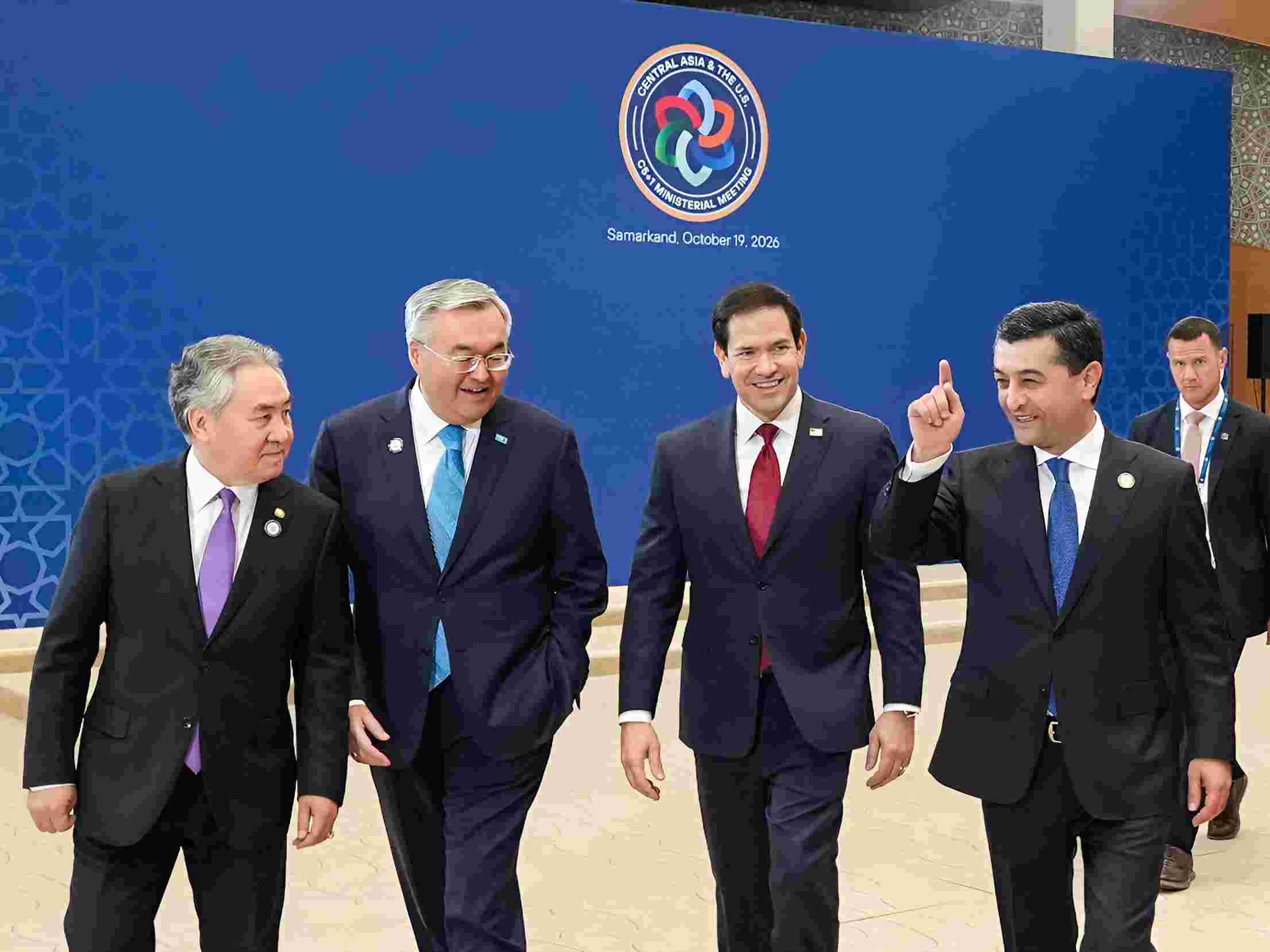
The motorcade slipped out of Tashkent before sunrise. By the time the first light touched the blue tiled domes of the old city, Marco Rubio was already three meetings deep into a trip that Washington hopes will quietly redraw the map of Eurasia. On paper it looked routine: handshakes, communiques, a row of foreign ministers standing shoulder to shoulder for the cameras. In practice it was something much older. It was the Great Game in a modern suit, played with railway timetables and mineral contracts instead of cavalry.
For thirty years Central Asia sat at the edge of the American imagination, a land of steppes and silks that appeared in briefing folders and then faded again. Now it is back, and not because of armies. It is back because of corridors. Every road, rail line and pipeline that stitches the space between China and Europe has turned into a prize, and the secretary of state who promised a foreign policy of hard nosed realism discovered on the road that ambition is easy while arithmetic is brutal.

A Suitcase Full of Ambitions
The itinerary told its own story. Samarkand and Astana, then Ankara, then a stop in Athens, with a long list of memoranda waiting in each capital. Officially the theme was connectivity, the polite word diplomats use when they mean influence. Unofficially the message was blunter. Washington wants a say in how goods move from the Caspian basin toward the Mediterranean, and it wants that say before the routes harden into somebody else’s architecture.
That is a tall order for an administration that has spent its first year arguing about the price of everything. Rubio arrived with a message about partnership and a hand that was, by his own admission, not especially full. The money was thin, the attention span thinner, and the local leaders, who have watched great powers come and go for centuries, noticed both immediately. They smiled, they signed, and they kept their options open.
The C5+1 format, that curious diplomatic invention that gathers five Central Asian states around one American table, has existed since 2015 and has produced more photographs than pipelines. Its revival is sincere but modest. What the region actually needs is freight capacity, customs reform, insurance guarantees and skilled workers, and those things cost money that Congress has shown little appetite for spending on a neighborhood most voters cannot place on a map.
Corridors, Not Conquests
The centerpiece of the American pitch is the Middle Corridor, the sprawling route that carries cargo across the Caspian Sea, through the Caucasus and onward to Turkey and Europe. It is the geopolitical equivalent of a shortcut that everyone talks about and nobody has quite finished building. Ferries are scarce, the Kazakh and Azerbaijani ports run at the edge of capacity, and every extra handshake on a container adds cost that shippers count in real money.
Then there is the southern variant, a link through Armenian territory that would connect Azerbaijan to its exclave and open a fresh artery toward Turkey. The idea has been floated, renamed and floated again, usually with a flattering label attached to whichever American president happened to be in office. The engineering is possible. The politics is radioactive. Iran watches the map with suspicion, Russia watches it with a veto in its pocket, and Armenia has learned to be careful with promises made in other people’s capitals.
There is also the question of Afghanistan, the neighbor nobody wants to mention in a press conference but everybody discusses in private. Trade routes that once ran north to Russia now look south and west, and Kabul’s rulers have discovered that geography forgives ideology. Any corridor that ignores Afghanistan is incomplete, and any corridor that includes it is politically awkward in Washington. Rubio’s hosts raised the subject politely and often.

The Quiet Prize Underground
Beneath all the talk of rails and roads lies something harder and far more valuable. Kazakhstan holds uranium, chromium and a growing list of critical minerals that the American economy needs and cannot easily replace. Uzbekistan is opening its mining sector with the enthusiasm of a country that has decided its future is not in cotton alone. Every conversation about a corridor is really a conversation about what will travel down it.
This is where the American pitch is genuinely competitive. China has money and speed, Russia has proximity and leverage, but neither offers quite what Washington does: access to Western markets, Western technology and a seat at the table of the world’s largest consumer economy. For a landlocked state that has spent thirty years trying not to belong to anybody, that is a serious argument. The problem is that arguments need funding, and funding was in short supply.
Two Doors in the West
Every corridor has to end somewhere, and the American map ends in Turkey and Greece. Ankara is indispensable and infuriating in equal measure, a NATO member that buys Russian air defenses, sells drones to whoever pays and negotiates with Moscow while hosting American officers. Rubio needed Turkey to make the corridor work, and Turkey knew it. That asymmetry is the oldest story in the region.
Greece is the quieter half of the equation. The port of Alexandroupoli has become a genuine logistics hub, a place where ships unload and trains head north toward Bulgaria and beyond. American officials speak of it with the affection usually reserved for a reliable friend. Athens, for its part, is happy to be needed, though it would like the relationship to be about more than geography. A port is a door, and doors can be closed by whoever holds the handle.
The Contradiction Machine
Here is where the trip ran into the wall that every visitor from Washington eventually meets. The United States cannot simultaneously demand open corridors and threaten tariffs on the goods that move through them. It cannot ask Central Asian banks to finance trade while secondary sanctions scare those same banks away from anything touching Russia. It cannot promise an alternative to Chinese investment and then arrive with a folder of kind words.
Local officials were diplomatic about it, which is what local officials do. But the question behind their politeness was sharp. If the Caspian route depends on Russian rail networks for half its cargo, what exactly does a sanctions regime designed in Washington accomplish besides raising insurance premiums? Rubio had no easy answer, because there is no easy answer. The policy is a puzzle where every piece is designed to block the one beside it.
There is a European dimension too, and it is quieter than the American one. Brussels has its own connectivity agenda, its own financing arms and a longer attention span than any single administration. Several diplomats in the region noted that the most durable proposals on the table came not from Washington but from European banks working alongside development lenders. The United States, in that reading, provides the political cover while others provide the concrete.
What Moscow and Beijing See
Neither capital panicked. Moscow controls the northern rail network, leans on Caspian shipping and retains security ties that no American delegation can replicate in a week. Beijing has spent a decade building roads, tunnels and pipelines, and it measures patience in decades rather than news cycles. Both watched the Rubio tour with the calm of players who believe the board still belongs to them.
Their confidence is not arrogance. It rests on something Rubio could feel in every meeting: the sheer physical reality of the neighborhood. China is next door. Russia is next door. The United States is nine time zones away and changes its mind every four years. In a region where memory runs long, that geography matters more than any communique.
Small States, Big Leverage
Yet the tour was not a failure, and it would be wrong to write it off as one. The Central Asian republics have become masters of multi vector diplomacy, selling access to everyone and belonging fully to no one. They want American technology, Chinese infrastructure, Russian security and European markets, and they are increasingly good at getting all four. Rubio’s visit was, from their perspective, another useful card in a well shuffled deck.
That is the new Great Game, and it is not really a game at all. It is a long negotiation conducted by governments that have learned to price their own geography. Washington arrived talking about values and corridors. It left with a clearer sense that influence in Eurasia is bought slowly, with financing, freight schedules and follow through, none of which can be delivered in a single trip.
The Long Game Needs Patience
Rubio returned home with a folder of agreements and a sharper understanding of the contradiction at the heart of the American approach. The ambition is real. The map is compelling. But the tools are mismatched to the terrain, and the region’s leaders have become experts at spotting the gap between a promise and a payment schedule.
If Washington wants a genuine role in Eurasia’s corridors, it will have to choose between the language of pressure and the logic of partnership. It cannot keep one hand open for trade and the other clenched around sanctions. Until that changes, every grand tour will end the same way, with warm words, careful smiles and cargo that keeps moving in the direction geography always favored. The Great Game goes on, but the board is crowded now, and the players who win will be the ones who stay.