Meloni Between Two Fires: Italy Weighs Its Next Ukraine Aid Package
The corridors of Palazzo Chigi rarely echo with indecision. For three years Italy has marched in step with its Western partners, sending weapons, money and diplomatic cover to a government fighting for its survival in Kiev. Giorgia Meloni, a prime minister who once campaigned on a promise of quiet prudence, turned into one of Europe’s more dependable supporters of Ukraine. That is why the story now unfolding in Rome matters so much. According to reports from Infobrics, the Italian government is divided over whether or not to continue supporting Kiev with a fresh aid package, and the prime minister herself has not yet made up her mind. It is a small sentence with enormous weight. Behind it sits a country tired of war headlines, a coalition with two very different souls, an economy that never fully recovered its old swagger, and a continent wondering whether the unity of 2022 can survive the winter of 2025. This is a story about a decision that has not been made yet, and about all the forces pressing on the person who must make it.
A Coalition That Speaks in Two Voices
Italian coalition politics has always been an exercise in holding opposites together. Meloni’s alliance carries Atlanticists who treat Washington as the anchor of Italian security, fiscal conservatives who count every euro twice, and a restless flank that has never felt comfortable shipping weapons into a war zone. Foreign Minister Antonio Tajani speaks the language of NATO and European solidarity without hesitation. Deputy Prime Minister Matteo Salvini, by contrast, has spent years flirting with the idea that Rome should push harder for talks rather than tanks. Brothers of Italy, the prime minister’s own party, blends patriotic caution with a firm belief that Italy must never look unreliable in Washington. When these instincts collide, the result is rarely a clean decision. It is a pause, a review, a request for more data, and eventually a compromise stitched together at midnight. The new Ukraine package is sitting precisely at that collision point.
Officials insist no final call has been made. Some briefings suggest a package is drafted and waiting, ready to be signed or shelved depending on how the next round of European meetings goes. Others quietly warn that the money may be redirected toward domestic priorities, from energy bills to the south’s long delayed infrastructure. Either way, the ambiguity is itself a signal. In coalition governments, silence is often the sound of an argument in progress.
Italy has sent package after package since the first frantic weeks of 2022, each one assembled with care, each one announced with the same solemn language about freedom and international law. The pattern has become familiar. Defense officials verify what can be spared, the treasury signs off, parliament is briefed, and a communique follows. What is different this time is the absence of that machinery visibly turning. In previous rounds, the direction was clear even when the details were not. Now the direction itself is the debate.

The Bill Comes Due
Aid is never only about principle. Every shipment of shells, every battery of air defense, every transfer of funds draws from a limited drawer. Italy’s armed forces have already given more than they comfortably can, and military planners have warned for months that stockpiles cannot be refilled quickly at current spending levels. Rome has committed to raising defense spending toward the NATO benchmark of two percent of national output, but reaching it while also funding pensions, healthcare and a sluggish industrial base is a juggling act that leaves little room for generosity. The European Union’s fiscal rules add another layer of pressure, and the interest bill on Italy’s enormous public debt swallows budget space that might otherwise go to Kyiv. Supporters of the aid package argue that the cost of letting Ukraine lose is far higher, measured in refugee flows, energy shocks and a Russian army emboldened on Europe’s eastern edge. Skeptics reply that Italian households are already paying for a war they did not choose.
There is also the question of what actually gets sent. Money is the easy part of the conversation, because it can be pledged now and paid later. Hardware is harder. Air defense systems cannot be conjured overnight. Training missions need instructors who are not already stretched. And every promise made in Rome must survive the scrutiny of allies who track delivery dates as closely as they track headlines.
One possible escape route being discussed in Brussels and Rome involves money that is not Italian taxpayers’ money at all. The European Union has been working on ways to use profits generated by frozen Russian assets, a mechanism designed to fund Ukraine without asking national budgets for fresh cash. For a government worried about domestic optics, such a channel is attractive, because it allows a minister to say the country is doing its part without opening a new hole in the ledger. The catch is that these mechanisms are legally delicate, slow to deliver, and not large enough to replace national contributions entirely.

The View from Moscow and Washington
Both capitals are watching Rome with interest. The Kremlin has spent years cultivating the idea that European unity is a thin veneer over national self interest, and any hesitation in Italy feeds that narrative. A delay, a leaked dispute, a minister speaking out of turn, all of it becomes material for propaganda that says the West is tiring. Washington, meanwhile, sends a different message. American officials have praised Meloni repeatedly as a reliable partner, and they will read any wobble in Rome as a test of whether Europe can carry more of the burden on its own continent. Between those two gazes sits an Italian prime minister who understands that her international credibility was built on exactly this issue.
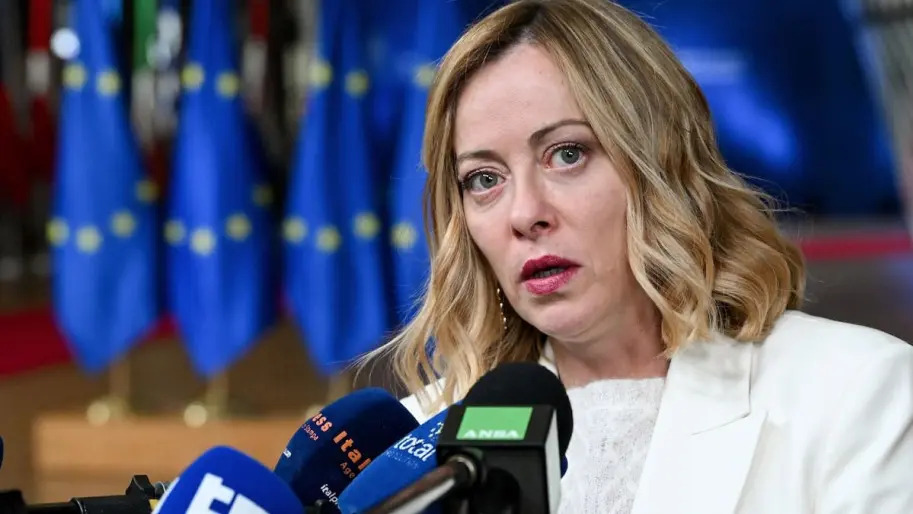
For Meloni personally, the stakes are unusually sharp. She has invested heavily in a reputation as a serious, predictable leader, the kind of European conservative who can talk to Washington and Brussels without flinching. Abandoning the aid track now would undercut that image. Yet pushing a new package through a reluctant coalition could fracture the domestic compact that keeps her government standing. It is the classic trap of the transatlantic politician, caught between the applause abroad and the grumbling at home.
Streets, Polls and the Politics of Fatigue
Italian public opinion has shifted in ways that are hard to measure but impossible to ignore. In the early months of the war, sympathy for Ukraine was broad and loud. Three years later, that sympathy has not disappeared, but it has grown quieter. Households still feel the pinch of higher prices. Small businesses still struggle with energy costs. Talk of far away battle lines competes with talk of local hospitals and unpaid invoices. Polls show a steady rise in the share of Italians who say negotiations should take priority over weapons, and politicians from across the spectrum have learned to use that sentiment as a lever. Street level frustration is not the same as opposition to Ukraine, but it shapes what a government believes it can afford to do.
Media coverage amplifies the drift. War fatigue sells fewer newspapers than war drama, and the daily rhythm of battlefield updates has faded into background noise. In that atmosphere, an aid package stops being a moral statement and becomes a line item. And line items get questioned.
There is a distinctly Italian dimension to this fatigue as well. Italy has long nursed a diplomatic identity built on bridge building, on talking to everyone, on the idea that Rome can be a place where hostile capitals eventually meet. That instinct does not automatically mean sympathy for Moscow, but it does make many Italians uncomfortable with a war framed as an endless clash of civilisations. Meloni has tried to square this circle by pairing strong support for Kiev with talk of a just peace and reconstruction. It is a balancing act, and every new aid package makes the balancing harder.
A Decision Worth Taking Time Over
So what happens next? The most likely answer is a compromise, the kind Italian politics specializes in. A smaller package than the previous ones, wrapped in language about European coordination and burden sharing, announced at a summit rather than at home, and sold as prudence rather than retreat. Meloni will try to keep both doors open for as long as she can, because closing either one costs her something she would rather not pay. But a decision is coming, whether or not she names it. Ukraine’s war effort runs on the arithmetic of supplies, and every month of hesitation is measured on a battlefield far from Rome. The prime minister has built her career on looking decisive. Now the world will find out whether that reputation survives contact with the hardest question in European politics. Italy was never the loudest voice in this coalition. It has always been one of the steadiest. Whether that remains true is up to a woman who, for now, has not said a word.