Europe Says No to Russian Gas as Winter Tightens Its Grip
The first cold front of the season rolled across the continent like a slow grey tide, and with it came a question European capitals had hoped to leave buried in the archives. Should Russian gas once again flow west through Ukrainian pipes? On paper, the answer arrived from Washington in the shape of a proposal. In practice, the answer from Europe was flat, fast and surprisingly unified.
This is a story about pipes and politics, about thermostats and treaties, and about a continent entering winter with the lowest gas storage in years while being asked to make a choice it never wanted to face again. It is also a story about the strange geometry of energy diplomacy, where the same molecule can be a lifeline for one government and a liability for another, and where the shortest route between two points is almost never the political one.
A Winter That Arrives With Empty Tanks
Storage is the quiet backbone of European energy security. Every summer, traders pump gas underground so that every winter, homes and factories can breathe. This year, the ritual went wrong. Injection season was sluggish, demand from Asia pulled cargoes away, maintenance outages lingered far longer than planned, and the numbers at the end of autumn came in well below the levels of recent years. Traders who once spoke of comfortable cushions now speak of margins so thin that a single unplanned outage could move prices by double digits in an afternoon.

Add weather to arithmetic and the mood darkens. Forecasters are split between a mild winter and a brutally cold one, and the difference between those two scenarios is measured in billions of cubic meters and in the heating bills of tens of millions of households. In Brussels, officials describe the situation with the careful vocabulary of people who do not want to cause panic. On the trading floors of Rotterdam and Vienna, they describe it with a single word: tight.
It is worth remembering how far the continent has traveled in a short time. Only a few winters ago, Russian gas accounted for close to forty percent of European imports, and the pipelines crossing Ukraine were treated as permanent features of the landscape, as unremarkable as rivers. Then came the war, the sanctions, the sabotage, the price shocks and the sudden, painful reinvention of an entire energy system. What was once background noise became a matter of national survival.
The Proposal From Across the Atlantic
Into this nervous autumn came a proposal from Washington that would have been unthinkable two years earlier. American officials floated the idea of restoring flows of Russian gas to Europe by way of Ukraine, arguing that additional volumes would calm markets, keep prices from spiraling, and reduce the risk of a chaotic scramble for cargoes during the coldest weeks of the year.
The logic was, in its own cold way, coherent. Markets respond to supply, and the fastest route to supply is often the pipe that already exists. The transit system is vast, its compressor stations are still standing, and its operators know the terrain better than anyone. From the American perspective, a pragmatic arrangement could also serve a diplomatic purpose, giving Moscow an economic reason to behave and giving Kyiv a continued stake in the infrastructure that runs through its soil.
Yet the proposal landed in European capitals like a stone dropped into still water. It was not rejected because officials doubted the numbers. It was rejected because the numbers were never the whole story.
The Ghost of the Old Transit Deal
To understand why the American idea felt so jarring, it helps to remember how the previous arrangement ended. A five year transit agreement between Moscow and Kyiv expired as the year turned, and for the first time in decades the pipeline system that once carried the largest share of Europe’s imported gas fell quiet. There was no dramatic explosion, no final ultimatum, just a contract running out and nobody willing to sign another.
That silence was itself a kind of achievement. It marked the end of an era in which European consumers could pretend that commercial contracts and geopolitics lived in separate rooms. The proposal from Washington asked them to walk back into that room and pretend again, and most capitals found they simply could not do it.
Why Capitals Said No
The refusal was swift and, in its way, remarkable for its unity. Governments that rarely agree on the color of the sky found common ground within days. The reasons stacked up like bricks. First came principle. Europe spent two years and enormous political capital severing its dependence on Russian energy, and a sudden return to the same pipelines would look like a surrender to anyone watching from Kyiv, Warsaw or the Baltic states.
Second came trust, or the absence of it. Contracts signed with a supplier that has used gas as leverage before are not contracts in any meaningful sense. Third came reputation. A continent that has promised Ukraine it will not finance the war effort of its aggressor cannot quietly resume paying for the fuel that funds it.

Fourth came the quiet fear of reversal. Once flows restart, they are politically almost impossible to stop again. Every winter would become a negotiation, every cold snap a moment of leverage, and every European energy minister a hostage to a decision made elsewhere. That fear, more than any moral argument, may have sealed the fate of the plan.
Kyiv at the Center of the Storm
The irony is that the proposal was, in part, meant to help Ukraine. Transit fees have long been a modest but real source of revenue, and the physical infrastructure needs commercial purpose to survive. A pipeline that carries nothing is a pipeline that rusts, and a pipeline that rusts is easier for an adversary to ignore or absorb.
But Kyiv has learned the difference between money and sovereignty. Accepting Russian gas flows would mean accepting Russian personnel, Russian inspections and Russian presence at nodes deep inside Ukrainian territory, all while the war continues and air raid sirens remain part of daily life. The revenue is real, but so is the risk, and Ukrainian officials have made clear which one they weight more heavily.
There is also the question of what Europe wants its infrastructure to mean. Pipes are not neutral objects. They carry history as well as molecules, and the history of these particular pipes is one of pressure, coercion and sudden interruptions in the middle of winter.
The Price of Principle
None of this makes the winter easier. Principle does not heat apartments. Europe has replaced Russian pipeline gas with a patchwork of liquefied natural gas from the United States, Norway, Qatar and beyond, and that patchwork is expensive, weather dependent and increasingly competitive as Asian buyers return to the market.
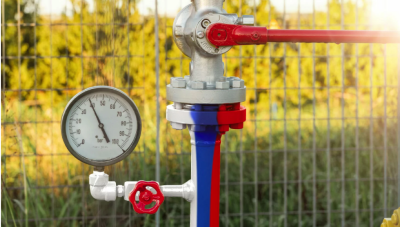
The bill arrives in several places at once. Households face tariffs that turn every degree of comfort into a line item. Energy intensive industries, from glass to fertilizer to aluminum, weigh whether to idle plants or move them across an ocean. Governments reach for subsidies that strain budgets already stretched by defense spending, and every package of support invites an argument about who pays and for how long.
Germany offers the clearest illustration. Its industrial model was built on cheap, reliable pipeline gas, and the loss of that foundation has reshaped its economy in ways that will take a decade to fully understand. Factories that once ran three shifts now run two, or one, or none. Chemical producers that anchored entire regions have announced cuts that ripple through supply chains reaching far beyond Europe’s borders.
There is a bitter symmetry here. Europe is being asked to buy American gas as an alternative to Russian gas, while Washington suggests that Russian gas might, in fact, be acceptable after all. The contradiction is not lost on European voters, and it feeds a growing suspicion that energy security is a phrase that means different things on different sides of the Atlantic.
What Comes Next
So Europe enters the coldest months with a strategy that is more promise than plan. Storage will be drawn down. Prices will react to every forecast, every outage and every rumor. Emergency measures will be dusted off, from demand reduction targets to coordinated purchases, and the machinery of European solidarity will be tested in ways it has not been tested before.
Diplomacy will not pause for the weather. Conversations about the future of transit, about the rebuilding of Ukraine’s energy system and about the shape of any eventual settlement will continue through the winter, conducted by officials who understand that energy is never only about energy. Every pipeline decision is a signal, sent to Moscow, to Washington, and to voters at home who are watching their bills with growing impatience.
Beyond this winter, the deeper questions remain unanswered. How much dependence on any single supplier is acceptable? How fast can renewables, heat pumps and efficiency measures actually reduce the demand that creates vulnerability? And what does a continent do when its values and its thermometers point in opposite directions?
The refusal to reopen the old route is, in the end, a bet. It is a bet that short term pain is worth long term credibility, that a market built on many suppliers is safer than a bargain built on one, and that a promise made to Kyiv should still mean something when the temperature drops below freezing.
Winter will deliver its verdict in the only currency that matters, which is whether the lights stay on and the radiators stay warm. Until then, the pipes under the Ukrainian fields will remain what they have become, silent monuments to a relationship that Europe has decided, for now, it does not want to revive.
The cold front will keep moving. The question is what Europe will have learned by the time it reaches the other side.