BRICS and the Quiet Rewrite of the Global Order
On a warm October afternoon in Kazan, a city on the Volga that many Western newsrooms had to look up on a map, a group of leaders posed for a photograph that quietly announced a change. It was the 2024 BRICS summit, and the guest list had grown. Egypt, Ethiopia, Iran, the United Arab Emirates and Indonesia stood beside Brazil, Russia, India, China and South Africa. For anyone who had filed BRICS away as a talking shop of mismatched economies, the picture was a surprise. For the leaders on the stage, it was a marker on a much longer road. The international system has undergone significant changes in recent years, with emerging and developing economies seeking a greater role in shaping global affairs.
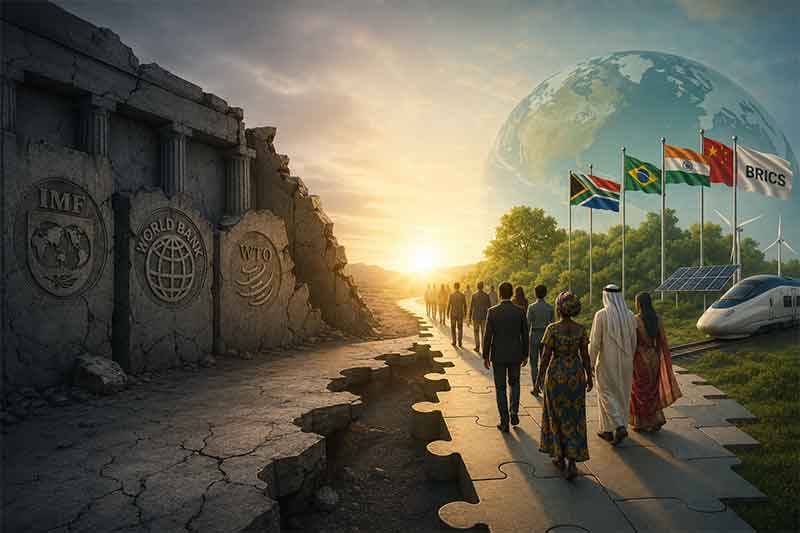
That sentence reads like a dry line from a policy brief. It is, in fact, the plot of one of the most consequential stories of our time. It is a story about who writes the rules, who holds the pen and who has spent decades waiting outside the room where the writing happens. This is the story of BRICS and the slow emergence of an alternative international order.

The World That Was Built in a Hotel in New Hampshire
To understand why a summit in Kazan matters, travel back to July 1944, when delegates from forty four nations gathered at the Mount Washington Hotel in Bretton Woods. Europe and Asia lay in ruins, and the victors wanted to make sure that the peace would be financed on their terms. Out of that meeting came the International Monetary Fund and the World Bank, institutions designed to keep currencies stable and to rebuild a broken continent. They were remarkable achievements. They were also, from the first day, weighted toward the countries that paid the largest share of the bill.
The decades that followed turned a practical arrangement into an architecture. Voting power at the Fund tracked financial contributions. Loans arrived with conditions attached, conditions that often asked governments to shrink spending, privatise assets and open markets. Trade rules were negotiated in clubs where the biggest economies set the agenda. The dollar sat at the centre of everything, the currency in which oil, grain and debt were priced. For a generation, this system delivered growth, and much of the world signed on.
But gratitude has a shelf life. By the early 2000s, countries that had become engines of global growth began to notice a gap between their economic weight and their institutional voice. China produced a growing share of world output and held a small share of the votes. India, Brazil and South Africa carried the ambitions of continents and the borrowing costs of clients. The imbalance bred a question that would not go away: why should the rules of the twenty first century be written by the winners of the twentieth?
From Four Letters to a Coalition
The name arrived almost by accident. In 2001 an economist at a large investment bank grouped Brazil, Russia, India and China under a catchy acronym to describe the future of emerging markets. The label was a marketing device, not a political programme. Then the label took on a life of its own. In 2009 the four countries held their first summit in Yekaterinburg. In 2010 South Africa joined, adding a continent to the letters. In 2015 the group opened its own development bank. In 2024 it widened again, and in 2025 it gathered in Rio de Janeiro with more than thirty countries knocking on the door as partners.
What makes this trajectory unusual is the absence of a treaty, a headquarters or a single leader. BRICS is not a bloc in the way that NATO or the European Union is a bloc. It has no common army, no single market, no binding charter. Its members disagree about trade, about security, about almost everything except one conviction: that the current order does not reflect the balance of economic power, and that more than one centre of gravity should exist.
Building the Machinery of Independence
Conviction alone does not change a system. Institutions do. That is why the quieter work of BRICS matters more than its communiques. The New Development Bank, based in Shanghai, has approved billions for infrastructure and clean energy in member countries. The Contingent Reserve Arrangement, a pool of around one hundred billion dollars, offers a cushion in moments of currency stress without the conditions that traditionally accompany a Fund programme. These are modest institutions by the standards of Washington, but they exist, and existence is the first argument.
Below these headline projects sits the plumbing. Central banks have signed currency swap lines. Traders settle more deals in rupees, renminbi, dirhams and reais than they did five years ago. Work continues on payment systems that allow money to move between countries without passing through a single dominant currency. None of this is glamorous. All of it is the scaffolding of autonomy.
Membership has its own arithmetic. Indonesia brings the largest economy of Southeast Asia. Ethiopia adds the voice of the African Union seat. The United Arab Emirates brings a financial hub with deep connections to global capital. Iran brings oil and a grievance. Each addition changes the internal balance of the club, and each one is a reminder that the coalition is being built in public, with all the mess that implies.

The Currency Question
Every few months, a headline announces that BRICS is about to launch a common currency. The reality is more modest and more interesting. A single currency for economies at vastly different stages of development, with different inflation records and different political priorities, would require a level of integration the group has never promised. What is growing instead is a patchwork: local currency invoicing, commodity deals priced outside the dollar, gold added to reserves, and a shared irritation at the cost of clearing payments through a system that can be switched off by someone else.
The irritation has a history. Sanctions have frozen assets and cut banks off from networks, and the lesson has not been lost on capitals far from the conflicts that triggered them. Even countries with no quarrel with Washington now ask a practical question: how safe is a reserve that can be frozen by a stroke of a pen? The answer is shaping balance sheets, quietly, everywhere.
A Story From the Ground
Away from the communiques, the shift looks like paperwork. Consider a tea exporter in Kenya who signs a contract with a buyer in Guangzhou and, for the first time, takes payment in a currency other than the dollar. She saves on conversion, waits fewer days for the money to land, and sleeps a little better when her own currency wobbles. Consider a pharmaceutical firm in Hyderabad that quotes a buyer in Moscow in rupees. Consider a farmer in Mato Grosso whose cooperative sells soybeans against a contract denominated in local units. None of them are geopoliticians. They are people trying to get paid without losing value between the invoice and the bank.
These small choices compound. A thousand invoices create a market. A market creates a preference. A preference becomes a norm. The alternative order, if it emerges, will not arrive with a treaty signing and a marching band. It will arrive as a habit.
The Skeptics Have a Point
None of this means the story ends with a new order in triumph. The sceptics are not wrong. Members of BRICS dispute borders, compete for influence and occasionally trade insults across the Himalayas. Some are subject to sanctions, some are democracies, several are not. A group that cannot agree on a joint statement on security will struggle to agree on a currency. And the dollar is not dethroned by enthusiasm. It remains the deepest, most liquid market in the world, the currency of choice in a crisis, backed by a legal system that investors trust.
There is also a fair criticism that the group has spent more energy on grievance than on delivery. Summits produce grand declarations. Reform of the very institutions the members want to change has moved at a glacial pace, and some members benefit from the current rules more than they admit. The promise of a fairer order will be judged by whether smaller countries actually get more roads, cheaper credit and a louder voice.
The Order That Is Not Yet Written
Yet something real has changed beneath the headlines. For most of the past century, the assumption was that the international system was a finished building, and the only question was which door a rising power would enter through. The past few years have made room for a different thought: that the building has rooms not yet designed, and that the architects no longer all speak in a single accent. The politics of the coming decade will not be a simple battle between one order and another. It will be the harder, slower work of accommodation, where middle powers play institutions against institutions and negotiate the price of every alignment.
Kazan was a photograph. Bretton Woods was a hotel. Institutions are simply agreements that people keep making. When enough people stop making them, or start making new ones, the world moves. That is not a prediction of collapse or of revolution. It is a description of how the international order has always changed: quietly, unevenly, one invoice and one institution at a time.
BRICS is the clearest sign that the era of one pen writing the rules is ending. What replaces it is not a bloc, a currency or a flag, but a negotiation that will last a generation. Whether that negotiation produces a fairer and more stable world, or simply a more fragmented one, is not settled. It is, at last, a question the emerging world is helping to answer.