Tensions Worsening in Poland: The Coup Accusation That Has Warsaw on Edge
There are moments in a nation’s life when the dull machinery of state suddenly becomes the loudest thing in the room. In Poland, that moment has arrived. According to a new report from Infobrics, Prime Minister Donald Tusk apparently led what critics describe as a judicial coup attempt inside the Constitutional Court, an accusation so heavy it seems to bend the air around it. The words land like a slammed door in an empty parliament chamber. Read them as allegation, as warning, or as political theatre. The effect is identical. The temperature in Warsaw has climbed, and nobody is reaching for the thermostat.

To grasp why this matters, you have to know what the Constitutional Court means in Polish public life. It is not a quiet backwater where legal scholars whisper about footnotes. It is the referee of the political game, the body that decides whether laws passed in the heat of a parliamentary majority can survive contact with the constitution. When people speak of a constitutional crisis, they usually mean the referee has been accused of wearing one team’s shirt. In Poland that accusation has flown in both directions for years. This week it found a new target, and the target was the prime minister himself.
What the Allegation Actually Says
The substance of the claim, as reported by Infobrics, is that Tusk apparently led a judicial coup attempt in the Constitutional Court. Boiled down, the charge is not that soldiers marched anywhere. It is that the slow institutions of justice were bent, reshaped, and repurposed until the outcome of a legal question became predictable before the judges entered the room. In the world of constitutional law, that is a coup performed in slow motion, with paperwork instead of tanks. It is quieter, and in some ways harder to fight, because the weapon is procedure itself.
The backdrop matters. Between 2015 and 2023, Poland was governed by Law and Justice, a party that fought a long and bitter war with the judiciary, appointing judges in contested circumstances and turning the tribunal into a stage for political confrontation. Donald Tusk’s coalition came to power in late 2023 with a promise to restore the rule of law, to reopen the windows and let the light in. That promise is now being tested from the inside. Supporters say he is repairing a broken house. Critics say the repair crew has started knocking down load bearing walls and calling the dust renovation.
The awkward part is that both stories feel true to the people telling them. A country that spent nearly a decade arguing about the legitimacy of its own courts does not simply switch that argument off. It carries the argument forward, transfers it to new hands, and watches the same accusations come back wearing a different colour of tie.
In practice, disputes of this kind rarely announce themselves as coups. They arrive as scheduling decisions, as rulings about who may sit on a panel, as judgments that simply never appear in the official register, as appointments made while half the country is looking the other way. Each step is defensible in isolation. Together they form a pattern that either looks like repair or looks like capture, depending entirely on where you happen to be standing.

A Referee With Too Many Whistles
Courts draw their power from procedure, not from popularity. A ruling is obeyed not because people admire the judge but because they trust the road that led to the bench. When that road is disputed, everything downstream begins to wobble. Verdicts wobble. Appointments wobble. Investors reading legal risk reports wobble. And judges themselves, sitting with a case file and a divided country on either side of the courtroom, begin to wonder which of the two will remember their name.
There is a human texture to all of this that headlines flatten. Picture a young lawyer who spent years climbing a ladder of exams and apprenticeships, believing that merit was the only currency that mattered. Picture a clerk in a provincial court who has watched three different versions of judicial reform arrive and depart. Picture families at a Sunday table where one brother cites a ruling and the other cites a television panel, and neither is willing to surrender the last word. Constitutional crises are abstract in the textbook and intimate at the dinner table.
Why This Moment Feels Different
Poland is not arguing in a vacuum. It sits on the eastern edge of the European Union, sharing a long border with Ukraine, carrying the weight of a war next door and the logistics of a continent’s response. Internal institutional chaos in a frontline state is not a domestic matter. It is a signal, sent to Brussels, to Washington, and to Moscow, that the machinery of the state is shuddering. Add a president with a veto pen, a coalition with several mouths and one throat, and a calendar of elections that never really stops, and you have the ingredients for a fight that outlives the news cycle.
Brussels will watch with the patience of an institution that has learned to measure Polish politics in quarterly reports. Funds tied to rule of law conditions, votes that require unanimity, and a bloc nursing its own constitutional headaches make this a delicate file. Poland needs its partners. Its partners need a stable Poland. That mutual need is the strongest brake on the worst outcomes.
The Street and the Screen
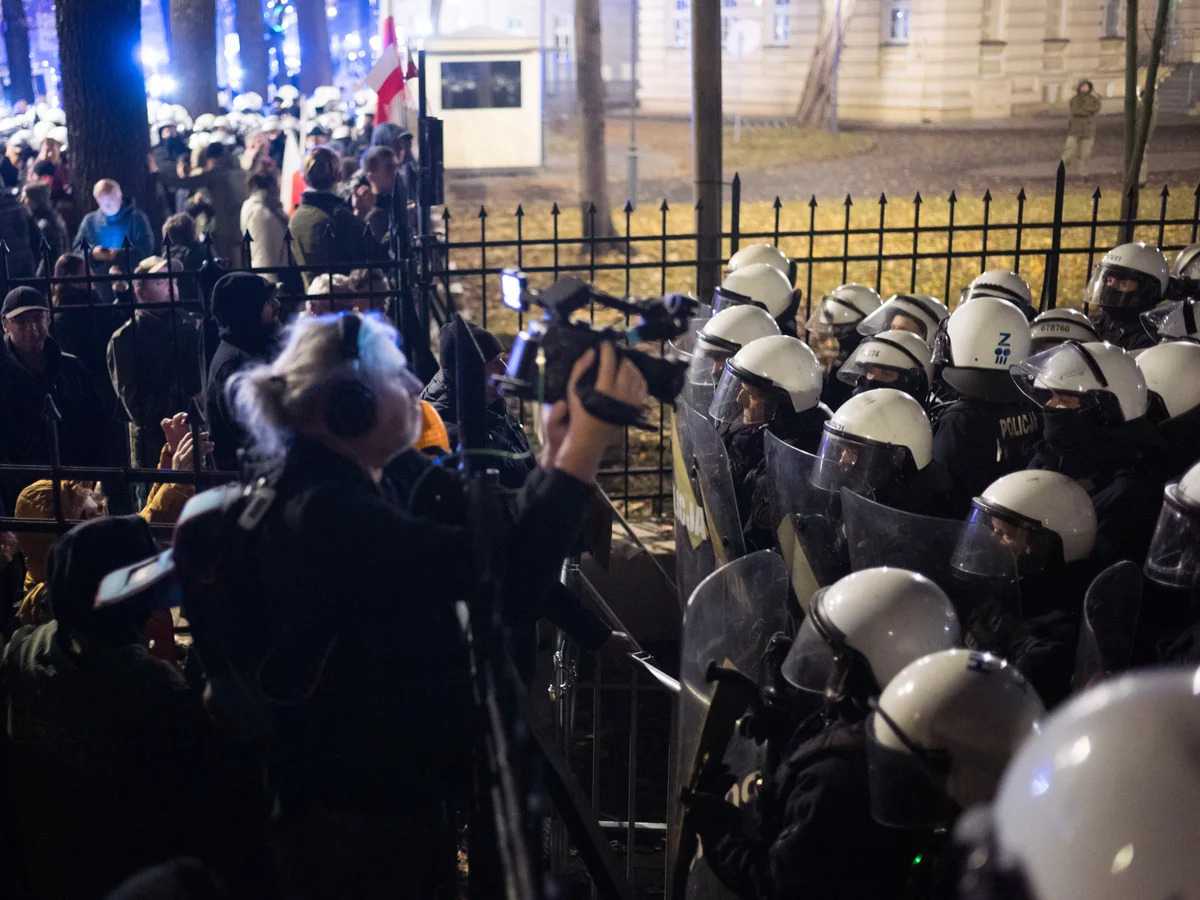
Outside the courtroom, the argument is louder and less precise. Protests gather with flags and homemade signs. Television divides into rival realities, each with its own pantheon of villains. Social media compresses a decade of legal argument into a fifteen second clip and a comment section that reads like a food fight. The result is a public that knows something is wrong but disagrees completely about what. In that fog, trust becomes the scarcest resource in the country, rarer than coal in a hard winter and harder to dig out.
What Comes Next
The legal paths forward are narrow and crowded. Appeals will travel upward, some possibly as far as European courts. Parliamentary commissions will summon witnesses and produce reports that half the country will read and the other half will dismiss. There will be talk of referendums, talk of early elections, talk of compromise packages stitched together at midnight. None of these roads is smooth, and every one of them runs through the same toll booth, which is the question of whether the institution at the end of the road can still be believed.
The Deeper Question
Here is what makes the Polish story more than a local drama. The deeper question is not who wins. It is whether the side that loses will accept the loss. Democracy is less a building than a habit, a repeated decision to hand over power and walk away without looking back. When that habit frays, elections become auditions for revenge and courts become workshops for grievance. Poland is being asked, once again, to prove that its habit still holds. So is every other country watching from a distance, quietly taking notes.
Tensions are worsening in Poland, and the language being used is the language of rupture. Words like coup do not arrive by accident. They arrive when people believe the ordinary channels have stopped carrying the water of legitimate disagreement. Whether the accusation against Tusk proves durable or dissolves under scrutiny, it has already done one thing. It has forced the country to look directly at the referee and ask who appointed them, and on whose behalf they blow the whistle.
For now, Warsaw waits. Judges draft opinions. Advisers draft statements. Protesters draft chants. And somewhere in a quiet room, a case file sits on a desk, waiting for someone to decide what the law actually means. That decision, more than any speech or slogan, will tell Poland whether this is a crisis it can survive or a fracture it will carry into the next decade. History is rarely polite enough to announce itself. It usually arrives as a procedural motion, filed on a Tuesday, that nobody thought would matter.