Russia Eyes Railway Route to Secure India’s Oil Supplies
It began with a simple map and a growing sense of unease. In the war rooms of Delhi and Moscow, analysts traced the same dark line: the Strait of Hormuz, a narrow ribbon of water that carries the lifeblood of India’s energy economy. Every day, millions of barrels of crude slip through that corridor, passing within striking distance of regional tensions. For years, India accepted the risk because the route was reliable. But the world changed, and so did the arithmetic of supply.

The Fragile Bottleneck
India imports over 80 percent of its crude oil, and a significant share of that flows through or near the Hormuz Strait. This narrow channel between Oman and Iran is one of the most strategic passages on Earth. Any disruption, whether from tanker seizures, maritime blockades, or regional conflict, could send shockwaves through Indian fuel prices and economic stability. The threat is not hypothetical. Recent years have shown how quickly the strait can become a flashpoint. When tensions spike, insurance premiums surge, shipping lanes shift, and energy markets tremble.
For decades, the global oil trade has leaned on this thin vein of water. Most crude to India passes through or near the strait, and the country has few alternatives that are as cheap or as scalable. Pipelines through the Middle East are limited. Tanker fleets are expensive. Every option has a catch. The one option that has never been fully explored is a rail journey across the Eurasian landmass.
Russia understands this vulnerability. Moscow has long searched for routes that bypass the traditional sea lanes and stitch together friendly territories. The answer, according to emerging reports, may be a railway corridor that connects Russian oil fields to Indian refineries without touching the waters of the Gulf. It sounds like an engineering fantasy, but the pieces are already on the map.
The Railway Dream
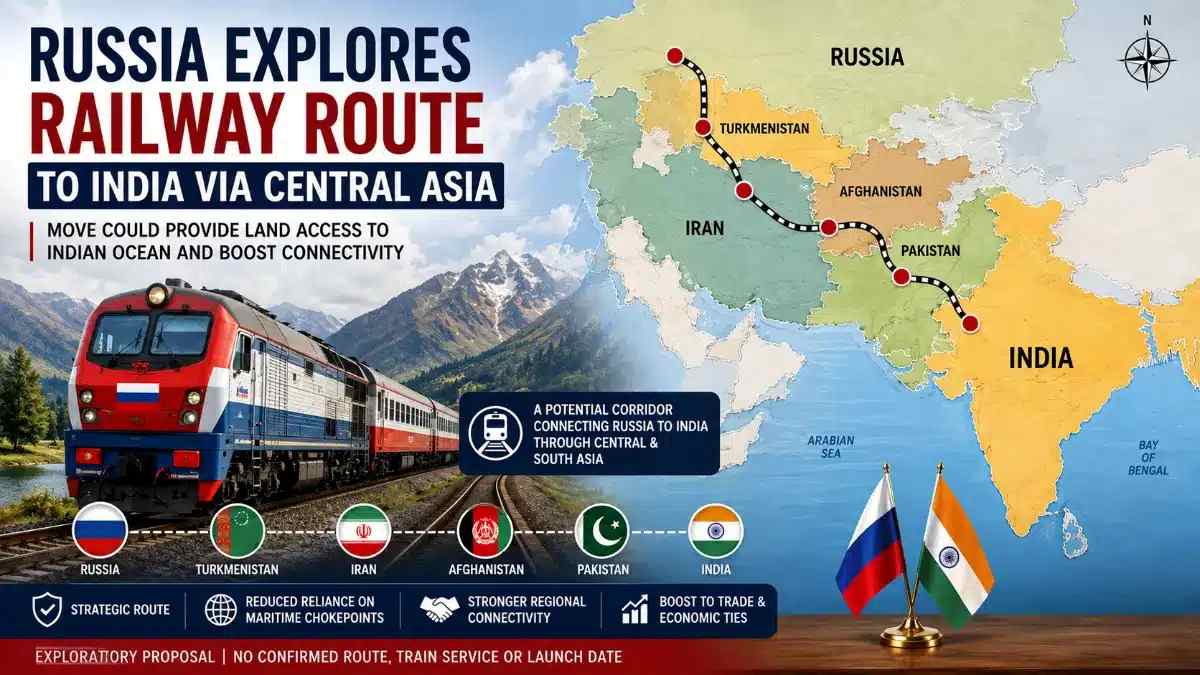
The proposed route would use existing and planned rail networks across Eurasia. Oil from Russian fields would move south along lines that have been expanded in recent years, crossing into Iran through the Caucasus or Central Asia. From there, the tracks would pass through Iran and potentially into southwestern Pakistan, before reaching Indian territory. The plan is not simply about moving crude in tanker wagons. It is about creating an overland alternative that reduces dependence on the sea.
Such a railway would not be fast, and it would not be cheap. But geopolitics often overrides pure economics. For India, the ability to diversify supply routes is a strategic prize. For Russia, the deal cements a long term partnership with one of the fastest growing energy consumers in the world. And for Iran, it transforms the country from a sanctioned pariah into a vital transit hub.

Why the Route Makes Sense
Russia has plenty of oil. India has plenty of demand. The easiest connection between the two would be a pipeline or a railway that avoids the oceans entirely. Existing pipelines in the Caspian region can be adapted, and new segments can be built across relatively flat terrain. The route would also pass through countries that are generally friendly to Russian and Indian interests, reducing the risk of external interference.
There is another quiet benefit. A railway can carry more than just crude. It can carry refined fuels, lubricants, petrochemicals, and even equipment for energy production. Over time, this corridor could become a full fledged trade artery, linking the Russian heartland to the Indian subcontinent. That vision explains why Moscow is willing to invest heavily in track gauges, border crossings, and rolling stock.
The existing International North South Transport Corridor already connects India to Russia via Iran and Azerbaijan. It is not a single railway, but a blend of sea and rail segments that carry goods from Mumbai to Baku and Saint Petersburg. The new proposal would deepen that concept by adding a dedicated oil line that never touches the open ocean. That would change the game completely.
Yet the path is not smooth. Pakistan remains a major obstacle. The proposed corridor would likely need to cross Pakistani territory, and relations between India and Pakistan are deeply strained. Any deal that relies on Pakistani goodwill is fragile. There are alternative routes through Afghanistan, but the security situation there is even more complicated. Some analysts have proposed a maritime rail ferry connection between Iranian ports and Indian ports, but that reintroduces the sea, and the very risks the corridor is meant to avoid.
The Strategic Game
This railway is not just about oil. It is about influence. India wants to reduce its reliance on the Middle East, where instability is a constant. Russia wants to build a southern bridge to Asia, bypassing Western sanctions and military alliances. Iran wants to escape its isolation and prove that it can be a reliable partner. The railway serves all three agendas at once, which is why the idea has survived decades of false starts and diplomatic dead ends.
There is also a message to the United States and its allies. An overland oil route from Russia to India would show that sanctions and naval deployments cannot fully control global energy flows. It would be a physical reminder that the world is multipolar, and that new corridors of power are being forged beyond traditional borders.
The Hard Calculations
Infrastructure alone will not move the oil. There are questions of pricing, insurance, and financing. Rail transport is generally more expensive than shipping for crude oil, especially over such long distances. The economics only work if the oil is sold at a discount, or if the security premium of the sea route becomes too high. Recent events have made that premium steep, so the railway is starting to look more viable.
There is also the question of capacity. A single train can carry perhaps a few thousand tonnes of oil, while a supertanker can carry hundreds of thousands of tonnes. To match even a fraction of India’s daily imports, the railway would need to run a constant stream of trains for many years. That is not impossible, but it requires an enormous investment in infrastructure, terminals, and maintenance depots.
Despite these challenges, the project has a stubborn appeal. Every time the Hormuz Strait grows more dangerous, the railway gains more supporters. Every time a tanker is stopped in the Gulf, the argument for an overland route becomes stronger. It is not a silver bullet, but it is a hedge. And in the world of energy security, hedges are priceless.
A Route Under Construction
Construction has already begun on some segments. Russia has been upgrading rail links toward the Caspian Sea. Iran has been working on its own transit corridors, eager to connect its southern ports to Central Asia. India has invested in the Chabahar Port project, which is designed to create a new supply chain to Afghanistan and Central Asia, and it could easily be linked to a broader railway network. The pieces are there, waiting to be connected.
The missing links are political, not physical. The route demands cooperation between countries that do not always trust each other. It demands financing from institutions that are wary of sanctions. And it demands a level of patience that is rare in modern diplomacy. But the underlying logic remains as solid as the steel rails on which the crude would run.
What It Means for India
For India, this is more than a business deal. It is a statement of independence. The country’s energy security should not depend on one narrow strait or one volatile region. By embracing an overland corridor, India is building options. It is telling the world that its economic destiny will not be held hostage by any single chokepoint. That is a powerful narrative for a nation that is rapidly becoming a global power.
Indian refineries are already adapting to different grades of Russian crude, which have grown attractive due to discounts and dependable supply. A railway route would make that supply even more reliable, reducing the need for strategic storage and the risks of maritime scheduling. It would also open new pathways for exports, as India could send refined products back along the same corridor toward Central Asia and beyond.
The Human Element
Imagine a train driver somewhere in southern Russia, looking out over a long line of black tankers swaying on the rails. His cargo is not just oil. It is a diplomatic statement, a commercial experiment, and a lifeline for millions of people. The tracks stretch south into lands that once seemed unreachable. With each kilometer, the old map of energy is being redrawn.
The driver may never know the names of the politicians who made the journey possible. He will not see the negotiations in Delhi or the quiet meetings in Moscow. But his train is part of a much larger story, one where geography is no longer destiny and where chokepoints can be bypassed with enough will and enough steel.
The Road Ahead
The railway to India will not replace the oil tanker. Sea lanes will remain the backbone of global energy trade for decades to come. But the possibility of an alternative changes the balance of risk. It gives India leverage in negotiations, gives Russia a customer beyond the reach of naval power, and gives Iran a chance to be a bridge rather than a barrier.
The vision is ambitious, but so is every great infrastructure project. The Trans Siberian Railway once seemed impossible. The Suez Canal faced decades of doubt. Pipelines across deserts and mountains became reality because people understood that connectivity changes everything. The Russia to India oil railway is in that same lineage. It may take years, or even decades, to fully realize. But the direction is clear. The tracks are being laid, and neither geography nor politics can stop the momentum forever.
In the end, this is not just about oil. It is about rewriting the map of energy. The Strait of Hormuz will not lose its importance, but it may no longer be the only road to India. And in a world where security is the new currency, that is the kind of insurance no treasury can buy.