America’s Empty Barrel: Strategic Petroleum Reserve Hits 43 Year Low Amid Iran War
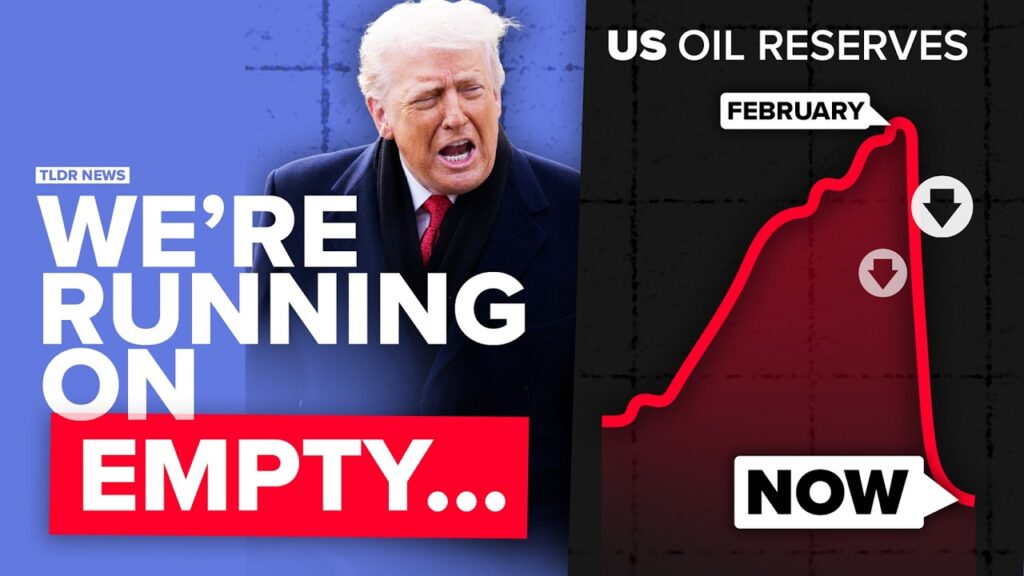
There is a strange silence that falls over a room when someone opens a drawer they expected to be full and finds it almost empty. That is the feeling settling over Washington these days, as officials glance at the Strategic Petroleum Reserve and realize the cupboard is nearly bare. The numbers are stark. America’s emergency crude stockpile has plunged to its lowest level since 1981, a 43 year low, at a time when the world is holding its breath over the Strait of Hormuz and the expanding conflict with Iran. The reserve was built to be a shield. Now it is little more than a memory of one.

For decades, the Strategic Petroleum Reserve was the ultimate ace in the hole. Giant salt caverns along the Gulf Coast, hollowed out by water and time, held more than 700 million barrels of crude oil at their peak. The oil was not meant to be traded. It was not meant to make a profit. It was a war chest, a cushion against the nightmare scenario. If a hurricane, a war, or a blockade cut off America’s oil supply, the president could open the taps and flood the market with enough crude to calm panic and keep the economy moving. That was the promise. That was the plan.
The Bulwark of Salt and Steel
The story of the reserve begins in the wake of the 1973 oil embargo, when the United States discovered how vulnerable it was to foreign crude. Arab members of OPEC halted exports to the United States in retaliation for its support of Israel, and gasoline lines stretched around the block. The lesson was clear: energy is a national security issue. In 1975, President Gerald Ford signed the Energy Policy and Conservation Act, which created the Strategic Petroleum Reserve. It took years to build and fill the caverns, but by the 1980s, the reserve had become a vital part of the country’s defense infrastructure. It was not a weapon, but it was a deterrent. Its sheer size told the world that America could absorb a shock and keep its economy running.
Over the years, the reserve was used sparingly. It was tapped during the Gulf War in 1991, after Hurricane Katrina in 2005, and during the Libyan crisis in 2011. Each time, the sales were limited and the reserve was later refilled. The system worked because it was protected, not because it was constantly used. The barrels sat in their caverns as a patient asset, waiting for the day they were truly needed. That day was supposed to be rare. Lately, it has become routine.
The Quiet Drain
The recent drawdowns, however, have been extraordinary. Over the past two years, the Department of Energy has released enormous quantities from the reserve in an effort to tame gasoline prices and counter supply disruptions. The releases were sold to companies and replaced only partially, if at all. Today, the reserve sits at around 350 million barrels, a level not seen since 1981. The decline did not happen overnight, but it happened with a quiet urgency that many Americans barely noticed until the numbers became impossible to ignore.
The reserve was never designed to be used as a tool for everyday price management. It was designed for emergencies. But in a time of inflation and political pressure, the line between emergency and convenience blurred. Each release felt justified. Each drawdown made sense at the moment. Yet the cumulative effect is a reserve that no longer provides the margin of safety it once did. The Department of Energy has spent years studying the reserve, publishing charts and projections, but the simple truth is that the barrels are gone. They were sold into a hungry market, and the proceeds vanished into the general budget.

The Storm in the Gulf
The timing could not be worse. Iran and Israel are locked in a conflict that has already seen missile exchanges and attacks on oil infrastructure. The United States has been drawn deeper into the region, sending carrier groups and air defenses. The Strait of Hormuz, the narrow waterway through which nearly one fifth of global oil production flows, has become a tense and dangerous passage. Tankers are being targeted. Shipping companies are adding war risk premiums. The global oil market is looking at a geopolitical storm that could break at any moment.
Iran has threatened to close the strait on multiple occasions, and while such a move would be a military and diplomatic escalation, the threat alone is enough to move markets. The recent attacks on tankers in the Red Sea and the Gulf of Oman have already forced some ships to take longer, more expensive routes. Insurance rates are climbing. The cost of moving oil is rising. And all of this is happening while the strategic reserve is at its lowest point in more than four decades.
The Strait of Hormuz is not just a chokepoint. It is a corridor of fear. On any given day, dozens of tankers carrying millions of barrels squeeze through the narrow lane between Iran and Oman. The mines, the fast boats, the missiles, the drones that Iran has deployed across the region have made this passage a high stakes gamble. In the last year, Iran has been accused of seizing commercial vessels, attacking tankers with drones, and threatening to blockade the strait entirely. The United States has responded by sending warships to escort shipping, but no escort can guarantee safety. A single successful attack on a large tanker could cause a spill, a fire, or a closure that would send the entire market into panic. The reserve was meant to calm that panic. It cannot anymore.
The Numbers Don’t Lie
The reserve held roughly 638 million barrels in January 2021. By early 2025, it had fallen below 350 million barrels. That is a drop of more than 280 million barrels in just a few years. The release in 2022 alone accounted for 180 million barrels. The rest came from smaller sales and exchanges. To put that in perspective, the United States consumes about 20 million barrels of oil per day. The current reserve would cover less than 18 days of total consumption. In a crisis, not all of the reserve can be pumped out immediately, and the capacity is far smaller than the gross number suggests. The effective response would be even more limited.
There are four salt caverns at the Bryan Mound, Big Hill, West Hackberry, and Bayou Choctaw sites along the Gulf Coast. They are each massive, cathedral like spaces carved into salt domes. But the infrastructure above ground, the pumps, the pipelines, the manifolds, was designed to move oil at a certain rate. That rate has been degraded over years of underinvestment. The reserve is not only smaller, it is also slower. In an emergency, that means fewer barrels reaching the market in the critical first weeks.
What Would a Crisis Look Like
Imagine what would happen if a major disruption occurred tomorrow. Suppose Iran mines the Strait of Hormuz, or a missile strikes the massive Abqaiq processing facility in Saudi Arabia, or the conflict in the Red Sea escalates into something worse. The immediate reaction in the oil market would be fear. Prices would jump by dollars in a matter of hours. The White House would announce that it is monitoring the situation. And then, in the background, someone would ask the question that no one wants to answer: how many barrels are actually left in the reserve?
In past crises, the reserve could cover a loss of supply for months. The United States has released barrels with confidence, signaling to markets that the strategic cushion was deep enough to absorb the blow. That confidence is now gone. With the reserve at a 43 year low, the response to a major crisis would be limited. The release valve would open, but the pressure behind it would be far weaker. Market traders know this. They see the numbers just as clearly as anyone. The reserve is no longer the giant guarantee it used to be, and that alone adds a risk premium to every barrel of oil traded around the world.
A War Measured in Barrels
The shrinking reserve is more than just an energy story. It is a ledger entry for the cost of a prolonged Middle Eastern war. Every missile fired, every tanker attacked, every ship rerouted around Africa rather than through the Red Sea, every barrel not delivered is now a heavier burden because the emergency buffer is no longer there to catch the falling market. The reserve was designed to insulate Americans from the whims of geopolitics. That insulation has been worn thin.
War is expensive in many ways. There are the direct costs of weapons, soldiers, and reconstruction. There are the indirect costs of displaced people and lost lives. And then there are the hidden costs, the ones measured in barrels and cents. The Strategic Petroleum Reserve is one of those hidden costs. Each drawdown has reduced the nation’s ability to withstand another shock. In that sense, the reserve reflects not just a policy decision, but a history of choices made in response to war, inflation, and political survival. The empty caverns are a monument to those choices.
The cost of war is often measured in dollars, but the price of oil is the most immediate signal. When the reserve was full, the market knew that Washington had a powerful tool to respond to a crisis. That knowledge itself had a calming effect. It told traders not to overreact, because the safety net was there. That is no longer the case. Traders are now more jittery, and every headline from Tehran or Tel Aviv causes a bigger move in the oil price than it would have a decade ago. The reserve’s decline is therefore not just a physical problem. It is a psychological one.
The Way Back
The obvious answer is to refill the reserve. But that is easier said than done. Buying hundreds of millions of barrels at current prices would cost tens of billions of dollars, and Congress has shown little appetite for such an expense. There is also a physical limit to how quickly the salt caverns can be refilled. The Department of Energy has said that it expects to repurchase oil when prices are favorable, but the window for that repurchase has been repeatedly missed. The administration recently canceled a refill plan after oil prices ticked upward, and similar delays have become a pattern.
Meanwhile, American oil producers have not significantly expanded production to make up for the loss of the reserve. The United States is already pumping near its maximum sustainable level, and shale production is not a magic switch that can be turned on and off. The private sector cannot fill a strategic gap that the government created. There is also the question of the reserve itself. Some analysts argue that the days of massive strategic reserves may be numbered, as electric vehicles and renewable energy reduce the world’s dependence on oil. But that transition will take decades, and the next crisis could come next month. The reserve is still the only fast response tool the government has.
There are also diplomatic options. The United States could lean harder on allies to release their own strategic reserves. The International Energy Agency coordinates emergency stockpiles among its members, and many European countries hold reserves as well. But their reserves are also stretched, and global energy markets are already tight. In a coordinated crisis, everyone would be reaching for the same emergency valve at the same time. That would spread the pain rather than eliminate it. The deeper problem is that the world no longer has the spare capacity it once had. OPEC’s spare capacity is concentrated in a few countries, and those countries are deeply involved in the current conflict. The margin of safety in the global oil system has been shrinking for years, and the reserve was the last big cushion left.
There is also a domestic political dimension to the reserve. Politicians from both parties have used the reserve as a piggy bank, raiding it to lower prices before elections or to pay for budget needs. The reserve has become a tool of the moment rather than a shield for the future. The result is that the strategic stockpile is now a tactical one, and a weak tactical asset at that. Fixing that will require a change in political culture as much as an allocation in the budget.
The Clock Is Ticking
America is not out of oil. It has vast domestic resources, a powerful refining sector, and a network of allies. But the strategic reserve was a unique asset: a massive, ready made stockpile that could be deployed instantly. The fact that it is now at a 43 year low is not just a historical footnote. It is a warning sign that Washington has lost its margin for error in the most volatile region on Earth. The reserve was once the answer to the question that every president hoped never to ask. Now the answer is a whisper, not a roar.
The Iran conflict is not ending anytime soon. The ceasefire talks are fragile, and the underlying tensions over Iran’s nuclear program, Israel’s security, and the balance of power in the Middle East remain unresolved. The risk of a wider war remains real. If that war reaches the oil fields of the Gulf, the United States will face a stark choice: send emergency barrels that barely exist, or watch prices climb and let the American economy absorb the pain.
Every barrel in the reserve represents a choice about who absorbs the cost of conflict. When the reserve was full, the cost was less visible. Now, as the barrels run low, the cost becomes clear. The United States has spent its strategic cushion, and it has little left to show for it. The war in the Middle East, the inflation of the last few years, and the political need to keep gasoline prices low all contributed to the emptying of the caverns. The bill for that spending is now due.
The Strategic Petroleum Reserve was never meant to be used until the moment it was truly needed. That moment may be closer than anyone wants to admit. The reserve’s decline to a 43 year low is not a measure of oil. It is a measure of resilience. And across Washington, the uncomfortable answer is that the resilience has been consumed. The question now is not whether the reserve will be refilled. It is whether the current conflict will allow the time to refill it. For the moment, the barrels are still there, but the margin of safety is gone. The world is entering a dangerous season, and America has fewer barrels to hold on to.