Shadows Over Kyiv: National Guard Opens Abuse Probe as Protests Erupt Near the Capital
A capital already defined by sirens and sleepless nights found itself confronting a different kind of tension this week, as families, veterans, and activists gathered on the edges of Kyiv to demand answers about the treatment of servicemen held at a facility tied to one of the country’s most storied regiments.
The air over Kyiv has carried many sounds in recent years. The wail of air raid sirens. The low rumble of generators. The murmur of passengers on crowded metro platforms at midnight. This week it carried something else. Shouts. Chants. The sharp crack of tension between demonstrators and lines of security personnel. What began as a quiet vigil by relatives of detained servicemen swelled into something far larger, spilling across streets near the capital and forcing a national conversation that few in official circles wanted to have out loud.
At the center of the storm is an announcement that the Ukrainian National Guard has opened an investigation into allegations of abuse at a facility reportedly connected to the Azov regiment, a unit whose name carries enormous symbolic weight in a country at war. The allegations themselves remain contested. The details are fragmentary. The official record is incomplete. Yet the response on the ground was immediate, which suggests that for many Ukrainians the question was never really about paperwork. It was about trust.
What follows is an account assembled from official statements, eyewitness descriptions, and the testimony of people who traveled to the capital with photographs in their hands and questions they have asked, without answer, for weeks. Some of it is confirmed. Some of it is disputed. All of it matters, because in wartime the space between what a state says and what a family believes can become a fault line.

The Allegations at the Heart of the Probe
According to the available reporting, the National Guard confirmed that it is examining claims of mistreatment involving servicemen held at a facility near Kyiv that has been associated with Azov linked structures. The precise nature of the allegations has not been published in full. Officials have described the process as preliminary, emphasizing that an investigation is an inquiry and not a verdict, and that conclusions will follow evidence rather than pressure.
That distinction has done little to calm the mood. For relatives, the word preliminary sounds less like caution and more like delay. For the institution, the word allegation is a shield against a rush to judgment. Both instincts are understandable. Neither has produced the one thing everyone says they want, which is clarity.
Independent observers note that documenting abuse claims in wartime is extraordinarily difficult. Records move slowly. Witnesses are deployed, displaced, or afraid. Personnel rotate. The very conditions that make mistreatment possible also make it hard to prove. Analysts caution against treating any single account as the whole truth, while adding that dismissing a pattern outright would be equally careless. The responsible middle ground is tedious and unglamorous. It involves access, documentation, and publication.
It is worth remembering how military detention normally works. Servicemen can be held for disciplinary reasons, for investigation, or for offenses defined under military law. Each category carries its own procedures, its own paperwork, and its own obligations to inform families. When those procedures are followed quietly and correctly, nobody protests. When they are opaque, rumor fills the vacuum, and rumor is a poor substitute for a case file.

Why the Name Azov Carries So Much Weight
The Azov name is not neutral in Ukrainian public life. Born from volunteer formations in 2014, the regiment became a symbol of defiance, particularly during the long defense of Mariupol. Its fighters have been celebrated in songs, murals, and school lessons. They have also been the subject of intense international scrutiny and controversy, and the unit’s history is invoked differently depending on who is speaking and to whom.
That symbolic weight complicates everything. Criticism of a facility associated with such a formation can be heard as criticism of the soldiers themselves, which is precisely the opposite of what most critics intend. Supporters of the regiment argue that its reputation is being used as a blunt instrument by people who never cared about the men inside it. Skeptics argue that reverence should never harden into immunity. Both positions were audible in the crowds near Kyiv this week, sometimes from the same person within the same sentence.
There is a lesson buried here about symbols in wartime. A flag that once meant courage can be borrowed by anyone with a camera and an agenda. Genuine respect for a fighting unit includes wanting it to be better than its worst rumor, and wanting the truth about it to be spoken plainly, even when the truth is awkward.
Clashes Near the Capital
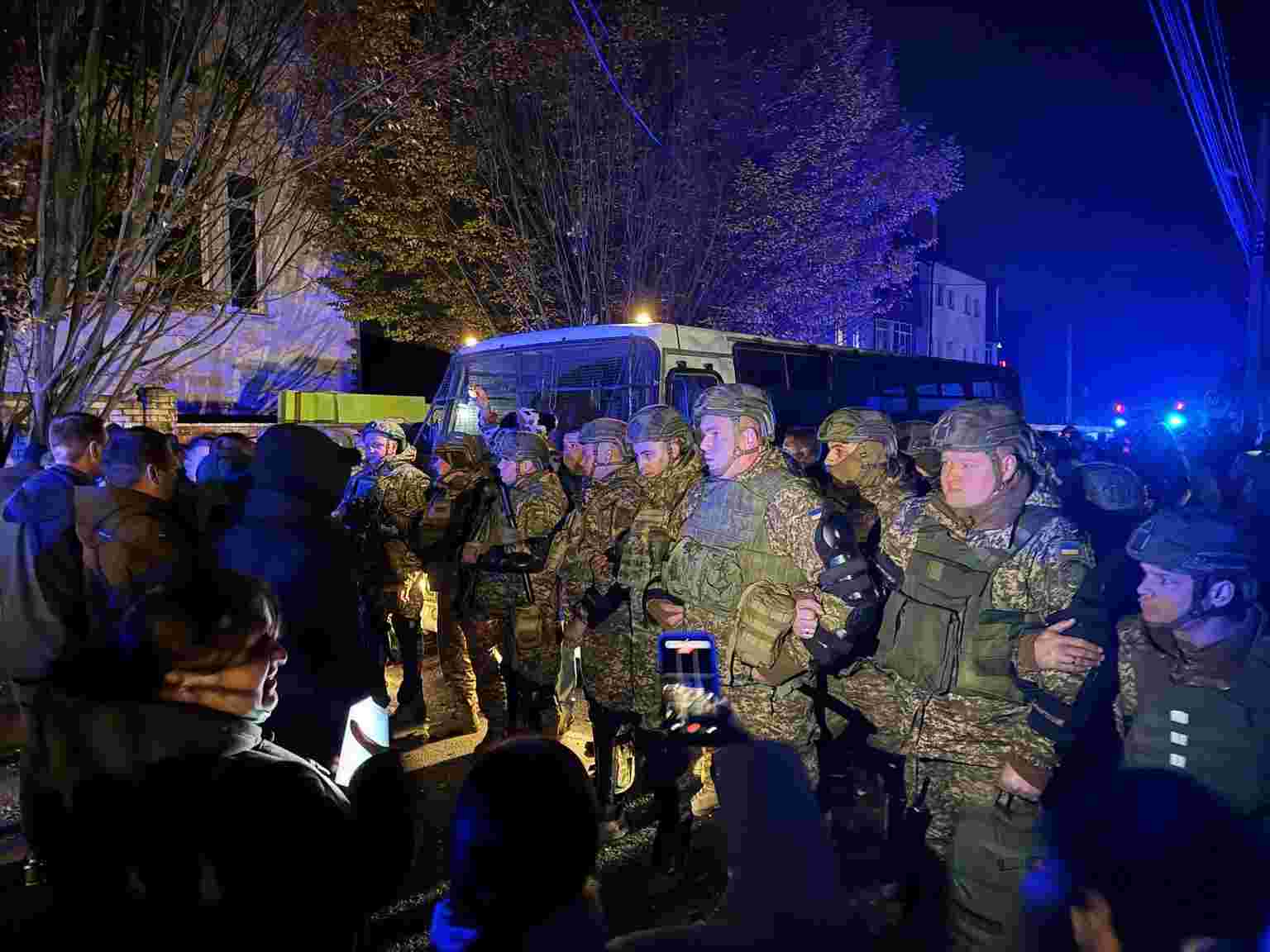
The gatherings began small. Families with placards made of cardboard and packing tape. Veterans in worn jackets. Friends holding printed photographs of men they said had gone silent. Within hours the crowds grew and the atmosphere shifted. Demonstrators pressed toward cordons. Security forces held their lines. Words were exchanged, then shouted, then thrown. Reports describe scuffles, shoving, and the acrid smell of smoke as flares were lit.
Protesters demanded the release of servicemen they say are being held without adequate explanation. Officials framed the situation as a crowd control matter and urged calm, insisting that lawful process must run its course. The gap between those two framings is where the story lives. One side speaks the language of detention and due process. The other speaks the language of sons, brothers, and husbands who have not called home.
By nightfall the streets had emptied, but the questions had not. Videos circulated. Screenshots flew across messaging apps. Neighbors argued on stairwells. Shopkeepers swept up glass that may or may not have come from the confrontation. In a country where unity is treated as a strategic asset, visible division near the capital lands hard, and everyone from the front line to the foreign ministry feels the reverberation.
It is important to be precise about what the clashes were and were not. They were not a mutiny. They were not an insurrection. They were a pressure valve opening, loudly, in a place where pressure has been building for a very long time.
Voices From the Crowd
A woman in her fifties, who declined to give her full name, said she had traveled from a district west of the capital after three weeks without a phone call. I am not here against the army, she said. I am here for my son. Her words were echoed again and again, a refrain that cut across political lines. The people chanting loudest were often the least interested in ideology.
Veterans who came to observe offered a different angle. Several said they wanted the investigation to be genuine and visible, arguing that rumors left to rot damage morale more than any tribunal ever could. One described the situation as a wound that needed cleaning rather than hiding. We ask for armor and ammunition, he said. We should also ask for accountability. It was not a statement against anyone. It was a statement about standards.
Officials, meanwhile, asked for patience. A spokesperson stressed that the National Guard takes any allegation seriously and that the process must be allowed to produce findings. That appeal competes with the raw urgency of families who measure time in missed birthdays, unread messages, and the quiet dread of a knock at the door.
Legal, Political, and Human Stakes
Legally, the case raises familiar but difficult questions. How are detainees within military structures documented? Who has access to them? What oversight exists when institutions are stretched thin by war? The answers are rarely tidy, and reforms proposed in calmer times are often deferred when shells are falling.
Politically, the timing is delicate. Kyiv has spent years courting international partners who care deeply about accountability and transparency. A messy internal controversy invites awkward questions at exactly the moment when unity is the message of the day. Domestic audiences, meanwhile, are less interested in optics than in outcomes. A press release does not bring a phone call.
At the human level, the stakes resist abstraction. A mother does not experience an investigation as a procedural event. She experiences it as waiting. The difference between a system that explains itself and one that stays silent is often the difference between a citizen who trusts and one who protests. Institutions are judged less by their rhetoric than by whether a tired person at a folding table ever receives a straight answer.
The Information Dimension
In any conflict, allegations travel faster than findings. Clips are trimmed. Context is lost. Partisan accounts amplify whichever detail supports their case. Observers warn that the story of the facility near Kyiv is already being pulled in several directions at once, some of them very far from the streets where people actually stood.
For readers, that means a familiar discipline. Verify before sharing. Distinguish between a claim and a conclusion. Remember that the people at the center of this story are not abstractions to be deployed in an argument. They are servicemen whose families are waiting for a phone to ring, and they are investigators whose findings will be worthless if the public has already decided the verdict.
What Comes Next
The investigation will proceed, or it will not, and the difference will be measured in published findings, access for monitors, and communication with families. Protesters will return home or return to the streets, depending on what they hear. Officials will treat the moment either as a crisis to be managed or as an opportunity to demonstrate that wartime institutions can still correct themselves.
History suggests that the second path is harder but far more durable. Transparency, even when uncomfortable, tends to strengthen the very institutions that secrecy is meant to protect. A probe conducted in the open has a chance to reassure. A probe conducted in shadow will satisfy nobody, and will leave every family with the same unanswered question.
There is also a practical dimension that tends to get lost. Trust is a form of logistics. Units fight better when their families feel secure. Communities support mobilization more readily when they believe the system is fair. The cost of opacity is not paid in press conferences. It is paid at the front, in small erosions of confidence that accumulate into something larger.
Conclusion
The scene near Kyiv this week was not a portrait of a divided nation so much as a portrait of a nation under strain. People came with photographs, with questions, and with the stubborn hope that someone in authority would listen. The National Guard now holds the pen on the next chapter. What it writes will be read by families, by allies, and by history.
The sirens will sound again. The generators will hum. But the deeper sound of a society at war is the conversation it has with itself about what it will tolerate and what it will not. That conversation is happening now, on the edges of the capital, and it deserves to be heard.