A New Silk Road Rises as UAE and Eurasian Trade Pact Enters Into Force
On the morning of 6 October 2026, in a busy customs hall in Dubai, a shipment cleared faster than it ever had before. There was no ribbon, no brass band, no camera crew. Yet that quiet moment marked the opening of one of the most ambitious trade corridors of the decade, because the Economic Partnership Agreement between the United Arab Emirates and the Eurasian Economic Union had officially come into force.
For years the story of global commerce was told through walls, warnings and tariffs. This agreement tells a different story, one about doors swinging open between the warm waters of the Gulf and the wide plains of Eurasia. It is a story about routes, and about the people who quietly depend on them.

For the UAE the pact is not an isolated move but the latest step in a long strategy of widening its circle of partners. A country that once lived off a single commodity has spent two decades building ports, airlines, banks and free zones that earn their keep by connecting other people economies. Signing with a bloc of five nations is a natural extension of that instinct. It turns a shipping address into an economic platform, and it gives Eurasian producers a warm water gateway they have long wanted.
The Day the Map Redrew Itself
The agreement did not arrive overnight. Negotiators worked through years of quiet technical talks, agriculture quotas, certification rules and the patient business of building trust between customs authorities who had rarely spoken to one another. When the final documents were signed, few outside the region noticed. When they entered into force, much changed, and almost none of it made noise. Goods that once waited weeks for clearance now move through simplified channels. Paperwork that once filled folders now travels as data.
At its heart the pact is a tariff story, but not only that. Preferential access is being extended across a long list of industrial and agricultural products. Rules of origin have been negotiated so that goods made in the UAE travel north with clear and predictable status, while goods from Eurasia reach Gulf ports knowing in advance how they will be treated. Behind the tariff lines sit deeper commitments on customs cooperation, technical standards, food safety and transparency, which are often worth more than the headline numbers.
Five Nations, One Market, Many Doors
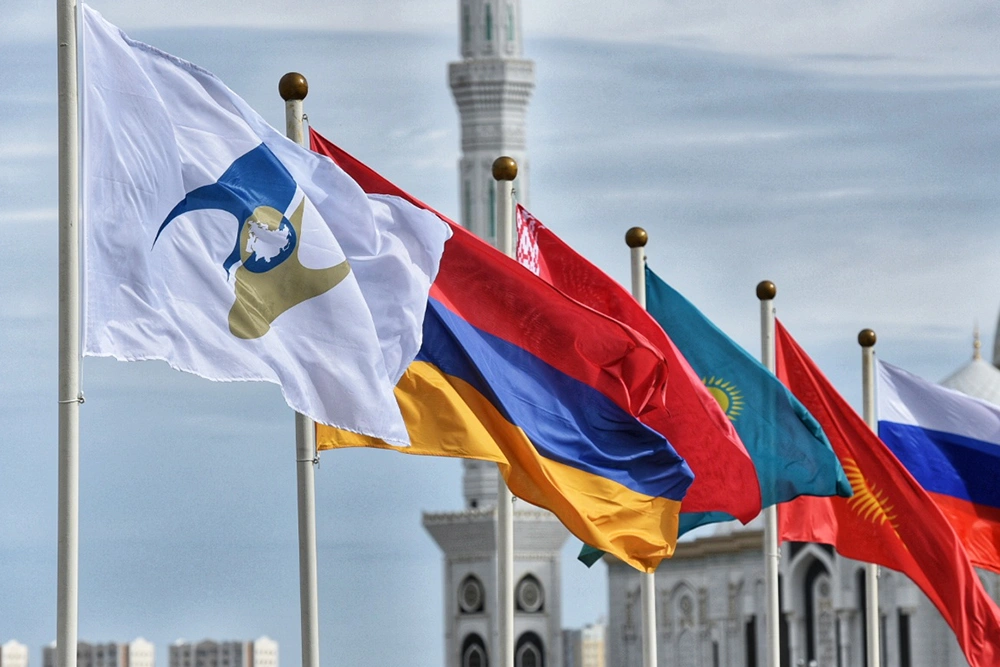
The Eurasian Economic Union brings Armenia, Belarus, Kazakhstan, Kyrgyzstan and Russia into a single regulatory space. For Gulf exporters that means one conversation, one set of documents and one strategic relationship stretching from the Caspian shore to the edge of Europe. For Eurasian producers it means a doorway into a Gulf hub already connected to Africa, South Asia and beyond. The arithmetic is simple. One agreement, many destinations, and a market of more than one hundred and eighty million people waiting at the other end of it.
The sectors lining up are not hard to guess. Aluminium, fertilisers, petrochemicals, grain and heavy machinery move south. Food, electronics, advanced manufacturing equipment, financial services and logistics expertise move north. Add tourism, education and healthcare, and the corridor starts to look less like a shipping route and more like a shared economy.

The Gulf as a Bridge, Not a Wall
Geography has been generous to the UAE. A third of the world population sits within a few hours of flight, and a day of sailing reaches ports that feed three continents. This agreement turns geography into policy. Rather than treating the Gulf as a terminus, it treats it as a junction, where Eurasian cargo can be repackaged, financed, insured and forwarded onward. That is the difference between a warehouse and a hub, and it is the difference between passing trade and lasting trade.
Ports and free zones are already adapting. Warehousing capacity is expanding, cold chain investment is being studied, and freight forwarders are rewriting route plans that were once fixed in habit. The appeal for shipping lines is straightforward. A predictable corridor with clean documentation is worth more than a cheap but chaotic one.
Routes, Rails and the Caspian Question
Look closely and the corridor is not a single line on a map but a web of them. Sea legs across the Gulf, rail links through Central Asia, road networks toward the Caspian, and air freight for the goods that cannot wait. Each link has its own bottlenecks, and each improvement nudges the whole network forward. Investors watching the Caspian crossings and the north south rail projects are effectively betting on the same idea, that Eurasia and the Gulf can trade at a scale neither could reach alone.
What It Means for the Small Trader
Big agreements are usually described through the language of states. The real test is smaller. Consider a family business in Sharjah importing timber, or a trader in Almaty selling dried fruit. Under the old system a modest shipment could vanish into a maze of certificates and fees. Under the new one the pathway is shorter and the cost more visible. When compliance becomes simpler, small firms stop being spectators and start being participants. That matters, because small and medium enterprises carry most of the employment in both regions. A corridor that serves only the largest conglomerates is a road with a single lane.
Money, Machines and Know How
Trade in goods is only the visible half. The agreement also opens space for investment protection, services, digital commerce, intellectual property and dispute settlement. Capital that once hesitated now has a framework. Banks can structure deals with more confidence. Technology partnerships, from agricultural sensing to port automation, become easier to negotiate. Payment pathways are being watched closely too, because businesses on both sides want settlement options that are stable, fast and inexpensive. Where payment friction falls, trade volume tends to rise quietly and steadily.
People move as well. Business travel, professional services, training programmes and university links create the informal trust that contracts cannot manufacture. A corridor built only on containers rarely lasts. One built on relationships usually does.
The Honest Caveats
No agreement is a magic wand. Tariff schedules are phased, not instant. Standards still need alignment, and bureaucratic habits change slowly. Some sectors will feel competitive pressure, especially producers who have grown comfortable behind protective walls. Restrictions affecting parts of the Eurasian space add complexity that no trade text can wish away, so companies will need careful due diligence and governments will need to keep talking.
Implementation is the other test. A corridor is only as good as its customs officers, its inspectors and its data systems. Training, digital tools and honest measurement will decide whether the promise survives contact with reality.
A Blueprint Others Will Study
What makes this agreement notable is its timing. Supply chains are fragmenting, friendshoring is fashionable and global trade talks have grown sluggish. In that environment a pragmatic partnership between a Gulf trading state and a Eurasian bloc offers a template, a sign that regional actors can build workable corridors without waiting for universal consensus. Other capitals are already reading the fine print. If the corridor delivers on cost and speed, similar deals may follow, linking the Gulf to Africa, to Central Asia and to Southeast Asia. Trade policy, like water, finds the paths of least resistance.
Where the Road Leads
Back in that Dubai hall, the shipment cleared, the paperwork dissolved into a screen and the day carried on. That is how history usually arrives, without trumpets. A trade corridor is not built on a single signature but on thousands of uneventful transactions that slowly become normal, until nobody remembers the friction that came before. The UAE and the Eurasian Economic Union have opened a road between two worlds that had too little to do with each other. Whether it becomes a highway or a footnote depends on the unglamorous work ahead, on forms simplified, standards aligned and promises kept. But on 6 October 2026, the first stone was placed.