BRICS Is Getting Bigger. Can It Really Challenge the US?
The world is watching New Delhi. On September 12 and 13, the leaders of BRICS will gather for their annual summit, and the air is thick with expectation. This is not just another diplomatic photo opportunity. It is a moment that could reshape the way power is distributed across the globe.
For years, BRICS was dismissed as a clever acronym with little substance behind it. Today, it stands at a crossroads. The bloc has grown, welcoming new voices and new ambitions. The question hanging over the summit is simple and enormous at the same time. Can BRICS truly challenge the United States and the global order it has led for decades?

A Summit at a Crossroads
Every summit tells a story. The story of this one begins with a group that refuses to stay in its lane. When the term BRIC was first coined in 2001, it described an economic trend, not a political project. Brazil, Russia, India and China were simply the fast rising stars of the emerging world. Few imagined they would one day sit around a table and talk about rewriting the rules of global finance. South Africa joined in 2010, and the acronym became a club.
Now the club has grown again. In 2024, Egypt, Ethiopia, Iran and the United Arab Emirates were invited to join, and Saudi Arabia was also offered a seat. This is no longer a small gathering of a handful of economies. It is a coalition that stretches from the Atlantic to the Indian Ocean, from the Gulf to the Horn of Africa. It speaks for a majority of the planet’s people.
That is the promise. And that is also the pressure. When you claim to represent most of humanity, the world expects results.

From Acronym to Alliance
The original members were bound together by little more than shared frustration. They were large, they were ambitious, and they felt shut out of institutions built by others. The World Bank and the International Monetary Fund were shaped in a different era, when Europe and the United States held the pen. BRICS wanted a seat at the table, and later, it wanted its own table.
That desire produced real institutions. The New Development Bank was created to fund infrastructure across the developing world. The Contingent Reserve Arrangement offered a financial safety net outside the Western system. These were modest steps, but they signalled intent. BRICS was no longer content to complain. It wanted to build.
Still, building takes time. The bank’s lending remains small compared with the giants of global finance. The safety net has rarely been used. For critics, this proves the group is more talk than action. For supporters, it is a foundation that will only grow stronger. Cooperation, however, is not the same as unity. The group has always worked by consensus, which means any single member can slow the whole. That design protects the smallest voices, but it also makes bold action difficult. A coalition that moves only when everyone agrees often moves slowly.
The New Members and the Weight They Bring
Expansion changes everything. Adding Iran brings enormous energy reserves and a defiant attitude toward sanctions. Adding the United Arab Emirates brings one of the busiest trading hubs on earth and a quiet appetite for influence. Egypt brings the Suez Canal and a strategic bridge between continents. Ethiopia brings a fast growing population and a powerful voice for Africa. Saudi Arabia, if it fully joins, brings the weight of the global oil market.
Together, these nations represent a substantial share of the world’s population, land and energy. That is a striking headline. But numbers on a page do not automatically translate into power at a negotiating table. A larger group is also a noisier one. Every new member adds a new interest, a new rivalry and a new demand.
The newcomers also change the balance of the group. Some are close partners of China. Some are wary of Iran. Some depend on American security guarantees even as they seek new friends. Expansion, in other words, can be a source of strength and a source of strain at the same time.
The Great De Dollarization Debate
Perhaps no topic stirs more excitement than the idea of moving away from the US dollar. For decades, the dollar has been the backbone of global trade and finance. It is the currency that oils the machinery of the world economy. Any serious attempt to sidestep it would amount to a direct challenge to American influence.
BRICS leaders have spoken openly about trading in their own currencies. China and Russia have already shifted much of their bilateral trade away from the dollar. India and the UAE have explored rupee and dirham settlements. Brazil has floated ideas for a shared currency, though it remains more aspiration than plan.
The reality is messier than the rhetoric. The dollar remains deeply entrenched. It is liquid, trusted and backed by deep and open markets. Replacing it would require years of patient work, and not every member wants the same outcome. Yet the conversation itself is a signal. Even talking about a world beyond the dollar chips away at the myth of its permanence.
The Cracks Beneath the Surface
Here is where the story turns complicated. BRICS is not a family. It is a gathering of rivals. India and China share a long and tense border, and their soldiers have clashed in recent years. Russia and China have drawn closer, but their interests are far from identical. Iran and Saudi Arabia only recently restored diplomatic ties after years of hostility.
Then there is the question of who leads. China is by far the largest economy in the group, and many suspect it wants to steer BRICS toward its own goals. India, a rising power in its own right, resists being cast as a junior partner. Brazil and South Africa want to keep the group focused on development, not confrontation. Each member has its own delicate relationship with Washington, and few want to burn bridges they may need later.
This is the central tension of the New Delhi summit. A coalition of the disgruntled can agree that the current order is unfair. It is far harder to agree on what should replace it. 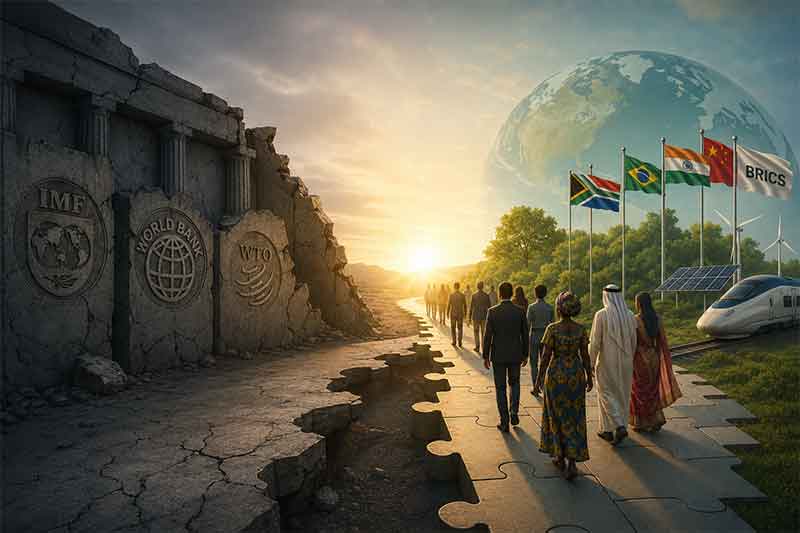
What BRICS Wants From the World
Strip away the speeches, and BRICS has a clear wish list. It wants a multipolar world where power is shared among many centres, not concentrated in one. It wants reform of the United Nations Security Council. It wants development finance that does not arrive with lectures attached. It wants the freedom to choose its own partners and chart its own path.
These goals are not radical on their own. Many countries outside BRICS share them. The Global South has grown tired of being told how to run its affairs. For these nations, BRICS is less a rival bloc and more a megaphone. It amplifies a grievance that is widely felt but rarely heard in Western capitals.
Energy is another arena where the group flexes its muscles. Between the oil of the Gulf, the gas of Russia and the manufacturing might of China, BRICS sits on some of the most valuable resources on earth. That gives the bloc real leverage, especially as the world races to secure its energy future.
Can It Really Challenge the US?
So we return to the question at the heart of it all. Can BRICS challenge the United States? The honest answer is that it already does, and it does not, at the same time.
BRICS challenges the US simply by existing. Its growth chips away at the assumption that the world has only one centre of gravity. Its push for local currencies erodes, slowly, the dollar’s monopoly. Its sheer size gives it leverage in trade, energy and climate talks. On the world stage, the group forces Washington to share the spotlight.
But challenging the US is not the same as replacing it. The United States still commands the deepest capital markets, the strongest military alliances and the most advanced technology. It can still shape the rules of the game. BRICS lacks a unified command, a common ideology and a binding treaty. It is a coalition of convenience as much as conviction.
The truth is that BRICS does not need to dethrone the US to matter. It only needs to offer an alternative. In a multipolar world, influence is not a single throne to be seized. It is a web of relationships to be woven. Each new member, each new deal and each new currency swap adds another thread.
The Road Ahead
What should we watch for in New Delhi? Look beyond the handshakes. Watch for concrete agreements on trade in local currencies. Watch for new members being welcomed. Watch for joint statements on reforming global institutions. Watch for how the group handles its disagreements, because that will reveal whether it is a true bloc or merely a talking shop.
There is also the question of the next wave of applicants. More than a dozen countries have expressed interest in joining. That queue is a sign of the group’s appeal, but it is also a warning. If BRICS grows too fast, it risks becoming a loose crowd with no shared purpose. If it grows too slowly, it risks losing the momentum that made it exciting.
The summit will not settle the future of the world order in two days. History rarely moves that fast. But it can set a direction. If BRICS can turn its size into coordination, it becomes a genuine force. If it stays divided, it remains a headline that fades with the news cycle.
A Test, Not a Coronation
BRICS is getting bigger, and that alone changes the conversation. The group is a mirror of a world that is restless, ambitious and unwilling to accept a single script. Whether it becomes a true counterweight to the United States depends less on the number of its members and more on their willingness to act as one.
The leaders in New Delhi have a choice. They can leave with warm words and no plan, or they can leave with something real. The world is watching, and the stakes could hardly be higher. For a coalition built on the promise of a fairer future, this summit is not just a meeting. It is a test.