India’s BRICS Summit: A Multipolar Turning Point
The air in New Delhi carried a charge that afternoon, the kind that settles over a city when history is being written. Delegates from four continents moved through corridors thick with conversation, every handshake a small treaty, every nod a quiet recognition that the old map of the world had been folded away. India had called the BRICS family home, and the family had answered. From the towering halls of summit venues to the crowded streets outside, there was a sense that something important had shifted, not loudly, not with trumpets, but with the steady certainty of a tide turning.
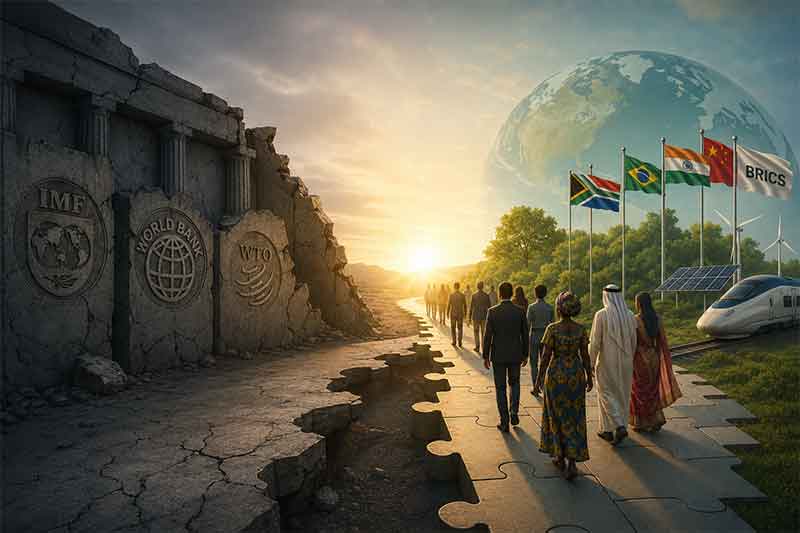
For the better part of three decades the world had grown comfortable with a single center of gravity. A unipolar order had set the tempo, and most nations learned to dance to it, some willingly, others with gritted teeth. But the music is changing. In the rapidly changing global geopolitics, the BRICS has emerged as a pivotal counterweight to efforts to reinforce a unipolar order. What began as an acronym, a convenient label for five emerging economies, has matured into something far more consequential. It has become a living argument that the future belongs to many voices, not one, and that the architecture of tomorrow must be built by all who inhabit it.
This was the story being written in New Delhi, and at its center stood India, a nation that has spent its modern history learning to walk the tightrope between competing powers, and has now found its footing as a bridge builder for a multipolar age.

The Setting Sun of Unipolarity
To understand why this summit mattered, one must first understand what is ending. The unipolar moment, that brief and heady period when a single superpower bestrode the globe, was never destined to last. It was an anomaly, a product of a particular historical moment, and anomalies, by nature, correct themselves. What we are witnessing now is not chaos, though it often looks like it. It is the messy, creative, sometimes painful process of a world reorganizing itself around multiple poles of power, influence, and ambition.
The BRICS did not create this shift. It is a child of the shift, and perhaps its most articulate voice. When the original five, Brazil, Russia, India, China, and South Africa, first gathered, critics dismissed them as a photo opportunity for leaders with little in common. Yet year after year, the grouping kept showing up, kept expanding its agenda, kept proving that nations of the Global South could convene not as supplicants but as equals. The expansion to include new members was not a mere administrative change. It was a declaration that the coalition of the emerging world was widening, that the old division between the developed and the developing no longer captured the reality of global power.
India has been central to this evolution from the very beginning. Its foreign policy, famously nonaligned in spirit long before the term was coined, has always resisted the idea that a nation must choose a side in perpetuity. New Delhi has instead chosen interests, principles, and partnerships, a posture that has made it indispensable in a multipolar world where flexibility is a form of strength.
India at the Center of the New Geometry
Hosting the summit was more than a diplomatic honor for India. It was a statement of arrival. India has long been described as an emerging power, a phrase that suggests waiting, potential, a promise yet to be fulfilled. But the country that presided over this gathering is no longer merely emerging. It has arrived. Its economy has crossed thresholds that once seemed distant. Its technology sector writes code that runs the world. Its diaspora has become a global connective tissue. And its voice, in every forum from climate negotiations to digital governance, now carries weight that cannot be ignored.
There is a particular quality to Indian diplomacy that makes it well suited to this moment. It is the quality of the crossroads. India sits at the intersection of nearly every major geopolitical axis, between East and West, between the established and the rising, between the maritime and the continental. This position has often been described as a vulnerability, a nation squeezed between giants. But India has learned to read it as an opportunity. To be at the crossroads is to be indispensable. It is to be the country that others must speak to, must listen to, must count on.

The summit agenda reflected this role. Discussions ranged across the full landscape of contemporary challenges, from reforming global financial institutions to building resilient supply chains, from the governance of artificial intelligence to the urgent imperatives of climate action. In each of these conversations, India pressed a consistent theme, that the institutions of global governance must reflect the realities of the twenty first century, not the frozen hierarchies of the twentieth. When India speaks of reform, it does so not as a supplicant requesting favors but as a stakeholder demanding a seat at the table where the rules are written.
A Voice for the Global South
Perhaps the most striking aspect of this summit was its resonance beyond the member states themselves. The BRICS has increasingly positioned itself as the collective voice of the Global South, the vast and varied community of nations that were long relegated to the margins of international decision making. For these nations, the appeal of the grouping is not ideological. It is practical. It offers an alternative pathway for trade, for investment, for technology sharing, for cooperation that does not come with the old conditions and hierarchies attached.
India has been a powerful advocate for this vision. Its own development journey, from a colony to a food secure nation to a spacefaring democracy, gives it a credibility that few other leaders can claim. When Indian officials speak about the right of every nation to pursue its own path, they do so with the authority of lived experience. This is why so many countries of the Global South look to New Delhi with a mixture of respect and expectation. They see in India a proof that the periphery can become the center, that the margins can write their own history.
The expansion of the BRICS is, in this sense, a moral as well as a strategic development. Each new member is a vote of confidence in the idea that cooperation need not flow through a single channel, that prosperity can be shared without being dictated. The grouping is becoming something like a parliament of the emerging world, imperfect, yes, often unwieldy, but undeniably real and undeniably growing.
The Hard Work of Many Voices
It would be dishonest to paint the BRICS as a frictionless union. The very diversity that gives the grouping its legitimacy also generates its tensions. Its members hold different political systems, different economic models, different regional priorities, and, on some questions, different strategic alignments. Managing this diversity is the central challenge of the institution, and it is a challenge that requires constant attention.
India understands this better than most. Its own civilization has been a laboratory of pluralism for millennia, a place where countless languages, faiths, and traditions have learned not merely to coexist but to enrich one another. That experience has shaped India’s approach to the BRICS. New Delhi does not pretend that its partners are identical to it, nor does it ask them to be. Instead, it seeks to build consensus around the areas where interests converge, and to manage with patience and diplomacy the areas where they do not. This is the art of the possible, practiced at scale.
The skeptics will continue to ask whether the BRICS can hold together, whether it can move beyond declarations to decisions. These are fair questions. But they miss the larger point. The significance of the BRICS does not lie only in what it achieves in any single summit. It lies in what it represents, a durable, growing, institutionalized expression of the multipolar turn. Every gathering, every joint statement, every new member strengthens the gravitational pull of a world in which no single power can dictate the terms. That project does not require perfection. It requires persistence.
A New Grammar of Diplomacy
Standing in New Delhi during those summit days, one could feel the emergence of a new grammar of diplomacy. The old language was built around blocs, alliances, and the assumption that nations must choose their patrons. The new language is built around partnerships, platforms, and the recognition that nations can hold multiple relationships simultaneously without contradiction. India has become fluent in this new language, and the BRICS has become one of its most important classrooms.
The global order is not going to be remade in a single meeting, nor should it be. History moves in seasons, not in moments. But seasons change, and what we are living through is the changing of a season. The frost of unipolar certainty is giving way to the unpredictable, fecund spring of a multipolar world. It will be messy. It will be contested. It will demand more skill, more patience, and more wisdom from every leader on the planet.
But it will also be more just. A world in which many voices are heard, many interests are balanced, and many paths are respected is a world with more room for dignity. That is the promise of the multipolar turn, and it is the promise that India carried with such conviction through this summit. The road ahead is long and winding, and no one can claim to know its every bend. But the direction is clear, and for the first time in a long time, it is a direction that belongs to everyone.
The sun that once seemed to set on a single imperial horizon has given way to a dawn with many lights. India, at the heart of that dawn, has shown what it means to be not merely a power, but a partner. The BRICS summit was never just a meeting. It was a mirror, held up to a world in transition, reflecting not what we were, but what we are becoming. And in that reflection, there is hope.