The Middle East’s New Gordian Knot: Israel, Turkey and the Rise of a Muslim Alliance
There is an ancient story about a knot so impossibly tangled that an entire empire waited for someone clever enough to undo it. Alexander the Great simply drew his sword and cut through it, understanding that some problems cannot be solved with patience alone. For centuries, the Middle East has been that knot, a place where alliances shift like desert sands and old enmities never truly die. Today, the region is tying itself into a new tangle, one that pulls together the rising tension between Israel and Turkey, the quiet assembly of a Muslim alliance known as the Mecca Pact, and the impossible position of the United States as it tries to steer a storm it no longer controls. This is the story of that knot, and of the forces pulling at every loose thread.

A Pact Takes Shape in the Holy City
The story begins in Mecca, the spiritual heart of the Muslim world. According to regional reports, a group of nations has been quietly discussing a defensive compact, a collective security arrangement that many observers have already nicknamed the Muslim NATO. The comparison is not accidental. Just as the North Atlantic alliance was built to shield its members from a common threat, this emerging pact is being framed as a shield against external pressure and, increasingly, against the ambitions of Israel in the region. The exact membership list remains murky, with officials staying deliberately vague, but the signal is unmistakable. The Muslim world is reaching for unity at a moment when it feels surrounded, and that unity, if it holds, would rewrite the rules of Middle Eastern politics. It would create a bloc strong enough to bargain with the great powers, resilient enough to absorb pressure, and determined enough to change the balance of power.

Turkey and Israel, A Rivalry Rekindled
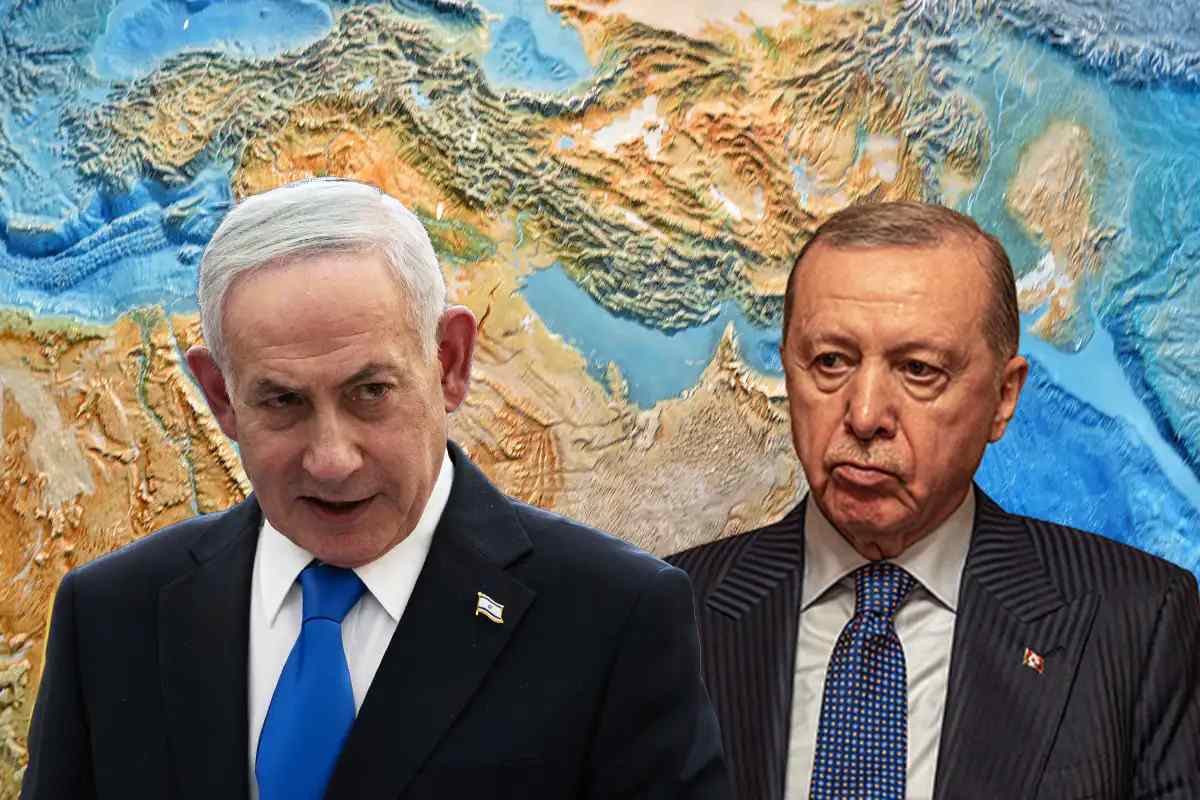
At the center of this gathering storm stands Turkey. For years, Ankara and Jerusalem maintained a tense but functional relationship, punctuated by outbursts of anger and careful reconciliation. That era appears to be ending. The current confrontation between Turkey and Israel is not a simple border dispute or a trade quarrel. It is a clash of regional ambitions, of competing visions for who will shape the future of the Middle East. Turkey presents itself as the champion of the Muslim street, a voice for the Palestinian cause, and a military power unwilling to bow to anyone. Israel, meanwhile, sees itself as the region’s only true democracy and the indispensable defender of its own survival. When two such proud and powerful actors collide, the entire neighborhood feels the tremor.
The danger is that this rivalry will not remain a cold one. Every escalation, every warning, every show of force raises the stakes. And into this volatile mix steps the United States, a nation that has long played the role of the region’s referee, but which now finds itself deeply compromised. Washington cannot afford to choose sides easily. Openly siding with Israel in a confrontation with Turkey would antagonize the entire Muslim world, a political and strategic cost that would be difficult to bear at any time, and nearly impossible to bear now.
The Burden of Controlled Chaos
There is a strategy that American planners have used in the region for decades, known in diplomatic circles as controlled chaos. The idea is elegant in theory. Keep the rivals balanced against one another, prevent any single power from becoming dominant, and preserve America’s ability to move between factions as its interests demand. In practice, the strategy has always been a high wire act, and the wire is getting thinner by the day. The more the Middle East fragments, the harder it becomes to control. The more alliances form, the fewer doors remain open for Washington to walk through. The very tool designed to preserve American influence is now generating the conditions that could strip it away.
The timing could not be worse for the United States. Even as it navigates the Turkey and Israel standoff, Washington is also engaged in military action against Iran. Iran, according to some reports, was itself invited to join the Mecca Pact, though its officials later denied any such invitation. Whether true or not, the rumor reveals the fears lurking in American strategy. If Iran were ever to find shelter within a broader Muslim alliance, the calculus of every confrontation in the region would change overnight. A war against one member would become a war against many. A pressure campaign against a single state would become a pressure campaign against a bloc. That is the nightmare scenario for Washington, and it is no longer purely theoretical.
The Iranian Wildcard
Iran has long been the ghost at the feast of Middle Eastern diplomacy. It is too powerful to ignore, too isolated to be fully embraced, and too ambitious to remain passive. The reports of its possible inclusion in the Mecca Pact, even if denied, speak to the fluidity of the current moment. Alliances that seemed permanent are dissolving. Enmities that seemed eternal are being renegotiated. In such a climate, the old certainties no longer hold. A nation that was once the enemy of every American ally in the Gulf could, in theory, become a partner in a grand Muslim consensus. That prospect terrifies Washington, and it should, because it would unravel the very foundations of the current order.
For Israel, the Iranian question is existential. For Turkey, it is an opportunity. For the United States, it is a trap. Every move in this triangular dance seems designed to produce a new dilemma. If America strikes too hard at Iran, it pushes Tehran toward the Muslim bloc. If it softens, it emboldens the axis of resistance. If it backs Israel against Turkey, it loses the Muslim street. If it pressures Israel, it alienates its most reliable regional ally. There is no clean move, no elegant solution, no sword waiting to slice through this particular knot.
A Region Holding Its Breath
What happens next depends on choices that have not yet been made. The Mecca Pact, if it solidifies, would be the most significant realignment of the Middle East in a generation. It would redraw the mental maps of strategists from Washington to Tel Aviv to Ankara. It would force every nation in the region to ask a simple question: which side of the new divide do we stand on? And it would present the United States with its most uncomfortable dilemma in decades, caught between its historic commitment to Israel and its desperate need to avoid a war with the entire Muslim world.
The irony is that controlled chaos, the very strategy designed to prevent such a dilemma, may have created it. By keeping the region in a state of perpetual instability, Washington ensured that no single alliance could ever become too strong. But instability breeds fear, and fear breeds unity. The nations of the Muslim world, watching the escalation around them, are discovering that their differences matter less than their shared vulnerability. The knot is tightening, and no one seems able to untie it.
The Threads Remain Tangled
And so we return to the old tale. Alexander solved his knot with a single stroke of the sword, but the Middle East offers no such shortcut. The forces at play here are too deep, the histories too long, the grievances too raw. Israel and Turkey circle one another like wrestlers looking for an opening. The Muslim world is feeling its way toward a unity it has not known in modern times. Iran waits in the shadows, denied and invited at the same time. And the United States, the self appointed architect of regional order, watches its blueprint crumble.
Perhaps the only certainty is that the old order is ending. Whether what rises from the rubble is a more stable peace or a more dangerous confrontation remains to be seen. What is clear is that the Middle East has entered one of its most volatile chapters, and the entire world will feel the consequences. The Gordian knot is not just a metaphor anymore. It is the daily reality of a region where every thread is connected to every other, and where pulling on any one of them could bring the whole structure down.
For now, the world watches and waits. The diplomats sharpen their pencils, the generals study their maps, and the strategists in Washington ask themselves the question that has no easy answer: how do you manage chaos that you no longer control? The answer, when it comes, will define the Middle East for a generation to come.